









Employee wellness benefits: How many vendors do you really need?
Too many wellness vendors? Learn how to audit your stack, cut costs, and consolidate benefits delivery without losing employee satisfaction.
In this piece
Most HR and benefits teams didn't set out to manage a dozen or more vendor relationships. It happened gradually: a gym reimbursement program here, a mental well-being app there, a commuter benefit added during open enrollment. Before long, the "benefits stack" became a spreadsheet of logins, contract renewals, and utilization reports that nobody has time to actually read.
At Forma, we call this “the more is more” paradox.
The frustrating part is that spending is going up while employee satisfaction with benefits stays flat. HR teams are buried in administration. CFOs are questioning the ROI. And employees, despite all the programs available to them, still aren't engaging at the rates employers want to see.
If you're managing five or more well-being and wellness-related vendors and you’re wondering whether there's a smarter way to structure this, you're asking the right question.
This article breaks down exactly how many vendors you actually need, what the hidden costs of vendor sprawl look like, and what a successful, scalable program looks like when it's working correctly.
Key takeaways
- Most companies are overspending on corporate wellness programs due to vendor sprawl, not because of the programs themselves.
- The "delivery layer" of benefits, how money reaches employees, should be consolidated onto a single platform, while wellness content and services can stay diverse.
- Administrative overhead, low utilization, and data silos are the most common signs a wellness vendor stack needs to be rationalized.
- CFOs and brokers respond to consolidation arguments best when framed around budget predictability, per-employee cost benchmarks, and utilization ROI.
- Forma's flexible benefits platform helps organizations consolidate LSAs, HSAs, FSAs, HRAs, and more into one admin experience with the reporting and global scalability to back it up. Schedule a demo today to see how it works for teams your size.
What corporate wellness programs look like in 2026 and why the tech stack is broken
Corporate wellness programs have come a long way from the days of a subsidized gym membership and an annual biometric screening. Currently, programs span physical fitness, financial health, professional development, caregiving support, commuter benefits, and more. With each often managed through its own vendor, portal, and contract.
The category has grown because workforce needs have genuinely grown more diverse. A 23-year-old software engineer in Austin and a 45-year-old operations manager in London don't have the same priorities. Benefits teams responded by adding more options, which created more vendor relationships and more administrative complexity along with it.
The problem isn't that companies are offering too many benefit types. The problem is that the infrastructure used to deliver those benefits hasn't kept up. Most organizations are running a patchwork of point solutions, individual vendors for each benefit category, when a unified delivery layer would accomplish the same goals with far less overhead. You can read more about this pattern in our breakdown of how point solutions fatigue affects benefits programs.
How "corporate employee wellness programs" became synonymous with vendor sprawl
The benefits industry sold HR teams on specialization for years. The pitch was that a dedicated vendor for each wellness category would deliver a better employee experience than a generalist platform. That logic made sense when platforms couldn't support multiple benefit types simultaneously.
Modern infrastructure has changed that calculus entirely. A single platform can now handle LSAs, HSAs, FSAs, commuter benefits, and HRAs. All with customizable eligibility rules, real-time reporting, and global currency support.
The vendors that used to justify their specialization on technological grounds now often justify their existence on inertia. Most HR teams don't audit their wellness stack the way they audit other software spend, which means underperforming vendors stay on contract renewal after contract renewal.
What employees are actually using (and what they're ignoring)
High vendor count does not equal high engagement. In fact, the industry points in the opposite direction. When employees are presented with too many disconnected benefit portals, they tend to use fewer of them, not more.
The programs with the highest reported utilization tend to share a few traits: they're easy to access, they're flexible enough to feel personally relevant, and they don't require employees to work with multiple systems to spend what they're entitled to. That's a delivery problem, not a content problem and it's one that consolidation solves directly.
The hidden cost of too many wellness benefits vendors
Before calculating whether well-being benefits consolidation makes financial sense, it helps to map where the costs are actually accumulating. Most CFOs see the line items for vendor contracts, but the real cost of a fragmented wellness stack goes well beyond subscription fees. Understanding the true cost of employee benefits per person is a good starting point for this analysis.
There are four areas where costs tend to accumulate invisibly across over-vendored benefits programs.
Administrative overhead
Every vendor relationship requires contract management, onboarding, renewal negotiations, and ongoing support coordination. When an employee has a question about their wellness stipend, HR has to route that inquiry to the right vendor and if the employee doesn't know which vendor handles what, the support burden lands entirely on the benefits team.
Benefits managers at companies with eight or more wellness point solutions often report spending more time on vendor coordination than on actual program strategy. That's hours of internal labor that don't show up in the benefits budget but absolutely affect total program cost.
Low utilization
Fragmented platforms create friction. When an employee has to log into a separate portal to check their gym reimbursement balance, a different app to submit a therapy claim, and a third system to view their commuter benefit, many of them simply don't bother.
According to SHRM research, a significant portion of employees leave employer-provided benefits on the table each year. Not because they don't want them, but because the process is too cumbersome.
Low utilization doesn't save money when benefits are funded up front. It means the company spent on programs that generated no value for anyone.
Data silos
Separate vendors mean separate data. HR teams trying to understand which programs are driving engagement, which are underperforming, and which can be cut have to pull reports from multiple sources, reconcile different data formats, and manually piece together a picture that should be visible in a single dashboard.
Without a unified data view, strategic decisions about the benefits program get made on gut instinct instead of actual utilization patterns. That's a meaningful disadvantage when benefits represent a significant portion of total compensation spend.
Benefits budget predictability
When every vendor invoices separately and on different schedules, the total cost of the wellness program is genuinely hard to see. Finance teams often don't have a consolidated view of what's being spent, which makes it difficult to evaluate ROI or build a meaningful case for program changes.
CFOs and CROs tend to push back hardest on wellness program budgets when they can't see a clear line between spend and outcome. Vendor consolidation doesn't just reduce costs, it makes costs visible and defensible.
How many vendors do you actually need?
The most useful reframe for this question is to separate delivery from content. These are two distinct functions that get bundled together in most wellness vendor conversations, and separating them makes the consolidation decision much clearer.
Content refers to the actual wellness resource: a fitness app, a meditation platform, a financial coaching program, a tuition reimbursement provider. Delivery refers to how funds move from the employer to the employee and how those transactions are administered.
The argument for keeping content diverse is legitimate. Different employees have different needs, and a rich catalog of eligible expenses or vendor partnerships gives employees more ways to find benefit dollars personally meaningful. The argument for consolidating delivery is equally straightforward: there's no strategic reason to run your LSA, HSA, FSA, commuter benefit, and HRA through five separate platforms when a single platform can handle all of them.
Here's a practical checklist for evaluating whether a vendor in your current stack belongs in the delivery layer or the content layer:
- Does this vendor handle how money flows to employees? If yes, it belongs in your delivery consolidation evaluation.
- Does this vendor provide a specific wellness service or content? If yes, it can remain as a content partner while delivery is consolidated.
- Can your consolidated platform support this benefit type natively? If yes, the standalone vendor is likely redundant.
- How many admin hours does this vendor require monthly? Any vendor requiring more than two hours per month of HR time warrants a utilization-to-effort audit.
- What is the per-employee cost relative to the utilization rate? Programs with high per-employee cost and sub-50% utilization are strong consolidation candidates.
Organizations scaling globally often prioritize unified benefits platforms like Forma to manage compliance, currency conversion, and equitable benefit delivery across regions. When benefit delivery is consolidated, the content layer can actually get richer because the administrative capacity that was tied up in vendor coordination can be redirected toward improving the employee experience.
What a consolidated corporate wellness program looks like in practice
When the delivery layer is running through a single platform, the day-to-day experience for both benefits teams and employees changes in ways that are immediately noticeable.
On the admin side, one dashboard replaces the multi-tab spreadsheet. Eligibility rules, funding levels, and program configurations are all managed in the same place. Reporting pulls from a single data source, so there's no reconciliation required before presenting utilization numbers to leadership.
Forma has customers who are saving months of admin time from consolidating programs and vendors onto our flexible, scalable platform.
On the employee side, one access point replaces multiple portals. Whether an employee is spending from a Lifestyle Spending Account, a Health Reimbursement Arrangement, or a pre-tax spending account, the experience is consistent. They check one balance, submit through one claims flow, and interact with one support team if something goes wrong.
Global teams benefit disproportionately from this model. When a platform can handle local currency conversion, country-specific eligibility configurations, and equitable funding across geographies, the alternative, managing that complexity across multiple vendors, becomes almost impossible to defend.
Companies like Lululemon have used this model to deliver wellness benefits across international workforces without building separate administrative structures for each region.
The outcome is fewer contracts, one data source, higher utilization, and a consumer-grade experience that employees actually use. For a practical look at what to evaluate when moving toward a unified platform, the unified employee benefits platform checklist covers the key criteria well.
The business case for consolidation — what CFOs need to see
Benefits consolidation conversations often stall not because the HR team is unconvinced, but because the financial argument hasn't been built in terms that resonate with the people who approve the budget.
CFOs want to see per-employee cost, utilization rates, and a clear line between benefits spend and business outcomes like retention and engagement. The ROI case for employee wellness programs is well-documented and the challenge is translating it into the language finance uses to evaluate software and vendor spend.
A few things tend to move the needle in these conversations:
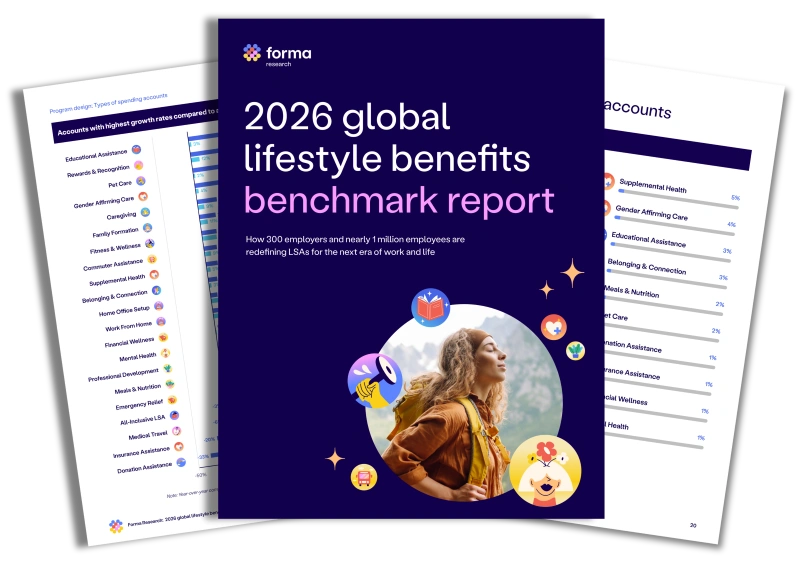
- Per-employee cost benchmarking: When total wellness spend is consolidated into a single number, it becomes comparable to industry benchmarks. Forma’s annual benchmark report is a useful reference point for evaluating whether current spend is in line with the market or significantly above it.
- Utilization as ROI: A program with 30% utilization and a $200 per-employee annual cost is delivering $60 of value per employee, not $200. Consolidated platforms with 70–80% utilization rates tell a materially different story.
- Budget predictability: LSAs and HRAs function as fixed employer-funded line items. Employees draw from what's been funded. That's a predictable, auditable structure that finance teams find easier to manage than variable expense reimbursement programs.
Brokers at firms like Mercer, Aon, and WTW are increasingly advising clients toward consolidation for exactly these reasons. When a broker recommends rationalizing a vendor stack, the financial argument carries significant weight with decision-makers who might otherwise resist change.
This benefits structure is typically selected for its flexibility and alignment with diverse workforce needs across automotive, healthcare, retail, hospitality, and media.
What employees actually want from a corporate well-being program
The programs employees rate most highly tend to have one thing in common: they feel like the benefit was designed for them specifically, not for a hypothetical average employee.
Flexibility is the mechanism that enables that feeling at scale. When an employee can direct benefit dollars toward what matters in their current life stage, childcare, professional development, fitness, or groceries, the benefit feels personal even when it's standardized from an administrative standpoint. The Lifestyle Spending Account guide covers how this flexibility works in practice across different employee populations.
This is also why utilization data is so instructive. Programs with high utilization almost always involve some degree of employee choice. Programs with low utilization almost always involve a benefit that was chosen by the company and assigned to employees without much input into whether it was something they actually wanted.
The practical takeaway is that wellness program design should separate the question of how much to invest per employee from the question of what that investment should be spent on. The first is an HR and finance decision. The second should involve the employee.
How to audit and simplify your wellness vendor ecosystem
A wellness vendor audit doesn't have to be a months-long project. Most of the information needed to make consolidation decisions is already sitting in existing contracts, HR invoices, and utilization reports, It just hasn't been assembled in one place.
Starting with an honest inventory is the most important step. For each vendor in the current stack, document the annual cost, estimated per-employee cost, last reported utilization rate, and monthly admin hours required. Once that picture is visible, most consolidation decisions become fairly obvious.
From there, the process looks roughly like this:
- Map current vendors against the delivery vs. content framework. Flag every delivery-layer vendor as a consolidation candidate.
- Calculate true per-employee cost including admin hours at fully-loaded labor cost, not just the vendor contract value.
- Compare utilization rates across vendors. Any program with under 50% utilization and more than minimal admin overhead warrants a hard look.
- Evaluate consolidated platforms against the programs you want to keep. Use the unified employee benefits platform checklist as a starting point for criteria.
- Pilot with one division or geography before full rollout. Pilots generate utilization data that makes the CFO conversation significantly easier.
The goal isn't to eliminate programs employees value. It's to stop paying administrative overhead for a fragmented delivery infrastructure when a single platform can handle the same function more efficiently.
Why Forma is built for the complexity you're trying to eliminate
Managing corporate wellness programs across multiple vendors is a problem that gets more expensive over time, not less. Every new contract renewal, every support escalation, every data export request compounds the cost of a fragmented infrastructure.
Forma brings LSAs, HSAs, FSAs, HRAs, commuter benefits, and rewards and recognition into a single admin platform with one dashboard, one data source, and one support relationship.
For global teams, Forma handles local currency conversion, country-specific eligibility rules, and equitable funding configurations that would require multiple vendors and significant manual coordination to replicate otherwise. The result is a benefits program that HR can manage confidently and employees actually use — with utilization rates that give CFOs something concrete to point to.
We did this consolidation for Stripe, and we can do it for you.
If your current wellness vendor stack is costing more than it's delivering, Forma can help. Schedule a demo today to see how we can consolidate programs without compromising the employee experience.
Frequently asked questions about corporate wellness programs
How many wellness vendors should a company have?
Most companies benefit from consolidating to one delivery platform — handling LSAs, HSAs, FSAs, HRAs, and commuter benefits — while maintaining select content partners for specific wellness services. There's no magic number, but if you're managing more than three to five vendor relationships for benefits delivery alone, the administrative overhead is likely eating into program ROI.
What is the average cost of a corporate wellness program per employee?
Industry benchmarks typically place corporate wellness program spend at around $150 to $300 per employee annually, though this varies significantly by company size, industry, and program scope. The more meaningful metric is utilization-adjusted cost, what you're actually spending per employee who actively uses the program, which tells a more honest story about ROI.
What's the difference between an LSA and other wellness benefits?
A Lifestyle Spending Account is an employer-funded account that employees can use for a wide range of eligible expenses, including fitness, professional development, caregiving, and more. Unlike HSAs or FSAs, LSAs are not tax-advantaged and don't require IRS-defined eligible expenses, which makes them significantly more flexible. Employers set the eligible categories, giving them control over how funds are used.
Why do employees underuse wellness benefits?
Low utilization is most commonly caused by friction in the claims or reimbursement process, lack of awareness about what's available, or programs that don't match employees' actual needs. Fragmented portals and complex eligibility rules are the biggest structural contributors. Consolidating access to a single platform and giving employees more spending flexibility consistently improves utilization rates.
How do brokers typically evaluate corporate wellness vendors?
Brokers at major advisory firms evaluate wellness vendors on utilization data, administrative burden, compliance capabilities, pricing structure, and integration with HRIS and payroll systems. They're increasingly advising clients to consolidate delivery-layer vendors onto single platforms, particularly for organizations with global workforces or complex multi-entity structures.
What is point solutions fatigue, and how does it affect wellness programs?
Point solutions fatigue occurs when employees and HR teams become overwhelmed by the number of separate tools, portals, and apps required to access different benefits. It leads to lower engagement, higher administrative costs, and fragmented data. It's one of the primary reasons companies are moving toward consolidated benefits platforms rather than maintaining separate vendor relationships for each benefit type.
Can a consolidated benefits platform support a global workforce?
Yes, the best consolidated platforms are built to handle multi-currency funding, country-specific eligibility configurations, local compliance requirements, and equitable benefit distribution across geographies. For multinational companies, the operational case for consolidation is especially strong because the complexity of managing separate vendors in each region grows exponentially with headcount.
This article is for informational purposes. Forma is not engaged in the practice of law. Nothing contained herein is intended as tax or legal advice nor to replace tax or legal advice from counsel. If you need tax or legal advice, please consult with counsel or a certified tax professional.
.png)


.png)