









How much are employers spending on well-being benefits?
Most employers spend $150–$300 per employee on wellness, yet utilization stays below 35%. Here's why, and how to fix it.
In this piece
Companies have been pouring more money into well-being programs year after year. The global workplace wellness market was valued at $57.9 billion in 2023 and is on track to more than double by 2034. Yet for most HR leaders and benefits managers, the ROI story is nowhere near as clean as those figures suggest.
Employees are showing up to work more burned out, more disengaged, and less satisfied with their benefits than at any point in recent memory. The programs are in place. The line items are funded. But something is clearly not working the way it should.
The disconnect is not a budget problem. It is a design problem. Employers are spending on well-being programs the way they always have, while the definition of what employees actually need has shifted underneath them. This article breaks down what companies are spending, what the evidence says about whether it is working, and what the benefits leaders at forward-thinking organizations are doing differently to close the gap.
Key takeaways
- According to Forma’s 2026 benchmark report, employers are spending a median of $980 per employee per year on an all-inclusive LSA. Most companies typically allocate $500-$1000 per employee per year for general lifestyle or wellness benefits.
- Gallup found that only 21% of employees strongly agree their organization cares about their overall well-being, tying a record low despite increased employer investment.
- The biggest driver of poor well-being ROI is not low funding. It is low utilization caused by program complexity and a one-size-fits-all design.
- Vendor fragmentation forces employees to navigate multiple platforms, which reduces engagement and creates administrative headaches for HR teams.
- Forma helps benefits leaders replace scattered point solutions with a single, employee-directed platform that drives measurably higher utilization. Schedule a demo today to see how it works for your organization.
What employers are actually spending on employee well-being
Benefits leaders are often surprised to learn how wide the range of well-being benefits spending is across organizations. Part of that is because "well-being spend" means different things to different people. Some teams count only direct wellness program costs. Others fold in EAP fees, mental well-being subscriptions, fitness reimbursements, and subsidized healthcare premiums all under the same umbrella.
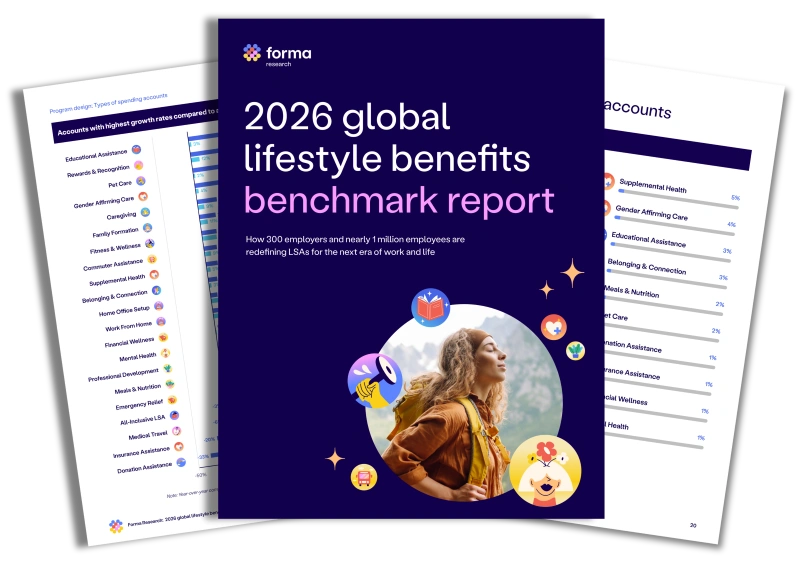
When you look specifically at dedicated wellness programs and spending accounts, Forma’s 2026 benchmark data suggests companies are spending $500–$1,000 per employee per year, depending on the program design.
Some targeted programs, particularly those addressing areas like mental health, caregiving, or medical support, can be funded at significantly higher levels. The range is wide, but the direction of spending is nearly universal: it is going up as employers expand investments in holistic well-being and targeted support programs.
You can take a look at these numbers and more in Forma’s comprehensive 2026 global lifestyle benefits benchmark report here.
Despite that growth, most organizations are not seeing proportional improvement in engagement or health outcomes. Only 21% of employees strongly agree their organization cares about their overall well-being, a figure that tied a record low in early 2024 even as CHRO surveys showed well-being was among the top organizational priorities. Employers are spending more, but employees are feeling it less.
A closer look at how benefits costs break down per employee reveals why. A significant portion of well-being budget gets absorbed by administration fees, vendor markups, and programs that employees simply never open. The money is technically allocated. It is not reaching people in a form they value.
Here is how typical employer well-being budgets are distributed:
- Direct wellness programs: Fitness subscriptions, incentives, stress management, telemedicine, and mental well-being apps
- Spending accounts: HSAs, FSAs, HRAs, and lifestyle spending accounts funded by employers
- Incentives and engagement: Gift cards, premium discounts, and rewards for program participation
- Administration and compliance: Platform fees, broker consulting, and HR staff time managing point solutions
When you add all of this up and look at benchmarking data across peer organizations, the picture becomes clear: it is not the total dollar amount that determines whether a well-being program succeeds. It is whether employees can actually access and use what is being offered.
Do corporate wellness programs work? What the research says
The question of whether employer wellness programs actually move the needle is one of the most contested in HR. The honest answer is: it depends entirely on how the program is built and who gets to decide how the funds are used.
The positive case for well-being investment is real. A meta-analysis published in Health Affairs found that for every dollar spent on wellness programs, medical costs fall by $3.27. Employers who see reductions in absenteeism, lower healthcare claims, and improved productivity scores tend to share a few common traits: high utilization rates, flexible program design, and strong employee communication.
The counter-evidence is equally compelling. Research from the RAND Corporation found that while disease management components of wellness programs can produce meaningful healthcare savings, lifestyle management components, like gym challenges and step-count campaigns, return only $0.50 for every $1 invested.
The headline ROI figures that get cited in benefits presentations often blend both components together, which inflates the numbers.
The reconciliation is straightforward. Programs that give employees real choices about how to spend their well-being dollars consistently outperform programs that push everyone through the same prescribed activities. A nurse working night shifts and a software engineer working from home have almost nothing in common in terms of what well-being support actually helps them.
The return on investment from wellness programs is not an inherent property of well-being spending. It is a result of how that spending is designed and delivered. When employees can direct their own benefit dollars toward things that matter in their actual lives, utilization goes up. When utilization goes up, so does the return.
We have seen this pattern consistently: the difference between a program that works and one that does not often comes down to whether employees can choose benefits that match their actual lives.
Why spending more isn't producing better outcomes
If the answer to low well-being engagement were simply more budget, most large employers would have solved this already. The real problem runs deeper than the dollar amount on the line item. There are four root causes that show up repeatedly when benefits teams audit their programs.
Measurement failure
Most organizations do not know which parts of their well-being spend are working because they are not measuring outcomes at a granular level. According to the International Foundation of Employee Benefit Plans, only 28% of companies measure the ROI of their wellness programs at all. Without clear metrics, budget renewals get justified by program availability rather than actual impact, and underperforming vendors stay on the books year after year.
The well-being gap
There is a growing mismatch between what employers offer and what employees actually want. A 2024 Gallup survey found that 23% of CHROs named well-being as a top organizational priority, yet that investment is not translating into employee experience. The gap is not about sincerity. It is about program design that lags behind a workforce that has changed dramatically in terms of where people work, how they define health, and what support they are looking for.
One-size-fits-all design
Legacy wellness programs were built for a homogeneous workforce in a single location. That workforce no longer exists. A global team spanning multiple countries, age brackets, family situations, and health needs cannot be served by a gym subsidy and a meditation app. One-size-fits-all design wastes spending on programs that only resonate with a narrow segment of the workforce.
Vendor sprawl and fragmentation
We've found that 80% of employers manage between five and 15 separate vendors for their well-being and benefits stack. Every new vendor adds a new login, a new claims process, a new compliance requirement, and another source of confusion for employees. Point solutions fatigue is real, and it is one of the primary reasons utilization stays low even when programs are technically available. The platform experience becomes a barrier rather than a bridge.
Based on platform benchmarks across flexible benefits programs, the single biggest driver of well-being ROI is utilization, and the single biggest barrier to utilization is complexity.
How to get more from every wellness dollar
Solving the spend-outcome gap does not require a larger budget. It requires a different architecture. Benefits leaders who are seeing real results have reorganized their programs around three principles.
Give employees control over their benefits
When employees choose how to spend their well-being dollars, whether on fitness, childcare support, professional development, or nutrition, they spend them on things they will actually use. Utilization rates for lifestyle spending accounts run significantly higher than for traditional point solutions precisely because the spending feels personal and relevant.
The growing adoption of "wallet" or sub-account structures within LSAs makes this even more targeted. A company can fund a general lifestyle wallet and a separate education assistance wallet, allowing employees to be intentional about different categories of spending without the rigidity of traditional pre-tax rules.
Consolidate your delivery layer
Every additional platform in your benefits stack is a participation barrier. Consolidating your pre-tax accounts, health reimbursement arrangements, and lifestyle benefits onto a single platform eliminates the friction that kills engagement. Employees who manage all their benefits in one place are more likely to use all of their benefits. HR teams who administer everything in one dashboard spend less time managing vendors and more time on strategy.
Measure what matters
Rather than tracking program availability, shift your success metrics to utilization rates, claim velocity, and employee satisfaction scores. Use an HR ROI calculator to model what a 10 or 20 percentage point increase in utilization would mean for your benefits budget efficiency. Set quarterly reviews against those benchmarks so you can identify what is working and reallocate away from what is not.
What the smartest employers are doing differently
The companies consistently cited as employers of choice, in benefits surveys and industry benchmarks alike, have made a deliberate shift in their philosophy. They treat benefits as a tool for genuine employee empowerment rather than a compliance checkbox.
Companies like lululemon, New Balance, and Logitech are not necessarily spending more than their peers on well-being programs. They are spending differently. Their programs are built around employee choice, global accessibility, and a platform experience that makes it easy for people to use what is available to them. The result is that employees at these companies frequently cite their flexible benefits as the number one benefit they receive, not just in passing but in annual engagement surveys.
The broker community is reflecting this same shift. Major advisory firms like Mercer, Aon, and WTW are increasingly recommending platform consolidation and employee-directed spending structures to their large enterprise clients. The strategic advice is consistent: fragmented point solutions that require separate administration are expensive and underperform compared to unified platforms that let employees self-direct.
Organizations that prioritize employee-directed spending through a consolidated platform consistently see employees rank flexible benefits as their number one benefit in annual surveys. When you build a program around what employees actually value, the investment starts to justify itself.
A smarter way of well-being spending
Reorganizing your well-being benefits strategy does not have to happen all at once. Most benefits teams find it useful to work through a structured sequence that builds momentum without disrupting what is already working well.
Start with a vendor and spend audit. Map every current well-being vendor to what it costs, how many employees actively use it, and what outcome metric it is supposed to move. The results are usually clarifying, and often uncomfortable.
Next, benchmark your current per-employee spend against the $150–$300 industry baseline and identify whether the gap is a budget issue or a delivery issue. More often than not, benchmarking your benefits reveals that delivery is the constraint, not budget.
From there, consider the following action sequence:
- Audit current spend by vendor and category to identify budget going to underutilized programs
- Benchmark per-employee spend against industry data to contextualize your investment level
- Shift toward employee-directed spending accounts that give employees meaningful choice
- Consolidate onto a single platform to reduce friction and administrative complexity
- Track utilization, claim rates, and sentiment on a quarterly basis with defined outcome goals
The goal is not to spend less on well-being. It is to spend so that employees actually feel the investment, use what is available, and reward the organization with the engagement and retention that justify the budget in the first place.
Why Forma helps close the well-being spending gap
Forma is a flexible benefits platform built specifically to solve the problem this article describes. Rather than adding another point solution to an already fragmented stack, Forma consolidates lifestyle spending accounts, pre-tax accounts, HRAs, and rewards and recognition programs into a single platform.
HR teams manage everything in one admin dashboard with real-time analytics, and employees access their benefits through a single portal, card, or claims experience.
Our platform's 78% monthly utilization rate is not an accident. It is a direct result of giving employees choice and making that choice frictionless. When employees can spend their benefit dollars on groceries, gym memberships, professional development, or caregiving support based on what their actual life requires, they use their benefits.
When they use their benefits, they feel their employer's investment. When they feel it, they stay.
Forma operates in more than 100 countries, handles currency conversion, compliance, and HRIS integrations without manual intervention, and has maintained a 98% customer retention rate since launch.
Schedule a demo today to see how Forma helps your organization turn well-being spending into well-being outcomes.
Frequently asked questions about employer well-being program spending
How much do companies typically spend on employee wellness programs per year?
Forma’s 2026 global benefits benchmark data consistently points to about $980 per employee per year for an all-inclusive LSA. Higher-investment programs that include coaching, incentives, and biometric screenings can be much higher. The right number depends on the size of your organization, program design, and whether you are measuring outcomes or just availability.
Why are employee well-being scores low despite increased employer investment?
The most common explanation is a design gap rather than a budget gap. Gallup's 2024 research found that despite well-being being a top priority for one in four CHROs, only 21% of employees strongly agree their employer cares about their well-being. Programs built around prescribed activities rather than employee choice consistently underperform in both utilization and employee sentiment.
Do corporate wellness programs actually produce ROI?
The evidence is mixed and depends heavily on program design. Disease management components of wellness programs tend to produce meaningful healthcare cost savings, while generic lifestyle management programs often return less than a dollar per dollar invested. Programs that incorporate employee choice and measure utilization closely tend to produce the strongest returns, with some studies citing $3.27 in lower healthcare costs per dollar spent.
What is the average utilization rate for employee wellness programs?
Despite the fact that 85% of workers report having access to at least one wellness program, the average utilization rate across those programs sits at just 30–35%. This gap between availability and engagement is the core challenge driving the shift toward flexible, employee-directed benefits like lifestyle spending accounts, which report significantly higher participation rates.
What is a lifestyle spending account and how does it differ from an FSA or HSA?
A lifestyle spending account is an employer-funded benefit that employees can spend on a wide range of eligible expenses defined by the employer, such as fitness, nutrition, childcare, or professional development. Unlike FSAs and HSAs, LSAs are not governed by IRS eligibility rules, which gives employers maximum flexibility in program design. They are taxable to the employee but offer a broader spend range that more employees find personally relevant.
How can HR teams justify well-being program budgets to CFOs?
The strongest CFO business case centers on utilization rates, employee retention costs, and productivity data. Replacing an employee typically costs between 50% and 150% of their annual salary. Programs that demonstrably reduce voluntary turnover pay back quickly. Using an HR ROI calculator to model the relationship between utilization, engagement, and retention can help benefits leaders frame the investment in financial terms that resonate with finance leadership.
What is the difference between a well-being program and a benefits platform?
A well-being program is a specific intervention, like a fitness challenge or an EAP, while a benefits platform is the infrastructure through which all benefits are administered and accessed. Many organizations run well-being programs through a fragmented set of point solutions with no unified platform underneath them. Consolidating onto a single benefits platform improves the employee experience, increases utilization across all programs, and reduces administrative overhead for HR teams.
This article is for informational purposes. Forma is not engaged in the practice of law. Nothing contained herein is intended as tax or legal advice nor to replace tax or legal advice from counsel. If you need tax or legal advice, please consult with counsel or a certified tax professional.
.png)


.png)