










Why more isn’t the answer: exploring the 5 Cs framework for scaling flexible benefits
Discover the 5 hallmarks of highly successful and scalable benefits programs.
In this piece
Benefits leaders know the feeling well. You’ve spent the better part of a year carefully evaluating vendors, building the business case, and rolling out a new program — only to find out that employees either don’t know it exists, can’t figure out how to use it, or simply don’t find it relevant to their lives.
So what do most organizations do? They add another program. Another vendor. Another login.
This is the “more is more” paradox — the well-intentioned trap that ensnares even the most forward-thinking benefits teams. In the effort to meet every employee’s need, many organizations now manage 15 or more point solutions, creating vendor sprawl and tech fatigue that stretches teams thin, scatters budgets across platforms, and leaves employees more confused than supported.
The antidote isn’t more. It’s better. And “better” finally has a framework.
At Forma, we’ve identified five hallmarks of highly successful flexible benefits programs: the 5 Cs framework.
When your benefits strategy and technology align around these principles, you build a foundation that can flex and adapt without requiring painful trade-offs or yet another point solution. Here’s what each one means and why it matters.
1. Comprehensive benefits
Breadth with integration, not fragmentation
Comprehensive doesn’t mean offering everything to everyone through a tangle of disconnected platforms. It means giving employees the ability to address diverse use cases and life stages — from fertility support to financial wellness to physical health — without requiring them to toggle between a dozen tools, and without requiring your team to manage an equally unwieldy patchwork of vendor relationships.
The data reflects a workforce that’s hungry for this kind of breadth: According to Aon, 63% of employees say they’d be willing to sacrifice their current benefits for a better choice of benefits. And nearly two-thirds of leading companies are planning to expand their inclusive benefits offerings in the year ahead.
Comprehensive benefits done right mean employees experience a connected whole, not a fragmented collection of perks that feels more like homework than support.
2. Customizable benefits
Designed for your workforce, not everyone else’s
Off-the-shelf benefits designed for a hypothetical average employee rarely resonate with your actual employees. Customizable benefits allow your organization to flex and adjust offerings to align with company priorities, reflect your values, and genuinely meet the evolving needs of your workforce — all without being locked into a rigid, one-size-fits-all approach.
The value of this is real and measurable. Research from Aon and Forma found that employees value lifestyle spending accounts at 150% of their nominal dollar amount — meaning for every actual dollar offered through a flexible, customizable benefit, employees feel like they’re receiving $1.50 in value. Yet despite this, 72% of employees say they value benefit customization while only 41% report actually having access to personalized options.
That gap is an opportunity. Benefits teams that close it don’t just improve employee satisfaction — they improve the perceived return on every dollar they spend.
3. Curated benefits
Making the right benefits easy for employees to find
You can have the most comprehensive, customizable benefits program in your industry, and still fail employees if they can’t navigate it. Curation is about thoughtfully organizing and presenting benefits in ways that show employees you understand their real-world needs — guiding them toward options that will be most relevant and helpful for their specific situation, life stage, or goal.
The navigation problem is significant. WTW research found that only 42% of employees feel confident navigating their benefits — yet 78% say they’re more likely to engage when they understand how a benefit meets their personal needs. That 36-point gap between confidence and potential is where curation lives.
Practically, this might mean structuring benefits into use-case-specific “wallets” or categories, building guided enrollment experiences, or designing a storefront that makes discovery feel intuitive rather than overwhelming. Use case-specific Lifestyle Spending Accounts have grown in popularity twice as fast as broad, all-inclusive LSAs over the past year — a clear signal that employees respond to benefits that feel like they were designed with their lives in mind.
4. Consolidated benefits
A unified experience, not a dozen logins and tools
Even the best-designed point solutions create friction when employees have to manage separate platforms, credentials, and interfaces for each benefit. Consolidation means bringing multiple offerings into a single unified experience, allowing you to deliver meaningful support without contending with dozens of separate vendors, point solutions, logins, and cost structures.
The administrative burden on benefits teams is real and growing. Only 4% of HR teams report being highly confident that their tech stack is fully optimized for maximum impact. That lack of confidence is a symptom of sprawl — too many systems doing too little talking to each other.
Consolidation solves for both sides of the equation. For employees, it creates a seamless, intuitive experience that makes benefits feel accessible. For benefits teams, it reduces administrative overhead, simplifies vendor management, and creates a clearer line of sight into how programs are performing. Fifty-four percent of companies have already consolidated multiple post-tax spending accounts onto a single platform — and those who have report significant improvements in both team efficiency and employee satisfaction.
5. Cost-effective benefits
Making the most of your benefits budget
In an environment where global health insurance costs continue to soar, cost-effectiveness has never been more critical. And cost-effectiveness isn’t just about finding cheaper options. It’s about ensuring every dollar you invest delivers measurable value and genuine impact.
True cost-effectiveness requires visibility. Are employees actually using the programs you’re funding? Which benefits are generating engagement and which are gathering dust? Can you demonstrate ROI to leadership when budget season arrives?
The organizations that do this well optimize spending based on real usage patterns, identify where dollars are being wasted on underutilized programs, and redeploy those resources toward benefits that move the needle on health outcomes, retention, and engagement. For example, Forma customer Garver saw their lifestyle spending account contribute to meaningful improvements in employee health metrics — cholesterol levels dropping, A1C numbers improving — ultimately reducing health insurance claims costs.
That’s cost-effectiveness in its fullest sense: benefits that pay for themselves.
Put the 5 Cs framework into practice
What makes the 5 Cs framework powerful isn’t any single principle on its own, it’s how they all reinforce each other.
Comprehensive coverage without curation leads to overwhelm. Customization without consolidation leads to sprawl. Cost-effectiveness without comprehensiveness leads to a benefits program that saves money but doesn’t actually support people.
Together, the 5 Cs solve the “more is more” paradox by replacing accumulation with intention. Rather than asking “what else can we add?”, benefits teams aligned around the 5 Cs ask: “How does this make our benefits more comprehensive, customizable, curated, consolidated, and cost-effective?” That single shift in framing changes everything.
The result is a benefits strategy that works harder for employees and for the business; one that can flex with your workforce as it evolves, without requiring you to start over every time the world changes.
Interested in assessing where your benefits program stands against the 5 Cs?
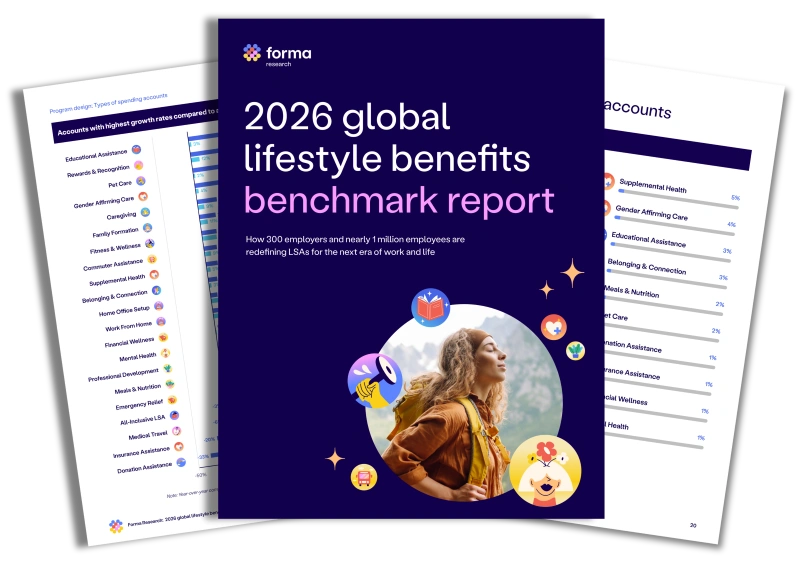
Download the guide to get access to the full framework and an interactive worksheet.
.png)


.png)