









Budgeting for GLP-1 and weight management benefits in 2026
GLP-1 cost is rising fast. Learn the top 2026 strategies HR leaders are using to manage access, control spend, and protect long-term ROI.
In this piece
GLP-1 medications were supposed to be a niche line item on the pharmacy ledger. For most employers, they've become the fastest-growing cost in the entire benefits program, sometimes jumping from the 30th-most-expensive drug category to the first in a single plan year.
The clinical case is real, and these medications are producing meaningful outcomes for employees managing obesity, type 2 diabetes, and cardiovascular risk, but the budgeting math has been a challenge for employers.
The question isn't whether to cover weight management and GLP-1s.
Most organizations with 500 or more employees will face that decision regardless of where they currently stand. The real question is how to structure access so that the investment produces measurable health ROI rather than ballooning pharmacy spend with little to show for it.
Blanket coverage without controls and blanket exclusions are not optimal choices in 2026, and the space between them is where the smartest weight management benefits design lives.
On the topic of making GLP-1s and weight management benefits affordable and accessible, Forma’s CEO & Co-founder Jason Fan said, “We’re helping our customers peel off the costly weight management use case from their core medical plans using a bunch of different methods, with specialty HRAs being a key one. When employers can self-fund these medications, we’re finding it can become much cheaper compared to directly having the carriers cover this.”
Key takeaways
- GLP-1 medications currently cost over $1,000 per month at retail before rebates, and 77% of large employers say managing GLP-1 costs is a top pharmacy priority heading into 2026
- Employers that cover GLP-1s without structured controls face premium increases between 5.3% and 13.8%, depending on eligibility scope and adherence assumptions
- Pairing GLP-1 access with mandatory coaching and lifestyle programs has shown up to 40% higher adherence and up to 54% medication cost savings in structured programs
- New 2026 levers, DTC channel subsidies, notional HRA funding, PBM contract reforms, and tight eligibility criteria, give benefits leaders more precision than any prior year
- If your GLP-1 strategy is still a pharmacy-only conversation, it may be costing you more than you think. Schedule a demo today to see how Forma helps employers build cost-smart, flexible weight management benefits programs.
What employers are actually paying for GLP-1s right now
The GLP-1 cost conversation is often framed in terms of sticker price, which misses the more complicated picture underneath.
What employers actually pay depends on plan design, rebate agreements, and the size of the eligible population that shows up to use the benefit, and all three of those variables are harder to control than most HR teams expected.
GLP-1 cost without insurance and the employer baseline
The retail price for branded GLP-1 weight-loss medications like Wegovy sits between $1,000 and $1,300 per month without insurance. After rebates negotiated through pharmacy benefit managers, employers typically land at an effective cost of $300 to $600 per member per month, still substantial at any meaningful employee headcount.
The deeper issue is the size of the potentially eligible population. Research from EBRI shows that roughly 34% of non-elderly adults covered by employer-sponsored insurance are clinically eligible for GLP-1 drugs based on diagnoses of diabetes, obesity, or being overweight with additional risk factors.
That translates to more than 57 million people nationally. This is a figure that makes broad, unrestricted eligibility an actuarial risk most employers cannot absorb.
Why spend is accelerating faster than expected
Employers who added GLP-1 coverage in the last two years have largely described the same experience: utilization came in higher and faster than projected.
In interviews conducted by the Peterson-KFF Health System Tracker, one HR director noted that GLP-1s went from their 32nd highest pharmacy spend category to their first within a single year. Another large retail firm reported a trajectory from $500,000 in GLP-1 spend to a projected $1.2 million the following year after initial coverage was introduced.
The Business Group on Health reports that 24% of employer healthcare dollars already go to pharmacy expenses, with an 11 to 12% annual pharmacy cost increase projected through 2026.
What makes GLP-1s particularly difficult to model is the adherence paradox: according to Mercer, citing Prime Therapeutics data, only about 1 in 12 members remain on GLP-1 treatment after three years, which means the upfront costs hit the plan immediately while the long-term health ROI that would offset them often doesn't materialize.
Weight regain after discontinuation also means the health gains aren't durable, compounding the return-on-investment problem.
The five cost-control strategies benefits leaders are using in 2026
The employers seeing the most sustainable outcomes in 2026 are not the ones who removed GLP-1 coverage entirely or approved it with no conditions.
They're treating GLP-1s the way any high-cost clinical intervention should be treated: with defined eligibility logic, structured support programs, and built-in reassessment checkpoints. These five strategies represent the current leading edge of how HR and total rewards leaders are approaching flexible benefits strategy for this category.
1. Tightening eligibility criteria with clinical precision
The fastest way to protect plan sustainability without eliminating access is to define eligibility narrowly using clinical thresholds rather than blanket inclusion. Most structured programs today limit GLP-1 coverage to employees with a BMI of 30 or higher, or a BMI of 27 or higher with at least one comorbidity such as hypertension or type 2 diabetes.
The EBRI simulation data is instructive here: expanding coverage to include individuals who are overweight without comorbidities results in notably higher premiums because the eligible pool expands dramatically.
Employers who hold the line at clinical thresholds can offer meaningful access while keeping the addressable population to a manageable size. Prior authorization protocols, specifying who qualifies, what must be ruled out first, and what documentation is required, are a necessary complement to any eligibility policy.
One note worth flagging: targeting a specific drug class for restrictions can raise ERISA and ADA compliance considerations. Employers should review any eligibility design with legal counsel before implementation.
2. Pairing coverage with mandatory lifestyle programs
Several employers are now requiring enrollment in a structured coaching or behavioral support program as a condition of GLP-1 coverage. This approach directly addresses the adherence problem. When employees have a coaching relationship alongside their medication, they're less likely to discontinue early and more likely to achieve the clinical outcomes that justify the spend.
Weight management programs designed with lifestyle supports have delivered approximately 15% average weight loss over 18 months alongside up to a 40% improvement in adherence rates.
The downstream implication for employee wellness programs ROI is significant: a member who stays on therapy and achieves durable weight loss is also generating long-term reductions in cardiovascular events, diabetes progression, and related medical costs.
3. Building step-down coverage models instead of open-ended plans
Open-ended GLP-1 coverage, where access continues indefinitely without reassessment, is one of the primary drivers of unsustainable spend. The alternative that leading employers are now implementing is a 12 to 18-month coverage model with structured checkpoints built into the plan document itself.
Some employers are now writing step-down language directly into plan documents, which eliminates ambiguity and gives the benefits team a clear operational framework to enforce. A well-structured model typically runs on three checkpoints:
- Month 3–6: Review clinical progress against defined benchmarks (e.g., weight loss targets, adherence rate). Members not meeting thresholds can be redirected to alternative interventions before additional spend accrues.
- Month 12: Formal reassessment to determine whether continued access is clinically warranted and whether the coverage condition is being met.
- Month 18: Final gate for long-term coverage approval, often requiring physician documentation and re-authorization.
This structure doesn't feel punitive to employees when it's communicated as a goal-oriented support program rather than a cost-cutting measure.
4. Using DTC channel subsidies as a predictable alternative
A growing number of employers are stepping outside the traditional plan-benefit structure entirely for GLP-1s. Rather than covering the medication as a plan benefit subject to rebate variability and formulary decisions, they're subsidizing direct-to-consumer purchases at a fixed rate, typically $100 to $200 per month per employee.
This approach gives employers a fixed, predictable line item that doesn't move with PBM rebate changes or formulary shifts. The TrumpRx drug-pricing initiative is expected to influence DTC pricing dynamics further in 2026, and employers who have built DTC subsidy frameworks will be better positioned to adjust as market prices move.
Compounding pharmacy options represent another access channel, though FDA regulatory activity around compounded semaglutide has made this option more complicated. Employers should verify current FDA guidance before including it in any formal program.
5. Auditing PBM contracts and formulary positioning
The rebate economics of GLP-1 coverage are more complicated than most employer plan sponsors realize.
Rebates on GLP-1 medications may be reduced or eliminated under certain utilization management configurations, which means the savings an employer expects from a tightly managed program may partially offset the rebate revenue they were counting on. Auditing the current PBM contract specifically for GLP-1 rebate structures is an underutilized cost lever.
On the formulary side, major PBMs are actively making decisions. CVS excluded Zepbound from its formulary starting July 2025 while continuing to offer Wegovy.
Employers who have delegated formulary management entirely to their PBM may not realize what coverage decisions are being made on their behalf. Express Scripts has introduced an Evernorth EnReachRx network strategy for GLP-1 management. It's worth evaluating, but it won't be the right fit for every plan.
The cost-plus contracting model, which some PBMs are also moving toward, offers a more transparent pricing structure that removes margin variability from the equation.
Why Forma helps employers manage GLP-1 costs without the operational chaos
GLP-1 cost management is ultimately a benefits design problem, not just a pharmacy problem. Every prior authorization has to be reviewed. Every step-down checkpoint has to be tracked.
Forma is a flexible benefits platform built to give HR and total rewards teams the administrative control and funding flexibility this category demands. Through Forma's specialty Health Reimbursement Arrangement, employers can create a defined, ring-fenced budget specifically for weight management and GLP-1-adjacent expenses.
Employees spend only what's been approved, and the employer pays only for what's actually used. That notional funding model keeps realized cost predictable: projected spend is calculated as median funding multiplied by utilization multiplied by headcount, not worst-case full utilization.
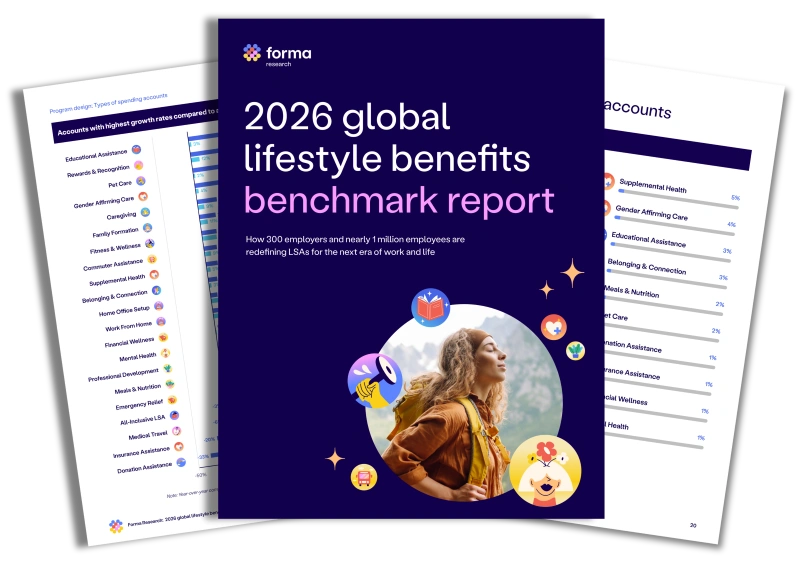
Forma's 2026 lifestyle benefits benchmark report shows that targeted account funding is accelerating across categories, mental well-being accounts alone saw median funding increase 525% year-over-year, and that same model applies directly to weight management programs.
The operational overhead of GLP-1 management is already high. Schedule a demo today to see how Forma helps employers fund targeted programs without overpaying.
Frequently asked questions about GLP-1 cost
How much does GLP-1 maintenance cost long term?
Once a patient reaches a maintenance dose, monthly GLP-1 costs remain largely the same as during the titration phase — typically $1,000 or more at retail without insurance. Because clinical evidence indicates that patients regain weight after discontinuation, most users need to stay on the medication indefinitely to sustain results, making ongoing cost a permanent plan liability rather than a time-limited one.
How can employees access GLP-1 medications at a lower cost?
Several options can reduce out-of-pocket GLP-1 cost for employees: manufacturer savings programs (where available), direct-to-consumer telehealth platforms that offer lower cash-pay pricing, HRA reimbursement through employer-funded accounts, and pharmacy discount programs. Eligibility for each option varies based on insurance status and the specific medication prescribed. Employees should check with their HR team to confirm what employer-funded support is available to them.
Is GLP-1 safe for long-term use?
Current clinical evidence supports long-term GLP-1 use for most patients with appropriate medical supervision. Aon's January 2026 analysis of over 192,000 GLP-1 users found that sustained use was associated with significant reductions in major cardiovascular events and lower cancer incidence in women. As with any medication, ongoing monitoring by a physician is recommended, and individual patient circumstances determine whether long-term use is appropriate.
How do employees qualify for GLP-1 coverage through an employer plan?
Qualification requirements vary by plan design, but common criteria include a BMI of 30 or higher, or a BMI of 27 or higher with at least one qualifying comorbidity such as type 2 diabetes or hypertension. Many employer plans also require a physician's documentation and prior authorization. Some plans now additionally require enrollment in a structured lifestyle or coaching program as a condition of continued coverage.
What is the difference between covering GLP-1s as a health plan benefit versus through an HRA?
Covering GLP-1s as a health plan benefit subjects the employer to premium implications, PBM rebate variability, and formulary decisions that may be outside the employer's direct control. An HRA, by contrast, allows the employer to set a defined annual budget per employee that is used on a reimbursement basis — the employer only pays when funds are actually spent. This notional funding structure makes cost more predictable and keeps total program liability capped at the employer's chosen allocation rather than scaling with utilization.
This article is for informational purposes. Forma is not engaged in the practice of law. Nothing contained herein is intended as tax or legal advice nor to replace tax or legal advice from counsel. If you need tax or legal advice, please consult with counsel or a certified tax professional.
.png)


.png)