










A benefits leader's guide to vendor consolidation in 2026
A guide to vendor consolidation for benefits leaders: how to evaluate, sequence, and build the case without disrupting employees.
In this piece
Quick answer: Vendor consolidation in benefits means moving multiple point solutions onto one platform with purpose-built wallets, reducing contracts, reporting gaps, and administrative work. Benefits platform consolidation means moving multiple point solutions onto one flexible platform, which reduces administrative work, enhances the employee experience, and streamlines costs.
Take an honest inventory of what your team touches in a given month. There is a wellness app with its own portal, a tuition reimbursement administrator that emails spreadsheets, a backup care vendor with a separate eligibility file, a recognition tool nobody remembers approving, a commuter provider, and a pre-tax administrator with its own renewal cycle.
Each one made sense on the day it was signed. Together, they produce a set of dashboards that cannot be combined, a renewal calendar that never lines up, and an employee experience that asks people to remember which login goes with which need.
We call this the more is more paradox. The solution? Consolidation.
This article covers how benefits leaders evaluate what should consolidate, what should stay, and how to build a case that finance and the CHRO will both sign off on.
Key takeaways
- Contract end dates and notice periods dictate a realistic consolidation timeline far more than budget availability does.
- Some employee needs are better served by a funded wallet the employee directs, while others genuinely require a specialized vendor relationship.
- A business case built on a clear mechanism, meaning fewer vendor relationships, consolidated reporting, and use-case-specific funding, holds up better with finance than an asserted ROI figure.
- Forma brings Lifestyle Spending Accounts, HRAs, and pre-tax accounts into one platform with purpose-built wallets underneath, so consolidation simplifies your stack without flattening your program design. Schedule a consolidated benefits demo with Forma today.
What vendor consolidation means for benefits teams
Vendor consolidation means reducing the number of separate providers involved in a benefits program while bringing more of the work under a smaller, more coordinated group of partners. For benefits teams, the objective is not simply to eliminate vendors. It is to reduce operational complexity, improve visibility across the program, and create a more consistent experience for employees.
The four dimensions of what actually consolidates
When benefits leaders talk about consolidation, they are usually describing four separate problems that happen to travel together. Naming them individually makes the scope much easier to define.
- Contracts and Renewals: Separate agreements, staggered end dates, and separate negotiations that never align into a single planning cycle.
- Administration: Eligibility files, integrations, invoice reconciliation, and support escalations multiplied across every vendor relationship.
- Reporting: Disconnected dashboards that cannot be combined into one view of how the program is performing.
- Employee Experience: Separate logins, separate claims processes, and separate support paths for needs that feel connected to the employee.
The point solutions fatigue that follows is not really about the number of vendors. It comes from the fact that each addition creates administrative work in all four dimensions at once, which is why adding a seventh vendor feels disproportionately heavier than adding a third.
Why you shouldn’t look at cost reduction in isolation
There is a version of this project that begins and ends with a spreadsheet of annual costs sorted descending. It produces fast wins and it damages programs.
Cost data tells you what a vendor bills. It says nothing about which employee population depends on that benefit, whether another contract already covers the same need, or what happens to in-flight claims if the relationship ends in March. Also, research from SHRM has consistently pointed to administrative time as a major burden on benefits teams, and that time cost rarely appears in a contract-value analysis.
Consolidation is worth doing when it improves program design and reporting. The cost savings that follow consolidation are real, but they are the outcome of better design rather than the goal on their own.
How to approach vendor consolidation in 4 steps
Most benefits vendor consolidation projects stall at the same point. Someone builds a list of vendors and costs, presents it, and then cannot answer the first question anyone asks: what does each of these actually do for employees?
The sequence below builds that view first, then works outward to timing and the business case. It is designed to be run by a benefits team rather than handed to procurement.
Step 1: Inventory vendors, contracts, and renewal dates
The inventory is where most teams find out how much information is scattered across departments. Benefits holds the program details, finance holds the invoices, and procurement holds the contract terms.
A usable inventory captures annual cost, contract end date, notice period, the employee population served, integration dependencies, and the internal owner. That last column tends to be the one that surfaces surprises.
The practical constraint most teams run into here is that renewal dates dictate the realistic timeline more than budget does. A vendor with eighteen months left on a contract and a ninety-day notice window is not a candidate for this plan year, regardless of how much overlap it has with something else.
Step 2: Map each vendor to the employee need it serves
This step converts a procurement exercise into a program design decision, and it is the part competitors' consolidation advice usually skips entirely.
Instead of sorting by cost, sort by need. Two vendors serving the same underlying need is a consolidation opportunity. One vendor serving a need that nothing else in your stack covers is a retention decision, even if it is expensive.
The output is a need-by-vendor map that shows three things clearly: where coverage overlaps, where gaps exist that nobody has funded, and where a single vendor is the only thing standing between employees and a need. That map is also what makes the eventual comparison between point solutions and flexible accounts concrete rather than theoretical.
Step 3: Decide what consolidates into an account structure and what stays a vendor
Not every need belongs in a funded account, and pretending otherwise is how consolidation projects lose employee trust. The distinction is whether the value comes from the money or from the specialized service attached to it.
Needs where employees benefit most from directing their own funds tend to consolidate well into configurable accounts. Categories that commonly fit this pattern include:
- Well-being: Fitness, mental well-being resources, nutrition support, and preventive services employees select themselves.
- Professional Development: Certifications, courses, conferences, coaching, and learning subscriptions.
- Home Office & Connectivity: Equipment, connectivity, and ergonomic setup for distributed teams.
- Caregiving: Childcare, eldercare, and pet care support where local provider choice matters.
- Family Formation: Fertility, adoption, and surrogacy support.
- Education & Tuition Support: Coursework, tuition assistance, and student loan repayment support.
What matters here is that consolidating benefits use cases with a single vendor on a unified platform does not necessarily mean collapsing them into one broad account. The stronger model, like the one offered by Forma, is one flexible benefits platform with multiple purpose-built wallets underneath, each configured around a specific use case, funding strategy, and workforce priority.
That structure preserves what made the individual vendors useful. A Well-being wallet and a Professional Development wallet can be funded differently, reported on separately, and communicated with different messaging, all inside one cohesive employee experience. Compliance-sensitive categories such as Family Formation may call for a different account structure depending on the countries and covered expenses, which is another reason a multi-account model with a unified experience works so well.
Step 4: Build the business case and the measurement plan
The case that gets approved is the one that explains a mechanism rather than asserting a return. Finance teams have seen enough vendor-supplied ROI slides to discount them automatically.
This final step has three parts: documenting where you are now, explaining what specifically changes, and building a forecast the finance team can stress-test.
Document the current state
Before any projection, the case needs a defensible baseline. Four components cover most of what a CFO will ask about:
- Total Vendor Cost: Annual contract value across every benefits vendor in scope, including per-employee fees and platform minimums.
- Administrative Time: Hours spent on benefits administration, eligibility files, invoice reconciliation, and support escalations.
- Reporting Gaps: Program-level questions the current dashboards cannot answer without manual work.
- Employee Experience Friction: Support tickets, repeat questions, and the access issues that surface during enrollment.
The last two are the ones teams tend to leave out, and they are usually the most persuasive with a CHRO.
Explain the mechanism behind the value
The mechanism is concrete. Fewer vendor relationships means less contract and integration work, and consolidated reporting means program decisions can be made from one view.
Use-case-specific funding means each category gets a budget that reflects its actual priority. That combination is what produces clearer budget control, which is a more defensible claim than a percentage.
With LSAs, notional funding also changes the cost profile in a way finance teams appreciate. Employers pay for the dollars employees actually use, so a $1,200 annual wallet where an employee spends $900 costs the employer $900.
Build the forecast and separate your metrics
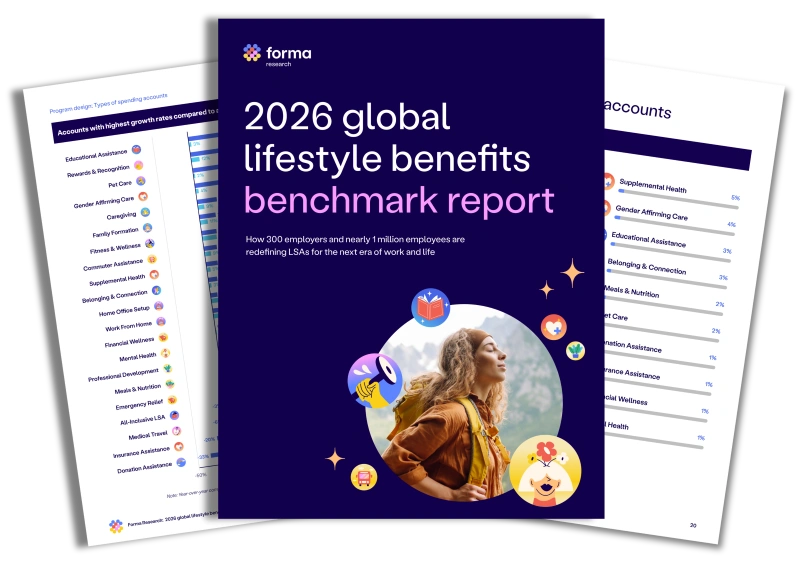
Our 2026 global lifestyle benefits benchmark report offers a straightforward forecasting model: median funding per employee, multiplied by utilization rate, multiplied by headcount, gives you a projected program cost. Applied to a $600 Well-being allocation at a 71% utilization rate across 5,000 employees, that produces roughly $2.13 million in projected spend rather than the $3 million a full-budget assumption would suggest. You can read more statistics like this in our 2026 benchmark report.
The goal is meaningful engagement, predictable spend, and better visibility into what employees actually value, which is the same standard any credible employee benefits ROI analysis should meet. A structured benefits value assessment can help translate these inputs into something a CFO will accept.
How Forma enables you to consolidate benefits without flattening program design
Forma gives benefits teams a way to run this sequence and land somewhere better than a smaller vendor list. Lifestyle Spending Accounts, HRAs, pre-tax accounts including HSA, FSA, and Commuter, and Rewards and Recognition all live on one platform with one admin dashboard, replacing separate vendor portals and separate eligibility files.
Underneath that platform, employers configure purpose-built wallets for each use case rather than one broad catch-all account. A Well-being wallet and a Caregiving wallet can carry different funding, different eligible categories, and separate reporting.
Consolidated reporting spans categories and markets, notional funding means you pay for what employees actually use, and the model extends across 110+ countries with cost-of-living adjustments so consolidation does not stop at the US program. Employees get one cohesive experience across all of it.
Consolidation should simplify your stack without simplifying your strategy. Schedule a demo with Forma today.
Benefits of consolidating benefits vendors onto one platform
The value of point solution consolidation shows up in three places at once: what the benefits team administers, what the employee experiences, and what finance can forecast. Teams that only measure one of those tend to undersell the result internally.
Each dimension reinforces the others. Cleaner administration produces better data, better data produces more accurate funding decisions, and more accurate funding produces a program employees actually engage with.
- Reduced Administrative Burden: Fewer contracts, renewals, eligibility files, integrations, and invoice reconciliations across the year.
- Cleaner Reporting: Category-level performance visible in one place instead of stitched together from separate exports.
- Budget Visibility: Consistent metrics across programs, with funding tied to specific use cases rather than blended into one line.
- Use-Case-Specific Funding: Employers can fund a Well-being wallet differently from a Professional Development wallet, a distinction one blended vendor stack cannot surface.
- Better Employee Experience: A connected benefits experience rather than separate logins and separate claims paths per benefit.
- Fewer Disconnected Vendor Relationships: Less time spent on benefits vendor management, more spent on program design.
That last point deserves weight, because the communication problem is measurable. MetLife research has found that employees who feel their benefits meet their needs report significantly higher loyalty to their employer, and a fragmented experience makes it substantially harder for employees to know what is available to them in the first place.
The reason benefits consolidation has become a priority for so many teams is that increasing vendor complexity compounds quietly. No single addition feels unmanageable, but the cumulative effect on reporting and administration is what eventually forces the conversation.
How Forma supports benefits teams consolidating vendors
Consolidating employee benefits vendors is easier to justify when the destination is clearly better than the origin, not just smaller. Forma gives benefits teams one platform where Lifestyle Spending Accounts, HRAs, pre-tax accounts, and Rewards and Recognition can live together, with dedicated wallets configured around each use case rather than one broad account absorbing everything.
That structure is what makes consolidation strategic. Each wallet carries its own funding, eligible categories, and reporting, so program-level decisions stay visible after the vendor count drops. With configurable account structures, cost-of-living adjustments across 110+ countries, and nearly 1 million members, Forma turns global benefits program design into a data-backed process rather than a market-by-market negotiation.
If your 2027 planning includes a vendor stack you would rather not renew as-is, now is the window to map it. Schedule a demo with Forma today and build a consolidation plan around your renewal calendar.
Frequently asked questions about benefits vendor consolidation
What is vendor consolidation in employee benefits?
Benefits vendor consolidation is the process of reducing the number of separate benefits vendors an employer manages by moving multiple employee needs onto one platform. It covers contracts, administration, reporting, and the employee experience, and it typically involves deciding which needs become funded accounts and which require a specialized vendor.
How many benefits vendors do most employers manage?
There is no reliable universal figure, and the number varies widely by employer size, geography, and program maturity. A more useful measure is how many separate contracts, eligibility files, dashboards, and employee logins your benefits team currently maintains, since that reflects the actual administrative load better than a vendor count.
When is the best time in the plan year to consolidate benefits vendors?
Sequencing usually works best around renewal dates and plan-year boundaries. Many benefits teams do the evaluation work in the first half of the year, make decisions ahead of open enrollment preparation in October and November, and target a January 1 start so employees experience the change at a natural transition point.
Which benefits vendors are easiest to consolidate first?
Categories where employees benefit most from directing their own funds tend to move first. Well-being, Professional Development, Home Office, and Rewards and Recognition commonly fit this pattern. Vendors delivering specialized clinical or advisory services generally require closer evaluation before any point solution consolidation decision is made.
Does consolidating benefits vendors reduce employee choice?
Consolidating employee benefits vendors does not have to reduce choice. A multi-wallet model preserves distinct categories with their own funding and eligible expenses while giving employees one place to access them. Choice typically expands within each category, since employees direct funds toward the specific providers and services that fit their situation.
What happens to unused employee balances during a vendor transition?
Treatment of unused balances depends on the account type, the outgoing vendor's contract terms, and plan documentation. Benefits teams should confirm run-out periods, grace periods, and claims deadlines in writing before any transition, and communicate the timeline to employees well ahead of the cutover date.
This article is for informational purposes. Forma is not engaged in the practice of law. Nothing contained herein is intended as tax or legal advice nor to replace tax or legal advice from counsel. If you need tax or legal advice, please consult with counsel or a certified tax professional.
.png)

.png)