










Best total rewards software compared for benefits and total rewards teams
Best total rewards software compared across benefits, compensation, and recognition. Honest features, pros, and cons for each platform.
In this piece
Quick answer: Total rewards software spans four categories: compensation engines, flexible benefits platforms, HRIS-embedded modules, and recognition platforms. Most teams build a stack of two or three rather than buying one platform.
Every total rewards leader has sat through the demo where a vendor claims to cover compensation, benefits, recognition, and analytics in a single system. The screens look good and the pricing looks reasonable. Six months after signing, the compensation module is doing real work and the benefits piece is a checkbox nobody uses.
The problem usually is not the vendor. It is that four different software categories all describe themselves using the same phrase, and the buying decision gets made before anyone establishes which category actually solves the binding constraint.
A compensation planning engine and a flexible benefits platform are not competitors. They sit in different parts of the stack and solve different problems, so treating them as interchangeable options on one shortlist is how teams end up paying for depth they never use in one pillar while running spreadsheets in another.
The comparison below sorts seven platforms by the category each one leads with, then covers what each does well and where it stops. The goal is a shortlist that matches the problem you are actually trying to solve.
Key takeaways
- Total rewards software divides into four distinct categories, and most buying mistakes come from choosing the wrong category rather than the wrong vendor.
- No single platform leads in all four pillars, which is why mature total rewards teams typically run a stack of two or three specialized tools.
- Flexible benefits and recognition are the pillars where employee participation tends to be highest and where consolidation delivers the fastest administrative wins.
- Global capability, multi-wallet configuration, and category-level reporting separate enterprise-grade platforms from tools built for a single country or a single pillar.
- Ready to strengthen the flexible benefits and recognition layer of your total rewards strategy? Schedule a demo today to see how Forma brings benefits and Rewards and Recognition onto one platform across 110+ countries.
What is total rewards software?
Total rewards software is any platform that helps employers design, administer, or communicate the value employees receive beyond base salary. That definition is broad enough to cover four categories that behave very differently in practice.
Compensation engines handle salary structures, market pricing, merit cycles, and pay equity analysis. Flexible benefits platforms administer funded accounts such as Lifestyle Spending Accounts, HRAs, and pre-tax accounts. HRIS-embedded modules extend a core system of record into compensation planning or benefits enrollment. Recognition platforms deliver peer-to-peer recognition, milestone awards, and reward fulfillment.
Knowing where a total rewards package begins and ends helps clarify why these categories stay separate. Compensation software answers what an employee is paid. Benefits software answers what an employee can access. Those are different data models and different administrative workflows.
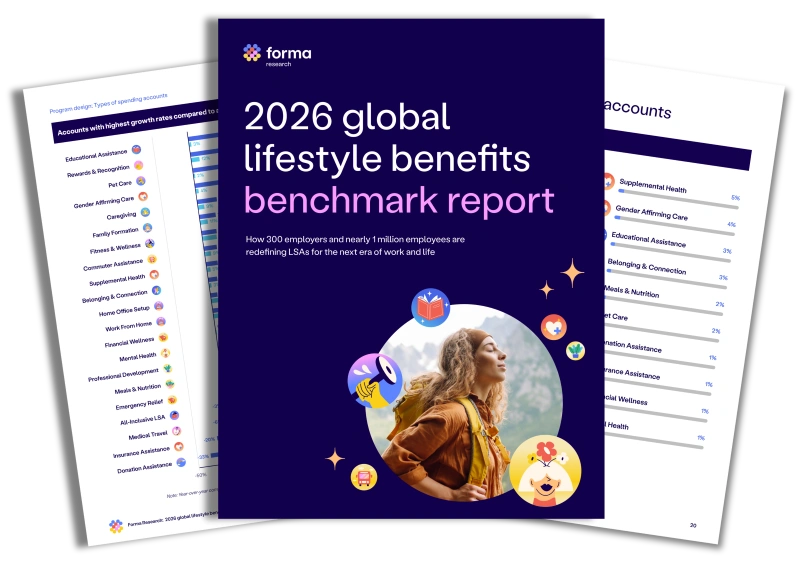
The recognition pillar deserves particular attention when evaluating a total rewards software tool. Among the ten account types tracked in the 2026 Forma Benchmark report, Rewards and Recognition showed 89% budget utilization, the highest of any category. That figure reflects how completely employees spend allocated funds rather than proving the category outperforms others, though it does signal that recognition budgets rarely sit unused. You can read more statistics like this in our 2026 Forma Benchmark report.
Where the categories genuinely connect is in program design. Teams building an LSA-driven total rewards strategy tend to think about benefits and recognition together, because both are funded, both are employee-directed, and both produce engagement data that informs the next planning cycle.
How we evaluated the best total rewards software
A comparison is only useful if the criteria are transparent. Every platform below is evaluated against the same six factors that total rewards teams use to build a shortlist.
- Category Fit: Which pillar of total rewards does the platform lead with, whether compensation, benefits, HRIS, or recognition?
- Program Scope: Single-pillar or multi-pillar capability, and how deep the platform goes on its primary pillar.
- Global Coverage: Country availability, local currency support, cost-of-living adjustments, and multi-language capability.
- Integration Model: HRIS and payroll integrations, single sign-on, and open API access.
- Reporting and Analytics: Category-level utilization, engagement metrics, and budget visibility.
- Commercial Model: How the platform charges, whether per employee per month, by tier, or through notional funding where employers pay only for dollars used.
This comparison draws on publicly available product information, verified user reviews, publicly accessible analyst coverage, and Forma's decade of experience in the flexible benefits category. Most vendors in this category quote per organization rather than publishing rates, so pricing is not covered here and should be confirmed directly with each vendor.
Forma appears in this comparison and is one of the platforms being evaluated. Where another platform leads a category Forma does not compete in, that is stated as a category difference rather than a shortcoming. Several platforms below are stronger than Forma at compensation planning, because Forma does not offer compensation planning at all. Considerations that shape total rewards package design vary by organization, so the right shortlist depends on which pillar is currently underserved.
7 best total rewards software platforms compared
The seven platforms below cover the four total rewards categories most teams evaluate. Each entry lists the category it leads with, the best-fit use case, feature depth, and honest pros and cons.
1. Forma
Category: Flexible benefits and recognition
Best for: Global employers consolidating benefits wallets, pre-tax accounts, and recognition onto one configurable platform
Forma is a flexible benefits platform that brings Lifestyle Spending Accounts, HRAs, pre-tax accounts, and Rewards and Recognition into one employee experience. Rather than one broad catch-all account, employers configure purpose-built wallets around specific use cases, each with its own funding, eligible categories, and reporting.
The platform operates across 110+ countries with cost-of-living adjustments and local currency support, serving more than 300 customers and nearly 1 million members. Forma does not offer compensation planning or market pricing, so total rewards teams typically pair it with a compensation engine or an HRIS compensation module.
Key features:
- Purpose-built wallets for Well-being, Caregiving, Family Formation, Professional Development, Home Office, and other workforce priorities
- Pre-tax accounts including HSA, FSA, and Commuter alongside HRAs and LSAs
- Integrated Rewards and Recognition for milestones, performance, and peer recognition
- Notional funding, so employers pay only for dollars employees actually use
- Category-level and country-level reporting for benefits and total rewards teams
- AI-assisted claims review with in-house compliance support
2. Workday
Category: HRIS-embedded
Best for: Enterprises already running Workday HCM that want compensation planning on the same employee record
Workday Compensation sits inside the broader Workday HCM platform, which means compensation decisions draw on the same employee record that powers payroll, performance, and core HR.
The module covers merit and bonus cycles, equity plan administration, salary range management, and compensation modelling, with AI-assisted recommendations for managers and analytics that connect pay decisions to performance and workforce planning data. It also generates real-time total rewards statements so employees can see the full value of their package.
Benefits capability exists but functions as enrollment administration rather than flexible spending account configuration.
Key features:
- Merit, bonus, and equity plan administration within the core HCM record
- Salary range management and compensation modelling
- In-flight cost modelling to view financial impact before committing
- Real-time total rewards statements
- EU pay transparency reporting tools
- Benefits enrollment administration
3. Payscale
Category: Compensation engine
Best for: Mid-market and enterprise teams that need market data and benchmarking as the foundation of pay decisions
Payscale is a compensation data and management platform built around benchmarking. Its suite covers salary benchmarking, pay analysis, annual review and budgeting, and compensation data reporting, with manager collaboration tools, customizable templates, and dashboards tracking pay decisions and salary history. It integrates with ADP Workforce Now, BambooHR, Tableau, and UKG Pro. The platform does not administer benefits accounts or recognition programs.
Key features:
- Crowdsourced and company-sourced compensation data
- MarketPay survey management and Insight Lab analytics
- Salary structure creation and maintenance
- Merit and bonus cycle planning
- HRIS data import and standardized reporting
- Pay equity gap analysis
4. HRSoft
Category: Compensation planning and total rewards statements
Best for: Enterprises with complex incentive structures that need configurable comp cycles and branded rewards communication
HRSoft focuses on compensation planning depth and total rewards communication. The platform covers total compensation planning, long-term incentive and bonus deferral automation, total rewards communication, and pay-for-performance linkage, with configurable workflows, global capability, and HRIS integration.
Its total rewards communication module delivers a branded portal that tailors compensation, benefits, and perks presentation to each employee, connecting to payroll, benefits, and HRIS systems for a unified view. HRSoft presents benefits data rather than administering benefits accounts.
Key features:
- Configurable salary, equity, incentive, and international budget planning
- Long-term incentive plan administration including stock options and RSUs
- Personalized total rewards statements and branded employee portal
- Pay-for-performance linkage
- Multi-currency conversion and multi-language statement packs on higher tiers
- HRIS integration across major systems
5. Bettercomp
Category: Market pricing and benchmarking
Best for: Compensation teams managing benchmarking across many surveys, job families, and pay markets
Bettercomp specializes in market pricing at scale. Teams manage the entire global market pricing process including job matching, data cut application, range and structure modeling, and reporting.
Global job matching aligns jobs to the surveys used across all pay markets, which matters for employers with roles spread across multiple locations. It is designed for organizations with at least five survey sources that need to automate market pricing, rather than very small teams. The platform does not cover benefits or recognition.
Key features:
- Automated job pricing based on pay markets, job matches, and level mappings, with pricing policies built directly in the platform
- Global job matching across multiple pay markets
- Salary structure and range modeling
- Survey participation management
- Multi-currency support, customizable reporting, and real-time analytics
- Integrations with Oracle Fusion Cloud HCM, SAP SuccessFactors, UKG Pro, and Workday HCM
6. Workhuman
Category: Recognition
Best for: Large global enterprises building peer-to-peer recognition into daily workflow
Workhuman is a recognition and employee experience platform. Its core peer-to-peer recognition feature lets employees celebrate achievements in real time, supported by Workhuman IQ for HR insights, Conversations for continuous feedback, and modules for work anniversaries and personal milestones.
The platform integrates with Microsoft Teams, Slack, Workday, and other enterprise systems, with API capabilities connecting to HRIS and productivity suites. It does not administer benefits accounts or compensation planning.
Key features:
- Peer-to-peer social recognition embedded in workflow tools
- Milestone and service anniversary programs
- Inclusion Advisor using natural language processing to flag implicit bias in recognition language
- Workhuman IQ analytics on recognition patterns
- Multi-language capability and localized reward options for international workforces
- Global reward catalog and fulfillment
7. Rippling
Category: HRIS and payroll
Best for: Growing companies consolidating HR, payroll, IT, and benefits enrollment onto one system of record
Rippling unifies HR, payroll, IT, and finance around a single employee record. The platform covers HR, US and global payroll, time tracking, benefits administration, IT and device management, corporate cards, expense management, and Employer of Record services in around 80 countries.
Compensation and benefits capability exists as modules within that system rather than as specialized total rewards tooling. Its benefits function is enrollment administration rather than configurable spending accounts.
Key features:
- Core HRIS with automated data propagation across modules
- US and global payroll with multi-state compliance
- Benefits enrollment administration
- Time and attendance, device management, and expense modules
- Contractor payments across 185+ countries
- Extensive app integration library
How to choose the right total rewards software
The right platform is the one that solves the binding constraint in your program. Once that constraint is named honestly, the shortlist usually narrows to two or three obvious candidates.
Most total rewards teams end up with a stack. That is not a failure of the software category or a sign that anyone bought badly. It is what mature total rewards programs look like, because compensation planning and benefits administration are genuinely different disciplines with different data models.
Start with the pillar that is currently underserved
The useful diagnostic question is not which platform is best. It is which pillar is currently costing your team the most time or producing the weakest employee response.
If merit cycles run on spreadsheets and market pricing takes weeks, the constraint is compensation and the shortlist is Payscale, Bettercomp, HRSoft, or an HRIS module. If benefits sit across several disconnected vendors and participation is uneven by market, the constraint is flexible benefits. If recognition happens over email and nobody can report on it, the constraint is recognition.
Buying a benefits platform to fix a compensation problem is the most common and most expensive version of this mistake.
Match global capability to your actual footprint
Global claims deserve scrutiny because they mean different things across categories. A compensation platform with global survey data is solving a different problem than a benefits platform administering funded accounts under local tax rules in each market.
For employers with distributed teams, the questions worth asking are which countries are genuinely supported, whether local currency and cost-of-living adjustment are native capabilities, and whether reporting can break down by market rather than presenting one blended global figure.
Decide how the pieces will connect
Stack decisions are integration decisions. Before signing anything, confirm how employee data flows between the compensation system, the HRIS, and the benefits platform, and who owns the eligibility file that keeps them synchronized.
Teams that skip this step tend to find the gap during their first open enrollment cycle, which is the worst possible moment for it to surface.
How Forma fits the flexible benefits and recognition layer
Forma is the flexible benefits layer of a total rewards stack rather than a replacement for it. Employers configure purpose-built wallets around Well-being, Caregiving, Family Formation, Professional Development, Home Office, and other workforce priorities, each with its own funding and eligible categories.
Pre-tax accounts including HSA, FSA, and Commuter sit alongside HRAs and LSAs on the same platform, with Rewards and Recognition integrated for milestones, performance, and peer recognition rather than living in a separate tool. Cost-of-living adjustments and local currency support extend across 110+ countries. AI-assisted claims review and in-house compliance handle administrative work that would otherwise sit with your benefits team.
Give your total rewards strategy the flexible benefits and recognition infrastructure it needs. Schedule a demo today.
How Forma strengthens the flexible benefits layer of total rewards
Total rewards teams rarely need another platform claiming to do everything. They need depth in the pillar that is currently underserved, delivered without adding vendor complexity.
Forma covers flexible benefits specifically. Lifestyle Spending Accounts, HRAs, and pre-tax accounts are integrated into a curated experience on one platform, with purpose-built wallets configured around each workforce priority. Employees get one cohesive experience while benefits teams get category-level and country-level reporting across 110+ countries.
That model is proven at scale. Stripe built a program across the Americas, APAC, and EMEA using purchasing parity data for equitable global funding, and lululemon configured country-specific programs with local tax compliance handled per market.
Build the flexible benefits and recognition layer your 2027 total rewards strategy needs. Schedule a demo today.
Frequently asked questions about total rewards software
What is total rewards software?
Total rewards software helps employers design, administer, or communicate the value employees receive beyond base salary. The category spans compensation engines, flexible benefits platforms, HRIS-embedded modules, and recognition platforms. Most organizations use more than one, since the four categories address different administrative workflows and data models.
What is the difference between total rewards software and compensation management software?
Compensation management software is one category within total rewards software. It handles salary structures, market pricing, merit cycles, and pay equity. Total rewards software is the broader term, also covering benefits administration, recognition programs, and rewards communication. Compensation tools answer what employees are paid rather than what they can access.
Do total rewards teams need one platform or a stack of specialized tools?
Most mature programs run a stack of two or three platforms. No single total rewards software tool leads in compensation, benefits, HRIS, and recognition simultaneously. Teams generally select the strongest option for their most underserved pillar, then confirm it integrates cleanly with the systems already handling the others.
How is total rewards software typically priced?
Most vendors in this category quote per organization rather than publishing rates. Common structures include per-employee-per-month fees with module add-ons, tiered pricing by headcount and feature set, and notional funding, where employers pay only for the dollars employees actually use. Implementation fees are often quoted separately.
What features should total rewards teams look for in software?
Priorities depend on the pillar being solved. Common criteria include depth on the primary pillar, genuine global coverage with local currency support, HRIS and payroll integration, category-level reporting, and a clear view of the commercial model including implementation and module fees.
How do total rewards teams measure success of a software platform?
Useful measures include administrative time saved, reporting quality, and employee participation. Engagement measures the percentage of eligible employees using a benefit at all, while utilization measures the percentage of allocated funds spent. Keeping them separate produces a clearer read than treating either number as a single success signal.
Can total rewards software integrate with HRIS and payroll?
Most enterprise platforms offer HRIS and payroll integrations, though depth varies. HRIS-embedded modules share a single employee record natively. Standalone platforms connect through APIs or file feeds. Confirm which system owns the eligibility file and how often data synchronizes before finalizing any stack decision.
This document is for informational purposes. Forma is not engaged in the practice of law. Nothing contained herein is intended as tax or legal advice nor to replace tax or legal advice from counsel. If you need tax or legal advice, please consult with counsel or a certified tax professional.
.png)


.png)