











Why benefits consolidation is a top priority, and how Forma can help
Consolidating your benefits helps your team, your employees, and finance alike. Discover why it's a top priority and what you can bring together on Forma.
In this piece
If you're thinking about consolidating your benefits, you're in good company. For a growing number of benefits and total rewards teams, bringing programs together has become a real priority.
It’s important to point out that benefits consolidation isn't about offering employees less. It's about making the benefits you already provide easier to use, easier to administer, and easier to stand behind — while keeping the breadth your workforce depends on. Read on for insights into why consolidation helps both your team and your people, and at what you may not realize you can bring together on the Forma platform.
Why consolidation is a priority now
Three pressures have converged to push consolidation to the top of the list.
First, costs keep climbing. Global health plan costs are expected to rise 10.3% in 2026 (WTW, 2026 Global Medical Trends), and every dollar of benefits spend is under sharper scrutiny. When budgets are tight, paying platform fees to a dozen separate vendors — each with its own minimums and admin overhead — is exactly the kind of waste finance teams are looking to cut.
Second, the tech stack isn't keeping up. Only 4% of HR teams are highly confident their technology stack is fully optimized for maximum impact (Mercer, HR Tech Confidence Check, Spring 2025). The proliferation of point solutions was supposed to modernize benefits; instead it left most teams with tools that don't talk to each other and reporting that has to be stitched together by hand.
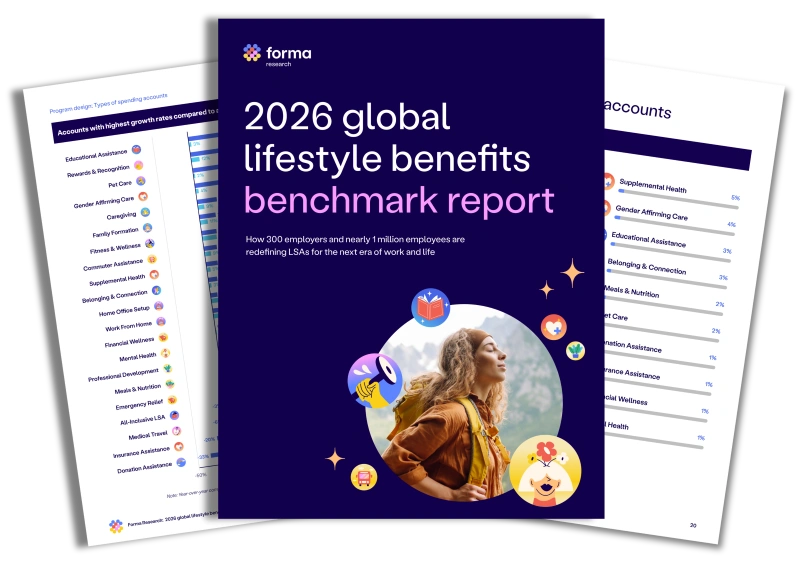
Third, the market has already moved. Consolidation is becoming the norm among leading employers. According to Forma's 2026 global lifestyle benefits benchmark report, 97% of companies have centralized multiple pre-tax accounts on a single platform, 58% have unified multiple post-tax spending accounts, and 21% have consolidated pre-tax and post-tax benefits on a single platform.
Why it matters
Fragmentation isn't just untidy — it quietly taxes everyone it touches.
For benefits and total rewards teams, every added vendor means another contract to negotiate, another renewal to manage, another data feed to reconcile, and another point of stress at open enrollment. Administrative time that should go toward strategy gets spent on coordination.
For employees, sprawl shows up as confusion. Only 42% of employees feel confident navigating their benefits, yet 78% say they're more likely to engage when they understand how those benefits meet their personal needs (WTW). A dozen logins and a dozen sets of rules make that understanding harder to reach — and benefits no one can find are benefits no one uses.
For finance, point solution sprawl means scattered spend and a fractured view of it. With programs spread across many vendors, every contract has to be tracked and renewed on its own timeline, spend has to be pulled from multiple systems, and overlap between solutions that quietly do the same thing is hard to even spot. That makes it difficult to forecast, difficult to see what's actually being used, and difficult to prove the value of the investment.
What it looks like when it's working
When consolidation works, employees feel it as simplicity and your team feels it as relief: variety without complexity, choice without confusion. It doesn't flatten your benefits into a single generic account; it brings a portfolio of dedicated, use-case-specific accounts into one coherent experience, with a consistent front door on top and funding and rules that flex by market underneath.
For employees, that means one place to go, one set of ways to pay — with Forma, that is the Forma Store, the Forma Card, and claims — and clear guidance toward the benefits meant for them. For the benefits team, it means one platform to administer, one source of reporting, and far less time lost to reconciliation. For finance, it means one view of spend and a predictable, defensible budget.
Logitech is a useful picture of what that shift feels like. By moving to Forma, the company consolidated down from more than 30 point solutions and saved 9.5 weeks of administrative time, while giving employees a more cohesive set of benefits across dozens of countries.
What you can consolidate on Forma
Forma can cover more than you may have realized.
The Forma platform is the flexible foundation for a variety of benefit types:
- Lifestyle Spending Accounts (LSAs)
- Health Savings Accounts (HSAs)
- Flexible Spending Accounts (FSAs), including DCFSA and LPFSA
- Commuter
- Health Reimbursement Arrangements (HRAs)
- COBRA
- Rewards & Recognition
Additionally, across these benefit structures, Forma enables you to address a multitude of use cases, business priorities, and employee needs, including:
- Well-being and wellness, including gym reimbursements
- Education & tuition support
- Caregiving
- Family formation
- Weight management
- Professional development
- Home office & connectivity
- Medical travel
- International healthcare
- …and more
The takeaway
The instinct to offer more — more programs, more support, more ways to care for your people — was never the problem; running all of it in isolation was.
Strategic benefits consolidation lets you keep the breadth your workforce needs while giving your team, your employees, and your finance partners something separate systems can't: a benefits experience that's actually connected. If consolidation is already on your radar, the real question isn't whether to simplify, it's how much of what you already offer you can bring together in one place.
On Forma, the answer is likely more than you think.
.png)


.png)