













Why large global employers choose LSAs for scalable benefits design
Enterprise companies like Microsoft, Logitech, and Tripadvisor use Forma for global lifestyle benefits. See why enterprise employers are moving to Forma.
In this piece
Quick answer: Large global employers choose Lifestyle Spending Accounts because LSAs let them deliver personalized, high-engagement benefits globally without increasing vendor complexity.
A global employer managing benefits across 20 countries faces a fundamentally different challenge than a domestic team supporting a single market. The difference isn't just scale.
It's the operational reality of contracting with dozens of different vendors across countries, each with separate renewals, separate integrations, separate dashboards, and no consolidated view of how benefits are performing globally. That model is costly, time-consuming, and nearly impossible to report on in a meaningful way.
A global LSA platform with flexible program and account design changes the equation entirely. Instead of sourcing a new vendor for every market and every benefit category, employers design configurable accounts through one platform that includes cost-of-living adjustments, local currency support, country-level configuration, and consolidated reporting.
Benefits teams get budget visibility across markets. Employees get locally relevant support through a connected experience. And the organization avoids the vendor sprawl that turns benefits strategy into vendor management.
This is the model that companies like Microsoft, Logitech, and Tripadvisor have adopted, and this article breaks down why it works, what these companies actually did, and what it means for global employers looking to build scalable employee benefits programs for the next plan year.
Key takeaways
- Point solutions increase complexity as organizations grow globally. Large employers often manage dozens of separate benefit vendors across countries, each with its own integration, reporting, and employee experience.
- Enterprise employers like Microsoft, Logitech, and Tripadvisor use Forma's platform to deliver personalized benefits across large global workforces, with measurable results in consolidation, engagement, and budget visibility.
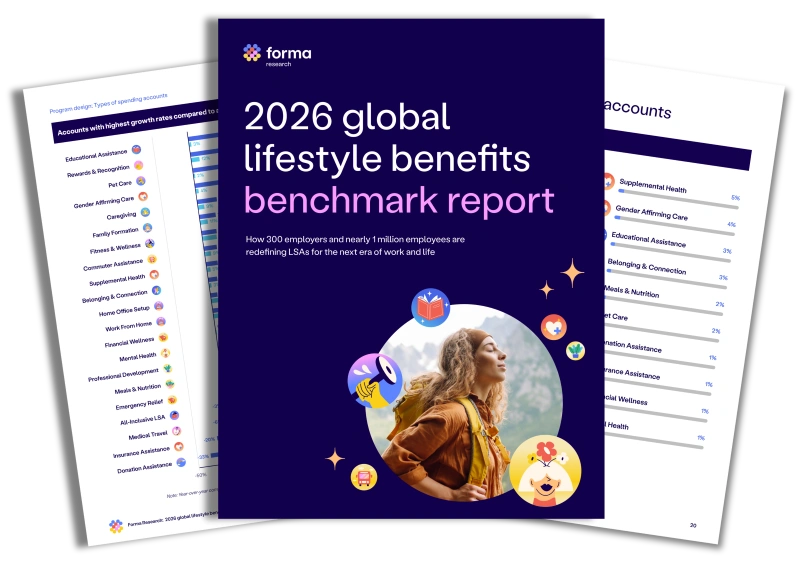
- Half of employers using LSAs now offer them in more than one country, according to Forma's 2026 global lifestyle benefits benchmark report.
- Forma powers global lifestyle benefits for hundreds of employers across 110+ countries. Schedule a demo today to see how the platform scales with your organization.
The global scalability problem with traditional benefits design
Before looking at solutions, it's worth naming the problem clearly. Many global employers already have messy, fragmented benefits systems with multiple vendors, regional complexity, and limited consolidated reporting.
The traditional approach has been additive: identify a new employee need or take on a new employee population, source a vendor, negotiate a contract, integrate with the HRIS, and launch the program.
Do that enough times across enough countries and you end up with a benefits stack that's virtually unmanageable. This is where the global employee benefits strategy conversation starts for most large employers, not with "what should we offer?" but with "how do we manage what we already have?"
Why benefits point solutions don't scale for global employers
The point solution model was designed for simpler contexts. When an employer operates in a handful of locations with a relatively uniform workforce, a dedicated vendor for each benefit category can work. The benefits team knows every vendor. Employees can find what they need.
For global employers, the same logic produces the opposite outcome. Each point solution has geographic coverage gaps. Each one has eligibility rules that weren't designed for multi-country complexity. Each one requires a separate integration, a separate claims workflow, and a separate renewal cycle that the benefits team has to manage alongside every other vendor in the stack.
The larger and more distributed the workforce, the harder point solution sprawl becomes to manage. What starts as “best of breed” selection becomes a fragmented ecosystem of increasing vendor complexity, disconnected reporting, and a benefits experience that no single person on the team can fully describe. A global benefits platform helps employers design programs across countries without needing a separate vendor strategy for every market. .
The engagement paradox at scale
Here's a pattern that frustrates global benefits leaders: large employers often spend more per employee on benefits than smaller companies, yet see lower employee engagement with those programs. The complexity of navigating multiple systems, each with its own portal and its own claims process, discourages employees from engaging with any of them.
Gallup's 2026 State of the Global Workplace report found that global employee engagement fell to 20% in 2025, its lowest level since 2020. Benefits programs that add friction rather than remove it contribute to that disengagement. For enterprise benefits platform decisions, the data suggests a clear pattern: simplicity at scale drives engagement. Complexity at scale undermines it.
A benefit that employees can't easily find and use is a benefit that doesn't exist in practice. When a Lifestyle Spending Account is designed with flexibility and delivered through one cohesive experience, engagement follows. The LSA enterprise model works precisely because it removes the friction that fragments the employee experience across dozens of disconnected tools.
Global equity as a design requirement, not an afterthought
For large multinational employers, global equity isn't a nice-to-have. It's a values commitment that shows up directly in how benefits are designed. A U.S.-centric program exported to a global workforce with no local adaptation produces unequal outcomes. Some employees get a robust benefit. Others get a nominal allocation that doesn't reflect their local cost of living or the support available to them.
Forma's 2026 global lifestyle benefits benchmark report shows that half of employers using customizable spending accounts now run them in more than one country. The U.S. leads in all-inclusive LSA adoption at 58%, but the highest-engagement markets globally are the ones where the program was adapted to feel meaningful in local context, not just translated from a domestic template.
Geographic equity means giving employees benefits that are equally meaningful relative to where they live and what things cost there. It does not mean giving every employee the exact same dollar amount or identical category access. Forma supports this through cost-of-living adjustments, local currency support, and country-level configuration that lets benefits teams design programs across markets without needing a separate vendor strategy for every geography.
How leading global employers are using LSAs
Some of the world's most recognizable companies have already made the move to a Lifestyle Spending Account platform. These examples show what this transition looks like in practice, not just in principle. Each employer faced a different version of the scalability challenge, and each used Forma's platform to solve it in a way that matched their workforce and priorities.
Microsoft: personalizing Well-being benefits at scale
Microsoft represents the enterprise benchmark for lifestyle spending account large employer implementation. With 220,000+ employees across 100+ countries, the company needed a Well-being benefit that could personalize at the individual level while maintaining administrative simplicity at massive scale.
Microsoft had been using a reimbursement vendor for health-related expenses, but when that vendor sunset its platform, the company partnered with Forma to build something more ambitious. Microsoft expanded its wellness framework beyond physical fitness to cover mental, emotional, and financial well-being, then increased the U.S. reimbursement limit from $800 to $1,500 per year.
The program, known internally as Perks+, needed to be tax-compliant and integrated with payroll systems in 100+ countries. Forma delivered that infrastructure while enabling market-specific funding equivalencies based on local cost of living. The result was a global employee benefits program that felt locally relevant everywhere Microsoft has people.
Read the full Microsoft wellness benefits case study for the complete story.
Logitech: delivering personalized benefits across a global workforce
Logitech's challenge was a textbook case of point solution sprawl and the "more is more" paradox. Over time, the company had accumulated 30+ separate benefit tools, each serving a different employee need in a different market. The administrative overhead was enormous, and the employee experience was fragmented.
By consolidating several programs onto Forma's platform, Logitech replaced that vendor patchwork with a connected benefits experience that funds employee choice across geographies. Instead of trying to anticipate what employees in each market would need, and sourcing a vendor for each prediction, Logitech funded dedicated accounts and let employees direct spending toward the categories that matched their actual lives.
The result was a benefits experience that traveled across borders without requiring country-by-country vendor sourcing. Benefits teams got consolidated reporting and a single admin interface. Employees got one cohesive experience that worked regardless of where they were based.
Read the full Logitech LSA case study for the complete story.
Tripadvisor: maximizing employee choice in a distributed workforce
Tripadvisor's distributed workforce presented a different version of the scalability challenge. Employees spread across many locations, each with different preferences, different needs, and different definitions of what a meaningful benefit looks like.
A traditional model would have required Tripadvisor to source solutions market by market, an approach that doesn't scale without adding proportional administrative complexity. Instead, the company partnered with Forma to deploy an LSA and pre-tax accounts through one platform, giving employees meaningful flexibility regardless of where they're based.
The flexibility of the model solved for geographic variability without requiring Tripadvisor's benefits team to manage the logistics of every local market. Forma handles the reimbursement and compliance infrastructure behind the scenes.
Read the full Tripadvisor flexible benefits case study for the complete story.
What to expect when moving from point solution sprawl to an LSA platform
The concept of consolidation is appealing. The logistics of actually making the switch is where most benefits leaders have questions. For large employers in particular, the transition involves real change management: existing vendor contracts, employee communications, HRIS integration, and internal alignment on whether a single platform can really replace multiple specialized tools. Here's what the process looks like at a strategic level.
The consolidation process
After consolidating point solutions into a configurable platform like Forma, the administrative relief is significant. Instead of managing dozens of vendor portals with separate renewal cycles, benefits teams manage one platform with Forma doing the heavy lifting. The value is not only personalization for employees. It is also consolidated administration, budget visibility, and program control for benefits teams.
SHRM data shows that 38% of companies plan to add or are considering adding an LSA. For those companies, the consolidation pathway is well-tested. Forma has onboarded hundreds of organizations, including many multi-country implementations. Teams considering a move can start by mapping their current vendor landscape against Forma's 5 Cs framework, which outlines the five elements that modern, scalable benefits programs need to succeed.
HRIS integration and data infrastructure
At enterprise scale, integration with the HRIS is non-negotiable. Employee eligibility, enrollment, and funding need to flow through existing data infrastructure, not live in a separate system that requires manual reconciliation.
Forma integrates with Workday, BambooHR, UKG, ADP, and other major HRIS platforms. That means employee data syncs automatically: new hires get enrolled, terminations get processed, and funding adjustments happen without manual file uploads. For large employers, eliminating manual data reconciliation removes a compliance risk that compounds as headcount grows.
On the security side, Forma is SOC 2 certified, GDPR compliant, and adheres to WCAG accessibility standards. These are the baseline credentials that global benefits design at enterprise scale requires.
Employee communication and adoption
The shift from multiple point solutions to a global lifestyle benefits platform is a change management moment. Employees who have been navigating separate portals for different benefits need to understand that everything is now in one place, and they need to experience that simplicity firsthand.
Forma's interface is designed for adoption with minimal training. The platform earns recognition for its UI/UX because the experience is intuitive enough that employees engage without needing a walkthrough. That design philosophy is reflected in the numbers: Forma maintains a 78% monthly utilization rate across its platform, along with a 75 NPS, 98 CSAT, and 98% customer retention rate. Forma is also one of TIME's 2026 America's Top WorkTech Companies and consistently earns leader rankings in G2 reports.
For benefits and total rewards teams, the communication strategy matters as much as the technology. The most effective rollouts pair the platform launch with clear messaging about what changed, what's now easier, and where to go for help.
With configurable account structures, cost-of-living adjustments across 110+ countries, and nearly 1 million members, Forma turns the complexity of global benefits program design into a straightforward, data-backed process. Whether the goal is consolidating vendors, improving budget visibility, or delivering locally relevant support to a distributed workforce, Forma helps benefits teams move from fragmented vendor management to intentional program design with clearer employee benefits ROI.
Global lifestyle benefits that scale with your organization
The employers who get large-scale global benefits design right have something in common: they stopped trying to anticipate every employee need through vendor selection and started building infrastructure for employee choice instead. Microsoft, Logitech, and Tripadvisor aren't outliers. They're leading indicators of where enterprise benefits design is heading.
Forma's 2026 benchmark data shows that LSAs deliver meaningful, predictable engagement globally when programs are designed with intent. The platform model consolidates Benefits administration while supporting benefits equity and giving employers clearer visibility into how funds align with workforce priorities. For employers building scalable employee benefits programs that need to work across geographies, employee segments, and the inevitable changes that come with organizational growth, Forma's model is the choice that scales globally.
Instead of treating benefits as a growing list of disconnected vendor contracts, the strongest global programs are building connected portfolios of dedicated benefits wallets through one configurable platform. Whether the priority is Well-being, caregiving, family formation, or professional development, each account can be purpose-built around specific workforce needs, funded intentionally, and managed through a single admin experience.
That's the model these companies chose, and it's available to any employer ready to design benefits for the next plan year with more intention and less complexity. Schedule a demo today to see how your organization can build a more scalable, configurable benefits program for the next plan year.
FAQs about LSAs for large and global employers
How does Forma handle benefits administration for employees in multiple countries?
Forma operates in 110+ countries with automatic currency conversion, multiple languages, and cost-of-living adjustment guidance to support local nuances. Employers can set funding levels by country or region, configure eligible expense categories by market, and deliver the entire program through a single admin dashboard. Employees in every market access their benefits through the same platform, with a cohesive experience regardless of location.
Can we run multiple account types for different employee populations?
Yes. Forma supports multiple wallet configurations within a single platform. Employers can create separate accounts for categories like Well-being, family formation, professional development, and caregiving, then configure which wallets are available by country, department, or employee group. This gives large employers the control of targeted, use-case-specific accounts with the simplicity of one connected employee experience.
What does consolidated reporting look like for a global program?
Forma's admin platform provides real-time analytics and dashboards covering fund usage, spending categories, and engagement by employee segment across all markets. Benefits teams can see which accounts are being used, where funds are going, and how different programs are performing, all from one dashboard rather than pulling reports from multiple vendor portals.
How does Forma support cost-of-living adjustments across markets?
Forma can automatically adjust funding allocations by country or region to reflect local cost of living, with currency conversion built into the platform. This means a benefits allocation in Singapore can be calibrated differently than one in São Paulo, ensuring the benefit feels equally meaningful to employees in both markets without requiring manual calculations from the benefits team.
How long does implementation take for a large employer?
Reach out to Forma to discuss the implementation process and any questions specific to your organization's timeline and complexity.
This article is for informational purposes. Forma is not engaged in the practice of law. Nothing contained herein is intended as tax or legal advice nor to replace tax or legal advice from counsel. If you need tax or legal advice, please consult with counsel or a certified tax professional.
.png)
.png)

.png)
.png)
