













How employers can solve the GLP-1 cost conundrum with HRAs and LSAs
Manage GLP-1 adoption costs by pairing HRAs for medications with LSAs for lifestyle support. See the 5-step approach.
In this piece
Quick answer: Employers can manage GLP-1 costs by pairing a dedicated HRA for the medication with a Lifestyle Spending Account for nutrition and lifestyle support, all delivered through Forma as one connected platform.
GLP-1 medications went from a niche diabetes treatment to one of the largest new line items in employer health spend in just a few years. Employees are asking why the drugs aren't covered, finance is asking why pharmacy costs keep climbing, and benefits teams are caught between the two.
The options on the table usually look binary: absorb the full cost through the health plan or drop coverage and deal with the fallout. There is a third path that gives benefits leaders real control over eligibility, budget, and outcomes, and it starts with choosing the right account structures.
Key takeaways
- GLP-1 coverage is now a board-level benefits issue, with nearly eight in 10 employers involving executive leadership in coverage decisions.
- Pairing an HRA for the medication with a Lifestyle Spending Account for lifestyle support replaces an open-ended pharmacy line with a defined, forecastable budget.
- Guardrails around eligibility, clinical pathways, and coverage duration keep GLP-1 programs sustainable and defensible to finance.
- Measuring engagement, utilization, and clinical outcomes separately tells you whether the program is working, not just what it costs.
- Forma brings HRAs and Lifestyle Spending Accounts together in one platform across 110+ countries, so you can run both sides of a GLP-1 program without adding vendors. Schedule a demo with Forma today to start designing yours.
What is GLP-1 adoption and why it's forcing employers into hard coverage decisions
GLP-1 adoption refers to the rapid growth in employees using GLP-1 medications such as Ozempic, Wegovy, Mounjaro, and Zepbound, and the coverage decisions employers now face as a result. Drugs once prescribed mostly for type 2 diabetes are in heavy demand for weight management, and the spend has grown fast enough to reshape how benefits teams approach weight loss spend altogether.
The numbers explain the tension. In a Business Group on Health 2026 survey, only 72% of employers currently covering GLP-1s for weight management said they were likely to continue that coverage into 2027, while 10% said they likely would not. The same research found that nearly eight in 10 employers now bring executive leadership into GLP-1 coverage decisions.
WTW research reported by BenefitsPRO tells a similar story. About 66% of large employers surveyed cover GLP-1s for obesity treatment, but 12% of those say they are likely or very likely to drop that coverage, and another 18% are somewhat likely.
The framing of "cover everything or cover nothing" is what makes the decision feel impossible. A structured HRA for the medication, paired with an LSA for the lifestyle support around it, gives employers cost control and compliance guardrails, while employees get a better shot at lasting clinical results.
How to structure GLP-1 coverage for employees in 5 steps
Most GLP-1 cost problems trace back to three design gaps: unbounded eligibility, no clinical pathway, and no lifestyle infrastructure around the medication. The five steps below close those gaps in order, from measuring the problem to managing the program.
Step 1: Quantify current and projected GLP-1 exposure
Start with your own pharmacy and medical claims data rather than vendor projections. Count active GLP-1 users, separate diabetes prescriptions from weight management prescriptions, and model spend over the next three years under your current eligibility rules.
This baseline matters because every later decision, from coverage philosophy to budget caps, depends on knowing your real exposure. A three-year model with clinical segmentation also gives finance something concrete to react to instead of headlines.
Step 2: Define your GLP-1 coverage philosophy
Decide whether coverage will be broad, targeted to defined clinical criteria, or tiered by program participation, and write the rationale down. With executive leadership involved in most GLP-1 decisions, an undocumented philosophy tends to unravel the first time costs spike.
Structured evaluation criteria help here. Benefits advisors are publishing tools like this five-pillar model for comparing metabolic health solutions, which can keep vendor conversations focused on outcomes rather than demos.
Step 3: Choose the right account structure
This is where a GLP-1 HRA earns its place. An HRA is an employer-funded account for qualified medical expenses, which makes it the appropriate structure for the medication itself in the US: you define the budget, the eligibility rules, and the plan documentation, and reimbursements stay within those boundaries. A dedicated weight management HRA can house the medication benefit, while specialty HRAs extend the same structure to adjacent medical needs.
The lifestyle support around the medication belongs in a Lifestyle Spending Account. Employers enable categories such as nutrition coaching, fitness, and weight management programs, and employees choose the well-being support that fits their situation.
The two accounts serve different purposes, but employees should not feel that difference. A one platform, multi-wallet approach means one login and one cohesive experience, with each account configured around its own purpose and funding strategy.
Step 4: Build eligibility, clinical pathway, and duration guardrails
Open-ended coverage with no clinical pathway is the single biggest driver of runaway GLP-1 spend. Guardrails worth documenting before launch include:
- Eligibility Criteria: Clinical thresholds and prior authorization requirements, set with your medical carrier or clinical partner.
- Program Participation: Enrollment in nutrition, coaching, or weight management support as a condition of medication coverage.
- Duration Rules: Defined coverage periods with documented continuation criteria rather than indefinite approvals.
- Transition Support: A plan for employees who taper off the medication, so lifestyle support continues after the prescription ends.
These rules do more than contain cost. They give employees a clear path through the program and give your benefits team a defensible answer when leadership asks how coverage is controlled.
Step 5: Set measurement standards and review cycles
Measure engagement and utilization as separate signals. Engagement is the percentage of eligible employees who use the benefit at all, while utilization is the percentage of allocated funds actually spent, and conflating the two hides real program performance.
Track clinical outcomes where your data partners allow it, including weight change, A1C improvement, and program completion rates. On the financial side, watch cost per member per month and compare actual spend against the budget you set.
Notional funding makes that comparison meaningful. Because employers only pay for the dollars employees actually use, actual spend lands below the full allocation, and that gap is worth tracking against your original forecast.
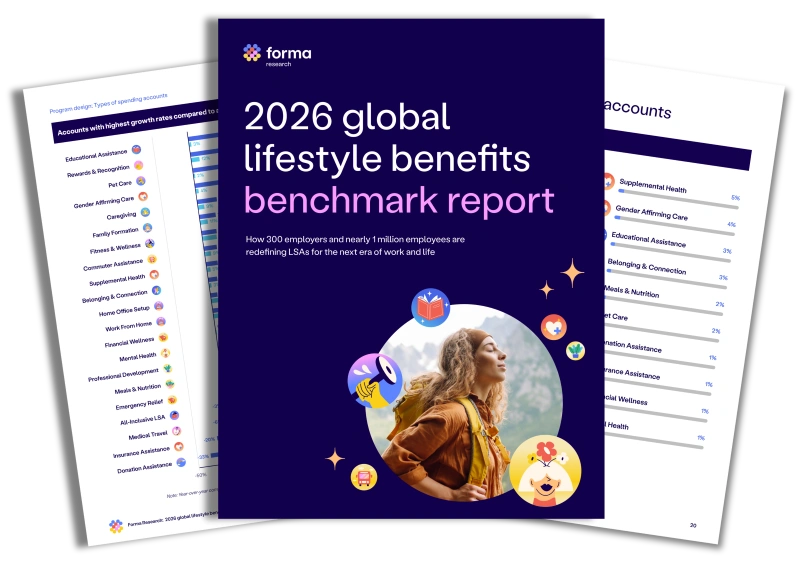
Benchmark data turns this into a simple planning model: median funding per employee, multiplied by expected utilization rate and headcount. In one example, a $600 Fitness & Wellness allocation at 71% utilization works out to $426 in actual spend per employee, which comes to $2.13 million across 5,000 employees rather than an assumed $3 million. You can read more statistics like this in our 2026 Forma benchmark report.
Running this architecture day to day is where Forma comes in. Forma unifies pre-tax accounts, HRAs, and Lifestyle Spending Accounts in one employee experience, so a GLP-1 program's medical and lifestyle components live behind a single login.
Schedule a demo today to see how both accounts work together in practice.
Here is how the five steps fit together at a glance.
Benefits of using HRAs and LSAs to support employees on GLP-1 medications
Separating the medication from the lifestyle support is more than an administrative choice. It shapes how employers support employees on GLP-1 medications day to day, and it matches where priorities already sit: 96% of employers view well-being as central to their workforce strategy, according to the 2026 Forma benchmark report. The structure creates distinct advantages on both sides of the program.
- Cost Predictability: The HRA carries a defined budget and eligibility scope, so finance forecasts a known number instead of absorbing whatever the pharmacy invoice says next quarter.
- Notional Funding: Employers pay only for the dollars employees actually use, which turns an assumed maximum spend into a realistic projection.
- Stronger Clinical Outcomes: GLP-1s work best alongside lasting habit change, and LSA funding for nutrition coaching and weight management programs gives employees that surrounding support.
- Retention Signal: Offering structured GLP-1 support at a moment when many employers are pulling back tells employees their well-being is a real priority.
- Cleaner Reporting: Medical HRA data and lifestyle LSA data stay in their own lanes, giving benefits teams category-level budget visibility instead of one blended line item.
- Global Consistency: Multinational employers can support GLP-1-related programs across 110+ countries with the right account structure for each market and one cohesive employee experience.
The cost pressure behind this design is not easing. Mercer’s research recently found that 77% of large employers said managing overall GLP-1 costs is extremely or very important, with weight loss GLP-1s priced above $1,000 per month before rebates. A defined medication budget paired with flexible lifestyle support lets benefits teams keep saying yes without losing control of the number.
The table below summarizes how each account contributes to the program.
How Forma supports employers building GLP-1 HRA and LSA programs
For benefits teams ready to move from philosophy to program, Forma is the execution layer for steps 3 through 5. Forma manages the HRA structure for GLP-1 medications, including plan documentation, eligibility rules, and claims compliance, and supports the companion Lifestyle Spending Account for Well-being, nutrition, and weight management programs.
Employees get one connected experience, while your team gets purpose-built accounts with separate budgets and reporting for medical and lifestyle spend.
Schedule a demo today and build a GLP-1 benefit your employees value and your finance team can stand behind.
FAQs about GLP-1 adoption and employer coverage
These answers cover the questions benefits teams ask most often when planning GLP-1 coverage and the account structures behind it.
Can an HRA cover GLP-1 medications?
In many cases, yes. An HRA reimburses qualified medical expenses, and prescription medications typically fall within that definition when the plan is designed to include them. The right structure depends on plan documentation, eligibility rules, and compliance requirements, so employers should confirm coverage details with counsel or a benefits compliance expert before launch.
What is the difference between health plan coverage and a GLP-1 HRA?
Health plan coverage folds GLP-1 costs into the medical or pharmacy benefit, where spend flows through claims experience with limited employer control. A dedicated HRA gives the employer a defined budget, its own eligibility criteria, and separate reporting, which makes GLP-1 spend easier to forecast, cap, and evaluate on its own terms.
How much does GLP-1 coverage cost employers per employee?
Costs vary widely based on drug mix, rebates, eligibility criteria, and duration rules, with list prices for many weight loss GLP-1s topping $1,000 per month before rebates. Program design matters more than the sticker price, since defined budgets, clinical pathways, and notional funding all shape what an employer actually spends.
Should employers require lifestyle program participation with GLP-1 coverage?
Many employers now tie medication coverage to participation in nutrition, coaching, or weight management programs. The pairing supports better long-term outcomes and demonstrates intentional program design to leadership. Requirements should stay realistic and consistently applied, since overly strict conditions can discourage the employees who would benefit most from the medication.
What happens when an employee stops taking a GLP-1 medication?
Weight regain after discontinuation is commonly reported, which makes the transition period a defining program design moment. Duration rules should include continuation criteria and a taper plan, and lifestyle support through a spending account can continue after the prescription ends so employees keep access to nutrition and fitness resources.
How are employers structuring GLP-1 benefits for 2027?
The dominant pattern is maintaining coverage with tighter guardrails rather than dropping it outright. That usually means documented eligibility criteria, required program participation, defined coverage durations, and executive involvement in the decision, along with dedicated account structures that separate medication costs from lifestyle support for clearer visibility into both.
This article is for informational purposes. Forma is not engaged in the practice of law. Nothing contained herein is intended as tax or legal advice nor to replace tax or legal advice from counsel. If you need tax or legal advice, please consult with counsel or a certified tax professional.
.png)
.png)


.png)
.png)