










How to evaluate employee well-being platforms
A benefits-team framework for evaluating well-being platforms across scope, global coverage, account structure, and reporting.
In this piece
Quick answer: The best employee well-being platforms for benefits teams fund and administer Well-being benefits through purpose-built wallets, with global coverage and reporting that shows finance what the spend delivers.
Every vendor in this category calls itself a well-being platform. Most are point solutions, such as a fitness marketplace, a meditation app, or a challenges tool, that solve one slice of the problem while the rest of the program lives somewhere else.
Benefits leaders end up stitching together a growing stack of separate contracts to build what should be one Well-being program. Meanwhile, engagement stays flat and finance keeps asking what the collective spend is buying.
This guide is written for benefits teams, not as a well-being roundup. The right choice depends on whether you are buying a content library, a fitness marketplace, or benefits infrastructure that funds and administers Well-being spend.
Key takeaways
- The well-being platform market splits into three categories: content and app libraries, fitness marketplaces, and benefits infrastructure. Most benefits teams need the third but end up buying one of the first two.
- Engagement, the share of eligible employees who use the benefit at all, is the metric that reveals whether a platform is working. A content library with 15% engagement is not outperforming a benefits platform with 85% engagement.
- Point solution sprawl is the real cost problem. Consolidating several well-being vendors into one platform reduces administrative burden and gives finance a clearer view of spend.
- Global capability matters more than most vendors admit. Country coverage, local currency support, and cost-of-living adjustments separate enterprise-grade platforms from US-only tools with international pricing pages.
- Ready to build a Well-being program your workforce will actually use? Schedule a demo today to see how Forma consolidates Well-being benefits into one configurable platform across 110+ countries.
What is an employee well-being platform?
An employee well-being platform is software an employer uses to fund, deliver, and administer well-being benefits for its workforce. The label covers three very different products: content and app libraries that supply programming, fitness marketplaces that supply network access, and benefits infrastructure that supplies funded accounts with claims, compliance, and reporting behind them.
The distinction matters because spend and perception are drifting apart. Fewer than one in four US employees strongly agree their organization cares about their overall well-being, according to Gallup research, even as employers keep adding programs.
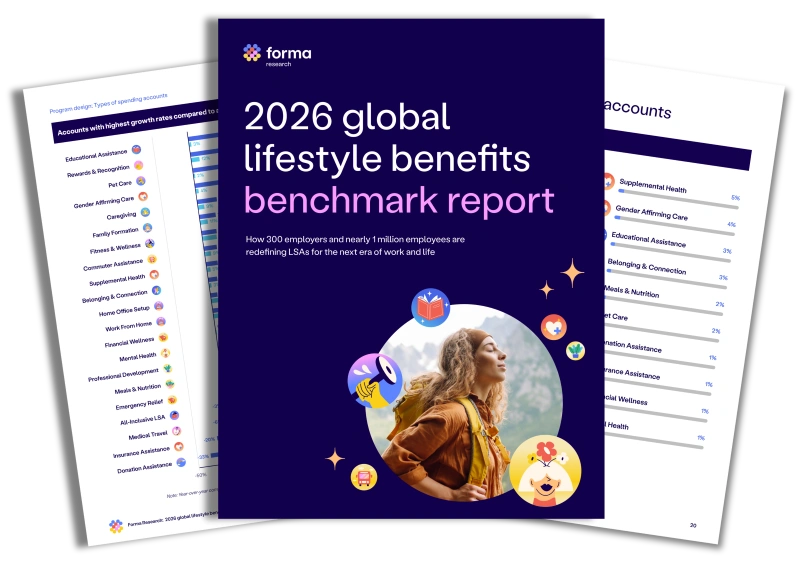
The employer side of the data tells a different story about intent. In Forma's benchmark data, 96% of employers view well-being as central to their workforce strategy, and Fitness & Wellness accounts run through a benefits platform show 71% budget utilization, meaning roughly seven of every ten allocated dollars are spent while actual cost stays below the full allocation. You can read more statistics like this in our 2026 Forma benchmark report.
Closing that gap between intent and perception is a program design problem before it is a software problem. Strong employee well-being programs start with structure, so it helps to design a well-being program around the outcomes you want to fund before comparing vendors.
How to evaluate well-being benefits platforms
Six factors do most of the work when a benefits team shortlists well-being vendors. Each one maps to a real operational question your team, your finance partner, or your workforce will ask, so the criteria below are worth working through in order before any demos are scheduled.
Program scope
Well-being is not one benefit; it is a category that spans fitness, mental well-being, financial well-being, professional development, and family support. A platform built for a single slice, whether that is meditation content or a gym network, forces benefits teams to bolt on separate vendors for everything else. Look for platforms that can fund and administer multiple workforce priorities in one place, so the program can grow with your strategy instead of your vendor list.
Global coverage
For distributed workforces, coverage across countries is only the starting point. Real global capability includes local currency support, cost-of-living adjustments so funding stays equitable across markets, and native language support rather than automated translation. Ask vendors for a country list, and confirm that features like claims processing, compliance handling, and reporting work the same way in every market you operate in.
Account structure flexibility
Well-being spend does not fit neatly into one account type. Some categories, like fitness memberships or meditation apps, run through Lifestyle Spending Accounts, while others intersect with tax-advantaged accounts such as HSAs, FSAs, or HRAs. Platforms that support multiple account structures, including multi-wallet configurations with different funding rules per category, give benefits teams room to design programs around actual employee needs rather than software constraints.
Administrative burden
Every additional well-being vendor adds a contract, an integration, an invoice, and a login for your benefits team to manage. A platform that consolidates claims processing, HRIS integrations, plan documentation, and compliance support in one place gives that time back. Look for AI-assisted claims review, self-service configuration for wallet changes, and in-house compliance expertise, since those features determine how much administrative work actually leaves your plate.
Reporting and budget visibility
Finance will ask what the well-being budget is buying. The platform's reporting should answer that question with category-level utilization data, engagement metrics broken out from utilization, and forecasting tools that model spend based on real usage patterns. Vague dashboards or aggregate well-being scores make the budget harder to defend, while granular reporting makes the next planning conversation easier.
Employee experience
Even the best-designed program fails if employees cannot use it. Evaluate the login model (one experience versus a separate app for every vendor), the mobile experience, the spending options (card, marketplace, claims reimbursement), and the time it takes an employee to actually receive a benefit. Employee experience is what drives engagement, and engagement is what makes the program worth the spend.
Here is how the six criteria come together as a shortlist checklist.
How Forma meets these evaluation criteria
Forma sits in the third category above: benefits infrastructure for funding, administering, and measuring Well-being spend at scale. That positioning maps directly to each of the six criteria.
- Program scope: Configurable benefits wallets sit on one platform, so a Well-being wallet can run alongside other purpose-built accounts such as learning and professional development, family support, and home office, without adding a separate vendor for each category.
- Global coverage: Forma operates across 110+ countries with local currency support, cost-of-living adjustments, and native language support built into program design.
- Account structure flexibility: Lifestyle Spending Accounts, HSAs, FSAs, HRAs, and Commuter accounts run through the same platform, with multi-wallet configurations that let each category carry its own funding strategy and eligible expenses.
- Administrative burden: AI-assisted claims review, HRIS integrations, 24/7 member support, and in-house compliance expertise take the day-to-day work off benefits teams. Logitech, for example, saved 380 admin hours annually after consolidating multiple point solutions onto Forma.
- Reporting and budget visibility: Category-level dashboards separate engagement (the share of eligible employees using the benefit) from utilization (the share of allocated dollars spent), so finance sees exactly what each wallet is delivering.
- Employee experience: Employees get one connected experience across three ways to spend, the Forma Store, the Forma Visa Card, and claims reimbursement, rather than a login for every vendor.
Notional funding means employers only pay for the dollars employees actually use, so the platform stays cost-efficient even as engagement grows. Consolidating benefits administration into one contract also removes the renewals, integrations, and invoices that quietly consume benefits-team bandwidth every quarter.
Ready to see how the platform delivers on each criterion for your program? Schedule a demo today and walk through a configured Well-being wallet built for your workforce.
How to choose the right employee well-being platform
The best platform depends on what problem the benefits team is actually solving. Once the underlying question is clear, the shortlist collapses quickly.
The right category maps to the gap you are actually filling:
- Programming and motivation: a content and challenges tool fills it.
- Gym and studio access: a fitness marketplace fills it.
- Funding, administering, and measuring Well-being benefits across a workforce: only benefits infrastructure fills it.
Buying one of the first two categories when the real gap is the third is how vendor sprawl starts.
Accountability is rising alongside the spend. In Business Group on Health's 2025 survey findings, 93% of employers planned to maintain or grow their well-being investments, and 94% said they will raise expectations of well-being vendors to deliver improved outcomes. The money is staying; the tolerance for unclear results is not.
Whichever category you land in, the six criteria above should anchor the shortlist. Program scope determines what you can fund without adding vendors, global coverage determines who the program actually reaches, and account structure and administrative burden determine what your team spends its time on.
How Forma powers Well-being programs for benefits teams globally
Forma is the platform behind some of the most visible Well-being programs in the market. Microsoft scaled its Perks+ benefit across 78 countries with 90% engagement worldwide and Stripe saw more than 95% of employees engage with their benefits at a 99% CSAT score.
With configurable account structures, cost-of-living adjustments across 110+ countries, and nearly 1 million members, Forma turns the complexity of global Well-being program design into a straightforward, data-backed process. Benefits teams get consolidated administration and budget visibility, and employees get one connected experience instead of a login for every vendor.
Give your workforce a Well-being program built on one configurable platform. Schedule a demo today and go into 2027 planning with fewer vendors and clearer results.
Frequently asked questions about employee well-being platforms
These answers cover the questions benefits teams ask most often when comparing well-being platforms and vendors.
What is the difference between an employee well-being platform and a well-being app?
A well-being app delivers content or services in one category, such as meditation or workouts, directly to the individual. A well-being platform is employer-side software that funds and administers benefits across categories, handling budgets, eligibility, claims, and reporting. Many platforms connect to apps, but the platform is the infrastructure underneath.
What features should benefits teams look for in an employee well-being platform?
Prioritize configurable account structures, global coverage with local currency support, claims automation, HRIS integrations, compliance support, and reporting that separates engagement from utilization. The platform should reduce vendor complexity rather than add another login, and its data should help your team forecast spend for the next plan year.
Can one platform replace multiple well-being vendors?
Often, yes. Platforms with configurable wallets and integrated marketplaces let employers fund categories such as fitness, learning, and family support without separate contracts for each vendor. Consolidation reduces renewals, integrations, and invoices while giving employees a connected experience, though specialized clinical services may still warrant dedicated providers.
How do benefits teams measure success of an employee well-being platform?
Track engagement and utilization separately. Engagement is the percentage of eligible employees who use the benefit at all, while utilization is the percentage of allocated funds spent. Healthy programs show broad engagement with utilization that lands near forecast, alongside signals like satisfaction scores and fewer benefits-related support requests.
Are employee well-being platforms tax-advantaged?
It depends on the account structures involved. Lifestyle Spending Accounts are typically post-tax, while HSAs, FSAs, and HRAs can be tax-advantaged when set up under applicable IRS rules. The right structure depends on covered expenses, compliance requirements, and program design, so confirm details with counsel or a certified tax professional.
What is the best employee well-being platform for global companies?
The strongest global platforms combine broad country coverage with local currency support, cost-of-living adjustments, native language support, and country-level configuration. Look for evidence of enterprise deployments across many markets, consolidated reporting across regions, and compliance handling in each country, rather than a US product with an international pricing page.
This article is for informational purposes. Forma is not engaged in the practice of law. Nothing contained herein is intended as tax or legal advice nor to replace tax or legal advice from counsel. If you need tax or legal advice, please consult with counsel or a certified tax professional.
.png)

.png)