










Everything you ever wanted to ask about LSAs
From finding the budget to designing and launching an LSA, Forma's lifestyle benefits experts answer the questions teams ask most.
In this piece
If you’ve been thinking about Lifestyle Spending Accounts, you’ve probably already run into some questions. Where does the budget come from? How often should we fund it? What can employees actually spend on? And once it launches, how do we keep it from turning into a stream of one-off exceptions?
We built our Benefits AMA webinar around exactly those questions. This session was intentionally designed for benefits professionals and consults to "ask us anything," with real questions coming in throughout from teams representing organizations of all kinds.
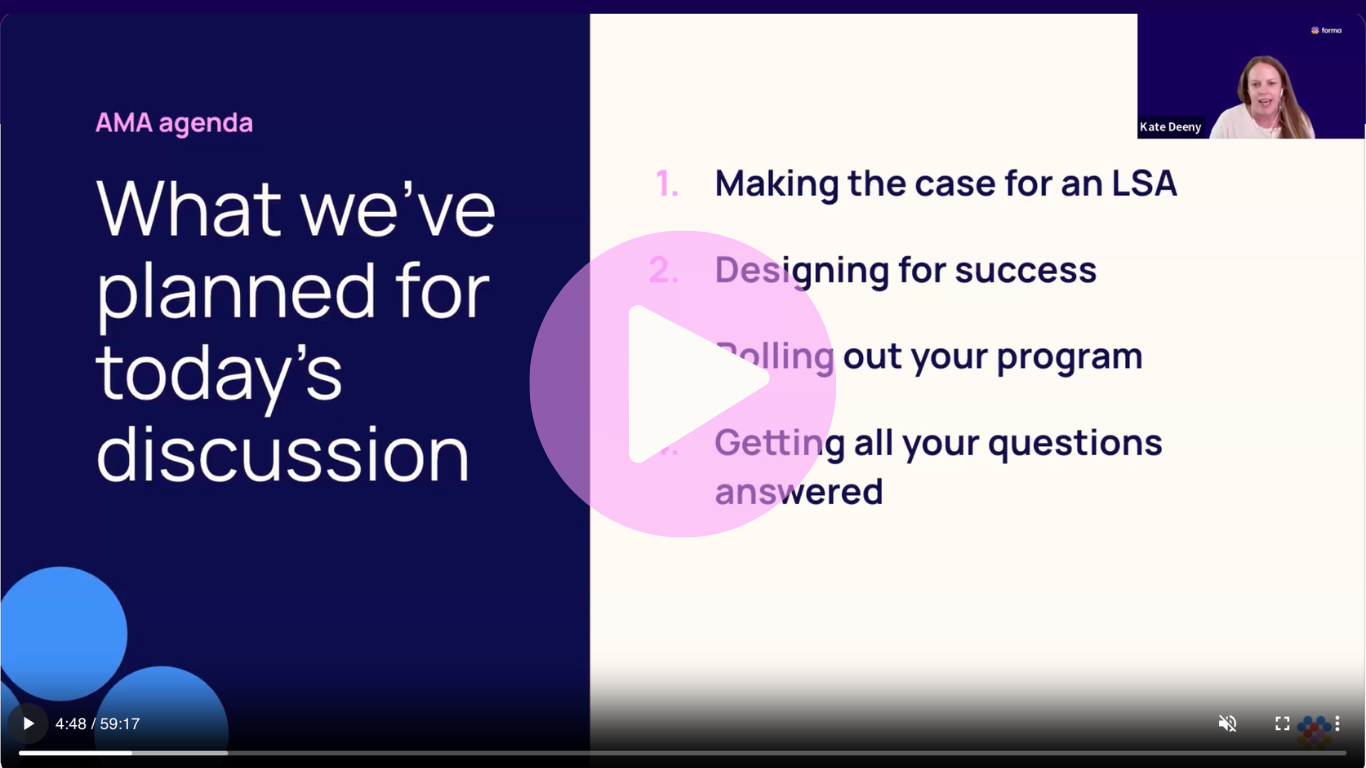
Three Forma experts walked through as many LSA topics we could possibly cover in one hour:
- Morgen Paul, Enterprise Account Executive
- Lindsay Dulude, Lead Customer Education Manager
- Kate Deeny, Lead Customer Success Manager
Here is a look at what each of them covered.
Part 1: Making the LSA business case
The first question most benefits teams ask is the hardest one: where does the budget come from?
Morgen's answer reframes the exercise entirely. Close to 80% of the customers we work with fund their LSA by repurposing budget they already have, not by asking finance for something net new. So the case does not start with "How much will this cost us?" It starts with "Where are we already spending, and is that investment working hard enough?"
The recommended starting point is a benefits inventory and audit, and Morgen made the point that it does not need to be a long, drawn-out process. From there, she framed the case in four moves: a
- Audit what you do today
- Align it to the business problems you are actually trying to solve
- Optimize by asking whether existing dollars could work harder
- Quantify the impact in terms leadership already cares about.
The throughline she kept returning to was "same dollars, better outcomes."
And she grounded all of it with evidence from real programs. A global travel company launched its LSA with zero net-new budget by pulling together stipends and credits that were already scattered across systems. A technology company untangled more than 30 vendors and reclaimed months of administrative time in the process.
An audience member asked a big question that stumps a lot of teams: How do you quantify ROI when an LSA is not a traditional health care benefit? The answer, and the specific numbers behind each of these stories, are worth hearing in Morgen’s words.
Part 2: Designing LSAs for simplicity
Once an LSA budget is approved, the design choices are the ones most teams underestimate, and the ones that ultimately determine whether the program is utilized and valued by employees. Lindsay's guiding principle is to let the platform automate as much as possible rather than layering on manual processes, since one of the advantages of an LSA is that it should lower administrative burden, not add to it.
She organized the conversation around four questions:
- How often should we fund employee accounts?
- How long should employees have to use those funds?
- Should there be a limit on how much they can accumulate?
- What can employees actually spend on?
Each one carries a tradeoff.
Funding cadence, for example, is not just an operational detail; it shapes both employee engagement and your financial exposure, and Lindsay walked through how to think about monthly and quarterly funding versus loading the full annual amount up front. On eligibility, she made a case for working through the edge cases before launch, using a deceptively simple example: if athletic shoes are eligible, what about dancing shoes? Track spikes? Golf cleats? Answering those questions early is what keeps your policy clear and your claim rejections down later.
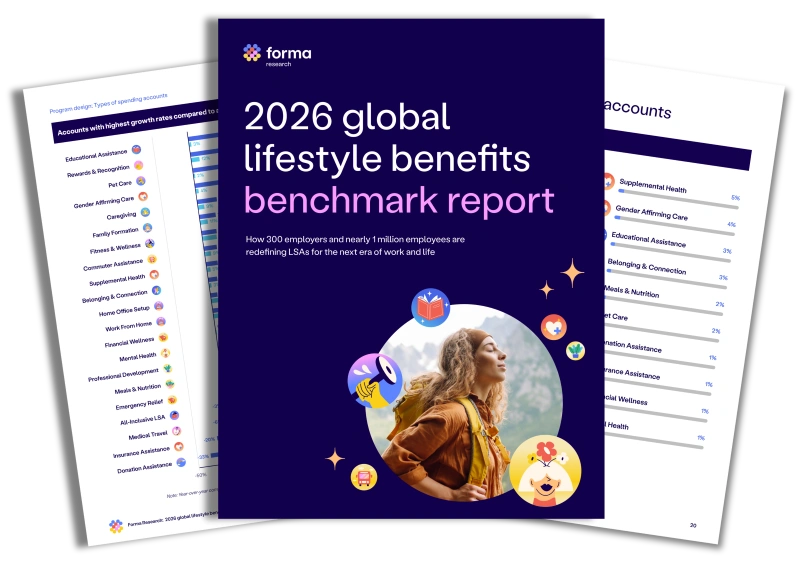
She also brought in Forma's industry-defining lifestyle benefits benchmark data to show how funding amounts and utilization vary across different LSA types, and made a point that tends to reset expectations: utilization is driven far more by how a program is designed than by how much money is in it.
And she and Kate tackled a common audience question: whether to consolidate everything into a single LSA or split it into separate wallets.
Part 3: Mastering the LSA rollout
Even a well-designed LSA program can still stumble at launch. Kate’s section focused on the change management work that ensures a successful start and evolution of an LSA, starting with two communication principles worth building every rollout around: announce the change simply, and point to help resources often.
From there, Kate named the places LSA rollouts commonly go sideways, like making piecemeal changes in the first few weeks or simply rebuilding an old program inside a new platform, and offered better moves for each. She also talked through how to handle the “loud minority” of tough feedback without redesigning the whole program every time someone is unhappy, including sharing a framework for deciding how and when to accept input.
She closed with a simple first-year timeline for turning early data into smart changes by month 12, plus a favorite tactic for keeping managers from giving employees different answers about the same benefit.
Watch Forma’s full Lifestyle Spending Accounts AMA session on demand
We packed a lot into this AMA. If you’re considering an LSA or want expert recommendations on how to uplevel your existing program, the on-demand recording is the fastest way to hear how our team thinks through it, with the real examples, ideas, and benchmarks.
.png)


.png)