










How to design a global lifestyle benefits program: best practices for LSAs in 2026
Design a global LSA program in 2026 using Forma's 5 Cs framework and benchmark data from 300 companies across 110 countries.
In this piece
Quick Answer: The strongest global lifestyle benefits programs combine benchmark-supported planning, local nuance, and configurable account structures that can scale across countries without forcing every employee into the same one-size-fits-all model. Forma helps employers build connected benefits programs through one platform, with purpose-built wallets and account structures designed around workforce needs.
Every global benefits leader designing or revising a Lifestyle Spending Account this year is facing the same challenge. You need a program that works across countries, cultures, and cost-of-living realities, all while hitting utilization targets that justify the budget you fought for. And you need to do it without a clear playbook, because the data shifts every year and what worked in 2024 probably isn't optimized for 2026.
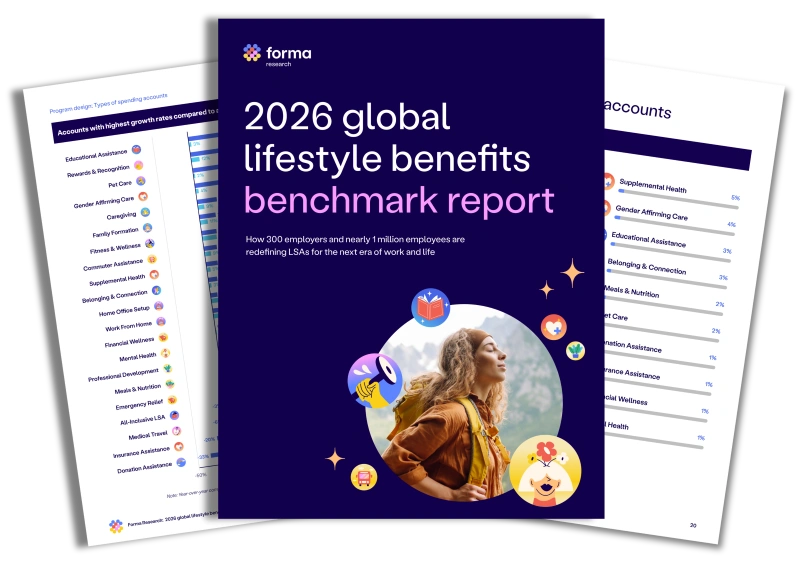
The good news is that the data now exists to make these decisions with confidence. Forma’s 2026 global lifestyle benefits benchmark report draws from nearly 1 million employees across 300 companies in 110 countries, and the patterns it reveals are specific enough to guide real LSA program design decisions: how much to fund across specific use cases, utilization trends, and insight into global and country-specific programs.
This article pairs that benchmark data with a perspective on best-practice global benefits design to give you a practical guide for building a lifestyle benefits program that works for a diverse, global workforce. Whether you're designing your first LSA or auditing one that's been running for a few years, these are the Lifestyle Spending Account best practices that the world’s best employers are using today.
Key takeaways
- Global lifestyle benefits programs work best when they balance scalability with local relevance, giving employees support that feels meaningful in their country, currency, and cost-of-living context.
- Forma’s 2026 global lifestyle benefits benchmark report helps benefits teams make more informed decisions around funding, program structure, utilization, and global benefits strategy.
- The most strategic programs are moving toward purpose-built benefits wallets and account structures that align funding with specific workforce priorities, rather than relying only on one broad all-inclusive LSA.
- Forma’s 5 Cs framework defines five elements of modern benefits design: Comprehensive, Customizable, Curated, Consolidated, and Cost-effective.
- Forma helps employers design connected, configurable lifestyle benefits programs through one platform across 110+ countries. Schedule a demo to start planning your 2027 benefits strategy with benchmark data behind your decisions.
Why this is a pivotal year for LSA program design
The benefits landscape is changing quickly, and 2026 benchmark data gives HR and total rewards leaders a clearer view of how employers are structuring lifestyle benefits across countries, use cases, and employee populations.
The important takeaway is not that employers are dramatically increasing funding across every category. Benefits budgets are already under pressure from rising healthcare and medical plan costs. What the data does show is that more employers are introducing dedicated programs faster, using more intentional account structures, and looking for better ways to understand how employees actually use their benefits.
For global benefits teams, the opportunity is to move from broad assumptions to better design decisions: which benefits to offer, how to fund them, where local adjustments are needed, and how to measure performance in a way that reflects both employee value and budget predictability.
What 2026 benchmark data tells us
Forma’s 2026 global lifestyle benefits benchmark report shows several category-level shifts in how employers are designing lifestyle benefits programs. The strongest signal is not simply higher funding. It is the growing use of dedicated programs that help employers align benefits spend with specific workforce priorities.
Well-being remains Forma’s most important use case and should be treated as a central part of lifestyle benefits strategy. Employers are also investing in areas such as meals and nutrition, rewards and recognition, Professional Development, Caregiving, and Family Formation, but these categories should be interpreted carefully based on how each program is structured.
Utilization also needs nuance. A high utilization rate does not automatically mean a program is performing better. A strong program should be valuable to employees while staying predictable for the employer. If employees use significantly more than the employer forecasted, the program may exceed budget expectations even if the utilization number looks strong.
The real value of benchmark data is that it gives benefits teams a clearer planning baseline. It helps employers understand where programs are gaining traction, how employees are using different benefit categories, and where account design, communication, or local relevance may need to improve.
The global complexity employers are navigating
Global lifestyle benefits design is no longer only about expanding a U.S.-based program into other markets. Employees in different countries experience cost of living, local benefit norms, currencies, and available services differently, which means the same benefit structure will not feel equally useful everywhere.
That does not mean every employer must offer a global program. But for companies with distributed teams, global benefits design requires more than one flat dollar amount and one generic list of eligible expenses.
Forma’s 2026 global lifestyle benefits benchmark report shows that many employers now manage lifestyle benefits across more than one country. The opportunity is to use that data carefully: not as proof that one model works everywhere, but as a guide for designing benefits that feel locally relevant, financially predictable, and aligned with workforce needs.
The 5 Cs framework for global LSA program design
Forma’s 5 Cs are five elements modern, scalable benefits programs need to succeed today and in the future. Together, they help benefits teams design Lifestyle Spending Account programs that are flexible enough for employees, manageable for HR, and aligned with business priorities.
Comprehensive
Comprehensive benefits give employers the ability to address diverse use cases and life stages without asking employees to navigate dozens of disconnected platforms or forcing benefits teams to manage an unwieldy patchwork of vendor relationships.
This does not mean promoting an all-inclusive Lifestyle Spending Account as the default model. Comprehensive design is about breadth with integration, not a broad “spend-on-anything” account. Employers can build dedicated accounts around specific use cases, such as Well-being, Caregiving, Family Formation, and Professional Development, while keeping the full experience connected through one platform.
Customizable
Customizable benefits give organizations the ability to flex and adjust offerings to align with company priorities, reflect company values, and meet the evolving needs of the workforce without being locked into a rigid, one-size-fits-all approach.
For a global Lifestyle Spending Account program, that might mean offering different eligible categories by country, adjusting funding based on cost of living, or configuring dedicated accounts for specific employee groups. The goal is a benefits structure that can evolve as employee needs and business priorities change.
Curated
Curated benefits are thoughtfully organized and presented so employees can quickly understand what is available, why it matters, and how to use it.
A funded account is only valuable if employees can find relevant, helpful options. Curation helps guide employees toward benefits that match their real-world needs, making the experience feel approachable, discoverable, and intentionally designed for them.
Consolidated
Consolidated benefits bring multiple offerings into a single unified experience. Instead of managing separate vendors, point solutions, logins, reporting systems, and cost structures for each benefit category, employers can deliver meaningful support through one platform.
This gives employees a simpler experience while giving benefits teams cleaner visibility into spending, engagement, and program performance.
Cost-Effective
Cost-effective benefits ensure every dollar invested delivers measurable value and genuine impact. The goal is not simply to spend less. It is to understand what employees are using, where funds are going, and whether the program is performing as expected.
Utilization should be interpreted carefully. Higher utilization does not automatically mean better performance if it exceeds what the employer forecasted. A strong program balances employee value with predictable spend, using real usage patterns to optimize future program design and ensure benefits investments translate into meaningful employee support.
With configurable account structures, cost-of-living adjustments across 110+ countries, and data-backed planning, Forma helps employers turn global Lifestyle Spending Account design into a more straightforward, measurable process.
Applying the 5 Cs to a global LSA program
Forma’s 5 Cs framework works at any scale, but global programs introduce specific design decisions that domestic-only programs don't face. Currency differences, local benefit norms, regional cost of living adjustments (COLA), and regulatory variation all shape how each ‘C’ gets applied when you're operating across borders. This section translates the framework into the global employee benefits program context.
Designing for geographic equity, not geographic uniformity
The instinct in many global programs is to give every employee the same dollar amount and the same set of eligible categories. That approach feels fair on paper. In practice, it creates inequity.
The goal isn't geographic uniformity. It's geographic equity: giving every employee a benefit that's equally meaningful relative to where they live and what things cost there.
Forma's cost-of-living adjustment capabilities let employers automatically convert funding to local currencies and adjust allocations by market. That's how you build a flexible benefits funding strategy that feels fair across every geography rather than one that exports a U.S. program and hopes it translates.
Funding decisions in a multi-country program
Different funding levels by country or region can help support global benefits equity and parity. The goal is not to give every employee the same dollar amount. The goal is to make the benefit feel equally meaningful relative to local cost of living, employee needs, and available services.
Start with benchmark data as a planning input, then adjust based on workforce priorities, market differences, and the specific account structures you plan to offer. A Well-being wallet, a Caregiving wallet, and a Professional Development wallet may all require different funding logic because they support different outcomes.
Expected utilization can help employers forecast program cost, but it should not be treated as a simple “higher is better” metric. The ideal utilization rate is one that shows employees are using the benefit while staying aligned with what the employer forecasted at the start of the program.
The key is to make these decisions deliberately. Many global programs default to flat allocations because they are easier to administer, then end up overfunding some markets and underfunding others. Tiered funding by region or cost-of-living band takes more upfront planning, but it produces a program that feels more relevant to employees across markets.
Account structure options for global teams
Global lifestyle benefits programs should distinguish between an all-inclusive LSA and Forma’s broader platform model.
An all-inclusive LSA is one broad wallet that acts as a catch-all for many categories. Employees receive one funded account and can spend it across a wide range of eligible expenses. This model is familiar because it is how many employers first understood LSAs, but it is not the only way to design a modern lifestyle benefits program.
Forma’s platform supports a more configurable, multi-wallet approach. Employers can deliver one employee experience while creating purpose-built benefits wallets or account structures for different workforce priorities. For example, an employee might access Well-being, Caregiving, Professional Development, or Home Office support from the same Forma experience, while the employer funds and configures each account differently.
This distinction matters. “One platform” does not mean “one huge wallet.” A connected platform can give employees a simpler experience while giving employers more control over funding, eligibility, reporting, and program design.
When compliance-sensitive use cases are included, account language should be especially precise. Family Formation, for example, may require different account structures depending on country, covered expenses, and compliance needs. In the U.S., Family Formation benefits are typically anchored in an HRA, while international programs may be structured differently.
Forma helps employers build connected portfolios of dedicated benefits wallets and account structures through one unified platform, rather than forcing every use case into a single all-inclusive LSA.
Schedule a demo today to see how your team can build a 2026 program with benchmark data behind every decision.
Build a lifestyle benefits program that works for everyone, everywhere
Designing a strong lifestyle benefits program for 2027 and beyond is not about following a one-size-fits-all template. It is about making deliberate choices: using benchmark data to guide planning, applying a clear framework to structure decisions, and building for the real diversity of your workforce.
The employers who get this right are not simply spending more. They are spending with intention. They are aligning benefits investments with workforce priorities, adjusting for local realities, and using real usage patterns to improve program design over time.
That is what modern lifestyle benefits design should do: help employees access support that feels relevant to their lives while giving benefits teams the visibility, flexibility, and control they need to manage programs with confidence.
FAQs about designing a global LSA program
What is a Lifestyle Spending Account and how does it work?
A Lifestyle Spending Account is an employer-funded account that gives employees a set amount to spend on eligible expenses defined by the employer. Depending on the program, eligible categories may include areas such as Well-being, fitness, meals and nutrition, Professional Development, or Caregiving. Employees may access funds through a benefits card, claims reimbursement, or a marketplace experience. LSAs are typically post-tax benefits, which gives employers flexibility in how they design eligible categories.
How much should employers fund a lifestyle benefits program?
The right funding level depends on the program’s goals, account structure, covered categories, workforce size, geography, and local cost of living. Forma’s 2026 global lifestyle benefits benchmark report can help employers use real benchmark data as a planning input, but funding decisions should also account for expected utilization, budget predictability, and the specific outcomes each benefits wallet or account structure is meant to support.
What’s the difference between an all-inclusive LSA and Forma’s multi-wallet platform model?
An all-inclusive LSA is one broad spending account that acts as a catch-all for many eligible categories. Forma’s platform is broader than that. Employers can use one portal and one employee experience while configuring multiple purpose-built wallets or account structures for different use cases, funding strategies, employee populations, and compliance needs. This helps employers move from one-size-fits-all benefits toward a more intentional, measurable program design.
How do you manage LSA funding equity across countries?
Geographic equity means giving every employee a benefit that's equally meaningful relative to their local cost of living, not necessarily an identical dollar amount. With Forma, most global programs use cost-of-living adjustments to scale funding by market, with automatic currency conversion to local currencies. The goal is a benefit that feels as relevant to an employee in Singapore as it does to one in Chicago, even if the specific dollar amount differs between those markets.
What utilization rate should employers expect from a lifestyle benefits program?
Utilization varies by account type, benefit category, communication strategy, geography, and employee population. The goal is not simply to reach the highest possible utilization rate. A strong program should achieve meaningful employee use while staying predictable against the employer’s forecasted budget. If utilization is much higher than expected, the program may cost more than planned. If utilization is much lower than expected, the issue may be program design, communication, or local relevance.
This article is for informational purposes. Forma is not engaged in the practice of law. Nothing contained herein is intended as tax or legal advice nor to replace tax or legal advice from counsel. If you need tax or legal advice, please consult with counsel or a certified tax professional.
.png)


.png)