










How to offer locally relevant, cost-adjusted benefits to global teams
How to offer locally relevant benefits to global teams: market-fit funding, categories, and account structures without losing consistency.
In this piece
Quick answer: Locally relevant benefits give employees support that is meaningful where they live, using consistent global design with funding, categories, and account structures configured per market.
There is a familiar pattern in global benefits program reviews. Engagement looks strong in the headquarters market, acceptable in one or two nearby countries, and lackluster everywhere else. The program was funded generously and rolled out carefully, but the numbers still come back uneven.
The instinct is to blame communication. Send another announcement, translate the enrollment guide, ask local people teams to promote it harder. Sometimes that helps a little. But the problem might not be awareness.
A gym stipend built around Austin fitness pricing does not stretch the same way in Sydney. A commuter benefit might be highly valued in France but means very little to a fully remote team in Poland. Employees in those markets probably know the benefit exists. It simply does not fit the life they are actually living, and no amount of promotion changes that.
What follows is how benefits teams decide which parts of a program should hold steady worldwide, which parts should shift by market, and how to fund those decisions with strategic cost of living adjustments (COLA) in a way that makes sense for both finance and local stakeholders.
Key takeaways
- Geographic uniformity gives every employee the same dollar amount and produces unequal outcomes, while geographic equity gives every employee support that is equally meaningful where they live.
- A workable global benefits strategy separates a consistency layer that holds worldwide from a flex layer that is configured market by market.
- Cost-of-living methodology, not spot-rate currency conversion, is what makes market funding levels defensible to finance and to local teams.
- Account structures vary by country, so a cohesive employee experience can sit on top of different underlying mechanics without pretending those mechanics are identical.
- Forma supports configurable account structures, funding levels, and eligible categories per market across 110+ countries, with country-level reporting alongside consolidated global visibility. Schedule a demo today to plan your 2027 program.
What locally relevant benefits mean for global teams
Offering locally relevant benefits to global teams starts with a distinction that resolves most of the tension in global program design. It is the difference between treating employees the same and treating them equitably.
Those two things sound similar and produce very different programs.
- Geographic uniformity: Every employee receives the same categories and the same dollar amount, regardless of where they live or what things cost there.
- Geographic equity: Every employee receives support that is equally meaningful relative to their local market, which means the amounts and sometimes the categories differ.
Uniformity is easier to administer and easier to defend in a slide. One number, applied everywhere, with no country-by-country rationale to document. That simplicity is exactly why it remains common in multi-market programs.
It also produces unequal outcomes. A fixed global amount buys substantially different things in different markets, so a program that looks scrupulously fair on a spreadsheet generates the most complaints from the markets it underserves. Employees notice when a benefit covers a meaningful share of a real expense for colleagues elsewhere and a fraction of one for them.
Building a global employee benefits program around local relevance does not mean abandoning consistency. The consistency moves to a different layer, which is what the next section works through. The same principle applies to employee-directed benefits for distributed teams, where location varies even within a single country.
How to design locally relevant benefits for global teams in 5 steps
Local relevance is not achieved by adding country exceptions to a headquarters program. That approach produces a growing list of special cases that nobody can explain two years later.
It comes instead from deciding upfront which elements stay consistent globally and which are configured per market. The sequence below builds that decision first, then works outward to funding, structure, categories, and measurement.
Step 1: Decide what stays consistent and what flexes by market
Naming your two layers explicitly is what keeps a program from becoming either rigid or ungovernable. Without that definition, every market request becomes a negotiation.
The consistency layer is usually the employee experience, the eligibility philosophy, and the categories of support offered. An employee in São Paulo and an employee in Dublin should encounter the same interface, the same logic about who qualifies, and the same understanding of what the company supports.
The flex layer covers funding amount, currency, eligible expenses within a category, and account structure. These are the elements that have to respond to local cost, local norms, and local rules.
Writing this down as a global standard, with the flex points marked, gives local teams a clear answer about what is open for discussion. It also gives your benefits team a defensible position when a market asks for something outside the design.
Step 2: Build funding levels around cost of living, not headquarters
This is where most programs offering locally relevant benefits to global teams either earn credibility or lose it. Funding logic is the part local stakeholders scrutinize hardest.
Cost-of-living adjustments are the mechanism that turns one global budget into market-appropriate amounts. Rather than setting a single figure and exporting it, you set a reference value and adjust it against local purchasing power, so the benefit represents a comparable level of support in each market.
The methodology matters more than the output. A defensible approach uses purchasing parity data, local market cost inputs for the categories you are funding, and a documented rationale that someone can audit next year. Published guidelines for cost-of-living adjustments give benefits teams a starting framework for that work.
The common failure is quieter than it sounds. Converting a USD amount at spot rate and calling it localized produces a number that changes with the exchange market rather than with what employees actually pay for things. Currency conversion is arithmetic, while COLA is a design decision.
Stripe offers a useful reference point here. Their global program uses purchasing parity data to set equitable funding across the Americas, APAC, and EMEA, which is documented in the Stripe benefits strategy case study. Employers running a similar approach often pair it with a global benefits program subsidy model to handle markets with unusual cost profiles.
Step 3: Choose account structures that fit each market
Account structure is a compliance and design decision, and it does not travel across borders unchanged. Assuming otherwise is how a US program becomes an international problem.
Pre-tax accounts are US-specific constructs. HSAs, FSAs, and Commuter benefits exist because of US tax code provisions, and they have no direct equivalent in most other markets. HRAs anchor medical-adjacent benefits in the US as well, which matters for compliance-sensitive categories.
Lifestyle Spending Accounts are more portable internationally, though they still carry country-specific tax treatment that varies by jurisdiction and expense type. The particulars of how Lifestyle Spending Accounts are taxed are worth reviewing with counsel for each market you operate in, alongside the broader compliance considerations for Lifestyle Spending Account benefits.
This is where a one platform, multi-wallet approach does real work. Employees see one cohesive experience regardless of market, while the underlying account structures, funding rules, and compliance requirements are configured to fit each country.
It is worth being explicit that a cohesive experience does not mean identical mechanics underneath. Cards, claims handling, and compliance requirements can and do vary by market and account type. Claiming otherwise creates a promise your program cannot keep, and employees notice the gap faster than anyone expects.
Step 4: Configure categories around what employees in each market actually need
Category design is where localized employee benefits become concrete for the people receiving them. The category list can stay consistent globally while the weighting shifts to reflect what each market actually needs.
- Well-being sits first in most global programs, covering fitness, mental well-being resources, nutrition support, and preventive services.
- Caregiving tends to carry different weight depending on local childcare and eldercare norms.
- Professional Development travels well across markets, since certifications, courses, and learning subscriptions are broadly relevant.
- Family Formation is compliance-sensitive and generally anchored in an HRA in the US, while internationally it may be structured differently depending on local rules and covered expenses.
Some categories depend on local provider access. Caregiving support and certain in-person services require someone nearby who actually offers them, which is why those categories benefit most from market-specific configuration. India is a useful example, where childcare benefits delivered through an LSA reflect caregiving norms that differ meaningfully from U.S. or European patterns.
Many other categories typically work anywhere. Learning subscriptions, digital tools, home office equipment, and remote services do not depend on local provider networks at all, which means they can be funded consistently without much market-specific work.
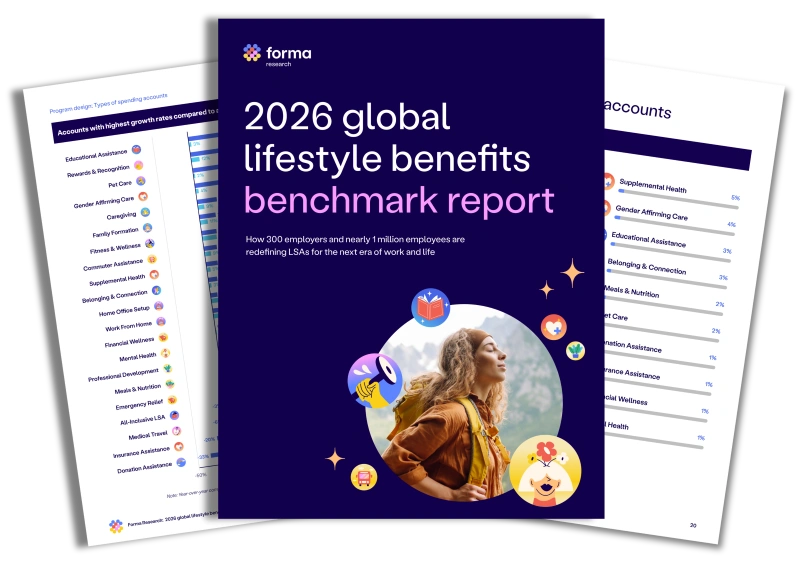
Forma’s 2026 global lifestyle benefits benchmark report shows LSA spending rates leading in several APAC markets, with Australia at 90%, India at 92%, and Singapore at 95%. Those figures signal that program fit and employee needs vary meaningfully by market rather than proving any single design is better. You can read more statistics like this in our 2026 benchmark report.
Step 5: Measure by market and adjust funding for the next plan year
Measurement is what turns this year's design into next year's defensible funding request. Without market-level data, the next planning cycle repeats the same assumptions.
Two metrics need to stay clearly separate. Engagement is the percentage of eligible employees who use a benefit at all, while utilization is the percentage of allocated funds that get spent. A market can show strong engagement with modest utilization, and that combination often means the program is reaching people at a funding level the employer forecasted correctly.
A single global average hides exactly what you need to see. Blending a well-served headquarters market with an underserved one produces a middling number that describes neither, and it gives you no basis for moving funding between markets.
The goal is not the highest possible utilization number. It is meaningful engagement, predictable spend, and clear visibility into what employees in each market actually value, which is what makes the next funding conversation straightforward rather than speculative.
How Forma supports market-level configuration
Forma gives benefits teams a practical way to run steps two through four without managing a separate vendor relationship in every market. Account structures, funding levels, and eligible categories are configurable per country, so a Well-being wallet in Singapore and one in Ireland can carry different amounts and different eligible expenses inside the same program.
Cost-of-living adjustments and local currency support extend across 110+ countries, with native language support rather than automated translation. Country-level reporting sits alongside consolidated global visibility, so benefits and total rewards teams can see both the market detail and the overall picture.
That configurability runs at scale, with nearly 1 million members across 300+ customers, and employees get one cohesive experience with purpose-built wallets underneath.
Local relevance should not require a separate vendor strategy for every market. Schedule a demo today to design your 2027 program around the markets you actually operate in.
Benefits of designing global benefits programs around global benefits equity
Market-relevant design is not only an employee experience win. It changes what benefits teams can see, forecast, and defend internally.
Each of these compounds. Better market-level data produces better funding decisions, and better funding decisions produce programs employees in every market actually engage with.
- Higher Engagement in Underserved Markets: Employees participate when benefits fit the way they actually live rather than a headquarters template.
- Budget Visibility by Market: Country-level reporting replaces one blended global line item that hides which markets are working.
- Defensible Funding Decisions: A documented cost-of-living methodology holds up with finance and with local stakeholders who ask why their amount differs.
- Reduced Vendor Complexity: Fewer regional vendor relationships, contracts, and renewal cycles to manage across markets.
- Recruiting and Retention Outside Headquarters: Benefits that feel meaningful locally are a differentiator in markets where global employers often underinvest.
- Faster Program Iteration: Configuration changes per market rather than renegotiating regional contracts every time priorities shift.
That last point is worth sitting with. Research from Mercer has consistently found that employee benefits are a significant factor in decisions to join and stay with an employer, and in markets where global companies compete against strong local employers, a program that feels locally considered carries real weight.
How Forma helps employers deliver localized employee benefits globally
Designing benefits for distributed teams across many markets is far more manageable when configuration replaces negotiation. Forma gives benefits and total rewards teams one platform where account structures, funding levels, and eligible categories can be set per market rather than compromised into a single global standard.
Cost-of-living adjustments and local currency support work across 110+ countries, with native language support rather than automated translation. Country-level reporting sits alongside consolidated global visibility, so you can answer both the market question and the program question from the same data.
Underneath the platform, purpose-built wallets stay dedicated to specific use cases, including Well-being as the category most global programs anchor on, while employees experience one cohesive program wherever they work.
If your 2027 planning includes markets where engagement has never quite landed, now is the window to rebuild the funding logic before open enrollment preparation begins. Schedule a demo today and design a program that works in local context.
Frequently asked questions about locally relevant benefits for global teams
What does geographic equity mean in employee benefits?
Geographic equity means employees receive benefits that are equally meaningful relative to where they live and what things cost there. It differs from geographic uniformity, which gives every employee the same dollar amount regardless of local cost. Global benefits equity typically requires different funding levels by market to produce comparable support.
How do employers set benefits funding levels for different countries?
Most global benefits strategy work uses a reference funding level adjusted by cost-of-living or purchasing parity data, supported by local market cost inputs for the categories being funded. The methodology should be documented so it can be reviewed each plan year and explained to finance and local stakeholders.
Should global benefits programs offer the same categories in every market?
The category list can stay consistent globally while the weighting and eligible expenses shift by market. Consistency in categories supports a coherent program identity, and local configuration is what makes each category useful. Some categories depend on local provider access, while many others work anywhere.
How do currency and cost of living affect global benefits design?
Currency conversion translates an amount, while cost-of-living adjustment translates the value that amount represents. A figure converted at spot rate changes with exchange markets rather than with local prices. Localized employee benefits programs use cost-of-living methodology so funding reflects what employees actually pay locally.
Can one benefits platform support different funding levels by country?
Yes. A configurable platform can hold different funding amounts, currencies, eligible categories, and account structures per market while presenting employees with one cohesive experience. The underlying mechanics, including account types and compliance requirements, may still differ by country and by benefit type.
What benefits categories matter most outside the United States?
It varies by market. Well-being is widely relevant, and caregiving support often carries different weight depending on local childcare and eldercare norms. Categories tied to US tax structures, such as pre-tax accounts, generally do not translate. Market-level engagement data is the most reliable guide.
How do employers keep a global benefits program consistent while allowing local flexibility?
Define a consistency layer and a flex layer explicitly. The consistency layer usually covers the employee experience, eligibility philosophy, and category set. The flex layer covers funding amount, currency, eligible expenses, and account structure. Documenting both prevents benefits for distributed teams from fragmenting into unmanaged country exceptions.
This article is for informational purposes. Forma is not engaged in the practice of law. Nothing contained herein is intended as tax or legal advice nor to replace tax or legal advice from counsel. If you need tax or legal advice, please consult with counsel or a certified tax professional.
.png)


.png)