









Global Lifestyle Spending Accounts at scale: a Q&A with UKG
Get an inside look at what UKG and Forma discussed on The State of Global LSAs webinar, hosted by BenefitsPRO.
In this piece
If you've ever tried to build a benefits program that works for employees in San Francisco, Germany, and Singapore simultaneously, you already know the challenge: the U.S. program doesn't translate, local programs get cobbled together, and nothing feels equitable. Add to that a growing stack of point solutions, fragmented reporting, and a team buried in admin, and you're not managing a benefits program anymore. You're managing chaos.
That was the backdrop for our recent BenefitsPRO webinar, The State of Global Lifestyle Spending Accounts, where Forma's Kathleen Harris sat down with Suzy Silvestri, Benefits Program Manager at UKG, to talk through how leading employers are rethinking global benefits, and why Lifestyle Spending Accounts are at the center of that shift.
Here's what we covered.
The data point that should change how you think about LSAs
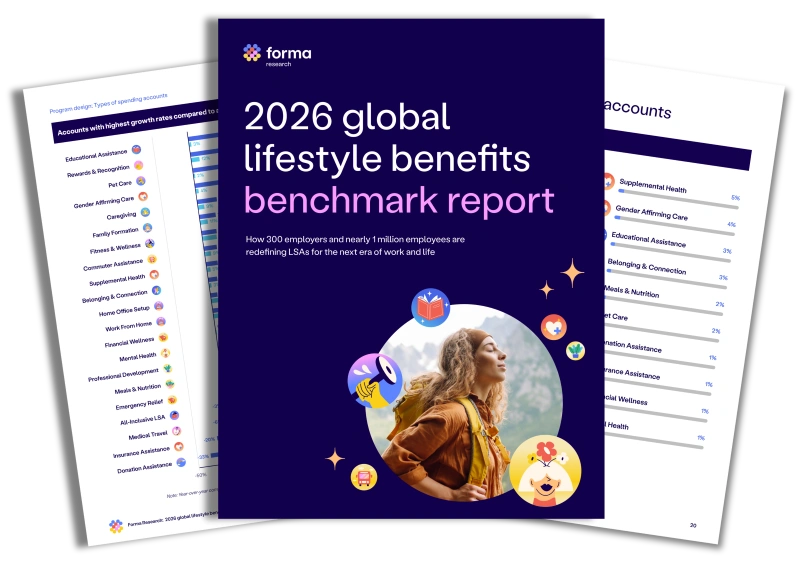
Kathleen shared a headline statistic from Forma’s 2026 global lifestyle benefits benchmark report: 50% of companies that offer LSAs now offer them in more than one country.
That's not a niche enterprise play anymore. LSAs have quietly become the default framework for global benefits equity because they're one of the few structures that can simultaneously deliver consistency at the organizational level and genuine flexibility at the individual level.
The alternative — what we call the "more is more paradox" — is a familiar trap. Add a wellness vendor. Add a caregiving platform. Add a recognition tool. Each one solves a piece of the puzzle and creates three new problems: another contract, another employee login, another set of invoices to reconcile, and reporting that can't tell you anything useful across the whole picture.
The essential question driving the conversation was straightforward: Can you really scale benefits globally without sacrificing personalization? The answer, as UKG's experience shows, is a clear yes.
Inside UKG's multi-wallet LSA program
UKG is a global HR and workforce management company with employees across 21 countries. When they set out to build a flexible benefits program on Forma, they didn't try to stuff everything into a single account. Instead, they built a suite of purpose-built LSA wallets:
- U Choose: their flagship well-being LSA, structured around four pillars: Physical Wellness, Financial Wellness, Work/Life Well-being, and Workplace Experience
- Tuition Reimbursement: offered globally
- Fertility: available in countries where coverage isn't included in the health plan
- Gender-Affirming Care: available where coverage isn't included in the health plan and in accordance with local laws
The multi-wallet LSA model matters for a reason Suzy articulated clearly: each account communicates something. When an employer creates a dedicated fertility wallet or a gender-affirming care wallet, they're not just processing claims, they're making a statement about who matters (everyone!) and what the company values.
Making global actually work
As Suzy explained, U Choose offers a generous annual allowance, and her team didn't just convert that dollar figure for international employees and call it global. UKG applies their own cost-of-living index to adjust the benefit amount for employees outside the US, so a team member in Switzerland and a team member in Bulgaria both receive an amount that's locally meaningful.
Eligibility rules flex by country as well. In Australia, Belgium, France, Germany, Ireland, the Netherlands, New Zealand, Spain, Switzerland, and the UK, employees are eligible for U Choose regardless of hours worked.
And the global nuance goes well beyond currency conversion. When UKG wrote "bikes" into their program policy, they quickly learned that the word means something very different depending on where your employees live: a bicycle in one country, a moped or motorcycle in another. A quick policy rewrite clarified the intent, but it's an instructive example of how even a single word can change what a benefit actually delivers. Similarly, when employees in India requested air purifiers due to wildfire smoke and poor air quality during certain seasons of the year, UKG added the category. It's a small thing, but it's exactly the kind of real, local, human need that a well-designed LSA can respond to in ways that a rigid point solution simply can't.
The result: 93% U Choose utilization in 2025, with more than 182,000 transactions across 21 countries.
Suzy, for her part, currently uses her own U Choose funds for childcare costs. "But in a few years, once my toddlers get out of that phase," she said, "I'm hoping to use it for something a little more fun, like fitness."
Global benefits programs thrive on simplicity
Here's the counterintuitive insight from UKG's program evolution: simplification doesn't mean providing less. It means designing with more intention.
When UKG first launched U Choose, it was so comprehensive that it unintentionally created confusion. Employees had a 20-page policy document to navigate. Suzy's team cut that in half — and paradoxically, part of simplifying the program involved adding categories. Some additions were practical: internet reimbursement, childcare support, tutoring and extracurriculars, loan repayment assistance. Others were more joyful: camping fees, hiking, kayaking, and national park passes, added with the specific intent of inspiring employees to get outside.
The outcomes: fewer claim denials, less employee frustration, and a program that required fewer questions to the benefits team overall — especially after UKG began using Forma's AI-powered claims adjudication, which delivers immediate approvals or rejections so employees can act without switching gears.
On LSA budget predictability
One of the more nuanced points Suzy raised was about designing for active employee choice rather than passive consumption. UKG wants employees to be engaged — making purposeful decisions about what's going to enhance their well-being — not just auto-spending on autopilot.
This is a meaningful design philosophy. Benefits that require zero decision-making can drive utilization numbers up, but they don't necessarily create the kind of employee engagement that justifies the program. UKG's intentional design has helped them calibrate budget predictability while keeping engagement high.
It's also worth noting: this is exactly what an LSA’s notional funding model makes possible. Because employers only pay for what employees actually use, there's no waste to defend to finance.
What this means for global benefits leaders
The key themes from UKG's story aren't unique to their scale or their industry. They show up for any benefits team trying to build something that actually works across a distributed, diverse workforce:
Cohesive program, local nuance. A global benefits program doesn't mean a uniform one. Cost-of-living adjustments, country-specific eligibility, and local tax compliance are table stakes, not nice-to-haves.
Employee choice is a design feature, not a fallback. Flexible spending accounts work because employees get to decide what matters to them. That's the engagement driver, not the dollar amount.
Sensitive benefits deserve a safe haven. One of the most important things Forma provides for UKG's fertility and gender-affirming care programs is a privacy buffer: employees submit sensitive claims to Forma directly, not to UKG. As Suzy put it, "Forma gives us the opportunity to have a buffer." For benefits that require employees to share deeply personal information, the administrative experience is part of the benefit itself.
Programs need room to evolve. UKG has been running on Forma since 2022, and the program looks meaningfully different today than it did at launch. That's not a failure — it's what good program stewardship looks like.
Want to talk through what a global LSA program could look like for your organization? Connect with us.
.png)


.png)