









Caregiving benefits: when to consider an LSA instead of another point solution
Standalone caregiving vendors leave distributed teams underserved. See when an LSA gives employees more choice and HR more flexibility.
In this piece
Quick Answer: A Lifestyle Spending Account is the best choice when designing caregiving benefits for workforces where caregiving needs vary widely or your current point solutions are inflexible or underutilized.
Caregiving is one of the most personal categories in any benefits package. Accessing support to help care for loved ones is often time-consuming and stressful, with important decisions that require a lot of trust - and can come with a big price tag.
This tension is at the center of every employer’s caregiving benefits decision. You can contract with a dedicated vendor and get an experience that works well for some employees but leaves others with a benefit they can't actually use. Or you can fund a caregiving spending account through a flexible platform and let employees direct that funding toward the providers they already know and trust.
Neither approach is universally right. But for a growing number of companies, particularly those with distributed, multi-generational, and global teams, the LSA model is solving problems that point solutions aren’t equipped to handle.
Key takeaways
- Caregiving responsibilities now affect 43% of full-time workers, and employer caregiving benefits funding grew 44% year over year, making this one of the fastest-moving categories in benefits design.
- Standalone caregiving vendors work well in dense metro areas but often leave employees in smaller cities, suburbs and commute-heavy areas, rural regions, and international markets without meaningful coverage.
- A caregiving Lifestyle Spending Account benefit lets employees choose the caregiving providers and services they know and trust without being locked into a point solution or restrictive provider contract.
- The right model depends on your workforce. An LSA fits best when geographic diversity, provider flexibility, and benefits consolidation are priorities. A dedicated vendor may be the better call for smaller workforces that are geographically concentrated in the same area.
- Forma helps companies deliver flexible, inclusive caregiving benefits on a global scale. Schedule a demo today to see how it works.
Why caregiving has become a bigger benefits priority
Caregiving isn't a niche concern anymore for benefits teams. It's a workforce-wide reality that touches nearly half of all full-time employees, and employers who ignore the demand to support caregivers risk losing people because of it. But the way you deliver caregiving benefits needs to flex to fit your employees' lives.
The growing caregiving burden on working employees
When most people hear "caregiving," they think childcare. But that's only part of the picture. Caregiving also includes elder care, support for family members with chronic illnesses or disabilities, or even pet care.
The scope of the modern caregiving burden is hard to overstate. A Guardian Life report found that 43% of full-time workers now juggle caregiving alongside their jobs, a 13% increase since 2019. These aren't low-stress responsibilities. Caregivers report higher anxiety, lower productivity, and significantly more missed workdays than their peers.
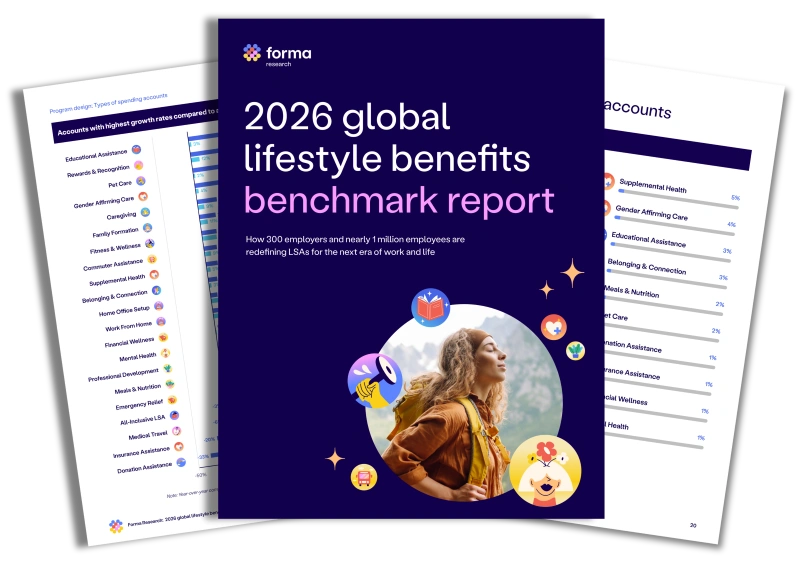
How are employers responding? Forma’s 2026 global lifestyle benefits benchmark report shows that caregiving LSAs carry a median annual funding of $3,630 per employee. This signals that organizations are getting serious about funding meaningful caregiver support benefits.
Our reporting found that caregiving LSA funding also grew 44% year over year, one of the fastest growth rates across all spending account categories. That momentum reflects a shift in how employers think about this benefit: as a strategic need worth investing in.
What's driving employers to revisit their approach
Many companies that contracted with a single caregiving vendor two or three years ago are now hearing the same feedback from their workforce. Employees in certain geographies feel left out. Employees with non-standard caregiving situations, like caring for an aging parent and a child with special needs at the same time, find that the vendor's network doesn't have answers for them.
The pattern is familiar to anyone who's managed standalone point solutions vs curated LSAs across other benefit categories. A vendor that works well for employees in one location may not work - or even be available - for others.. When the vendor can't serve the employee, the benefit goes unused, and the employer is paying for a program that isn't delivering value.
That gap between what's offered and what's usable is the core reason employers are rethinking how dependent care benefits and broader caregiving support get delivered.
When the point solution model for caregiving benefits leaves employees behind
The point solution breaks down in three predictable situations, and most large, modern workforces will hit at least one of them.
The first is geographic gaps. Employees in smaller cities or rural areas often find that the vendor's provider network is thin or nonexistent where they live. They technically have a caregiving benefit, but they can't find a participating provider within a reasonable distance.
The second is non-standard caregiving needs. An employee caring for an adult sibling, a parent with dementia who requires a specialist memory care provider, or a child with a disability who needs therapy beyond what a curated network covers. These situations fall outside the neat categories most vendor networks are built around.
The third is provider loyalty. Many employees have spent years building relationships with trusted caregivers, whether it's a longtime daycare, a family friend who provides after-school care, or a home health aide who already knows a parent's medication schedule. Asking those employees to switch to an unfamiliar vendor-approved provider isn't just inconvenient. It can feel like a step backward.
In all three cases, the employee effectively has no benefit, even though the employer is paying for one. That's the utilization gap that makes HR teams question whether their current approach is working.
What an LSA model looks like for caregiving
A caregiving Lifestyle Spending Account changes the model. Instead of contracting with a single caregiving provider or service and hoping it covers your workforce, the employer funds an account and lets employees direct that money toward the caregiving resources that actually serve their lives. For benefits and total rewards teams searching for a better caregiving solution, Forma is the platform that powers caregiving LSAs at global scale, supporting customized program design and administrative efficiency while employees get choice and flexibility in how they utilize their caregiving benefits.
How caregiving LSAs work with Forma
With a caregiving LSA, the employer sets the funding amount and defines which expense categories qualify: childcare, after-school programs, elder care services, in-home support, adult day programs, backup care, etc. Employees then spend their funds on any eligible caregiving providers and services that meet their needs.
That might be a national platform, a neighborhood daycare, a licensed home health aide, or a specialist recommended by their pediatrician. Depending on the program setup, employees have options to submit claims for reimbursement, pay with the Forma Card, or even access curated caregiving support in the Forma Store. Employees never have to fend for themselves navigating a vendor's network, and they're never locked into a single provider option that doesn't include the people and services they trust.
Coverage that works across geographies
An employee in Pune and an employee in rural Arkansas have fundamentally different caregiving options. A contracted vendor optimized for U.S. metros doesn't solve for either context particularly well, and it certainly doesn't address both.
Forma’s 2026 global lifestyle benefits benchmark report notes that 50% of employers running spending accounts now offer them in more than one country. That's not a coincidence. Companies with global teams are recognizing that standalone, disconnected benefits don't scale across borders without sourcing separate providers for each market.
Because Forma operates in 110+ countries and auto-converts funding to local currencies, employers can deliver a meaningful employee caregiving support benefit globally without adding a new vendor for every region. An employee in Tokyo can access the same funded flexibility as an employee in Toronto.
The full spectrum of caregiving, not just one category
Caregiving responsibilities don't stay in one lane. An employee who needs childcare support this year may become an elder caregiver next year. A working parent might be coordinating care for a child with a disability. These overlapping situations are common, and they're exactly where single-category vendor solutions fall short.
A caregiving LSA can cover elder care and childcare under the same account, all in one place. That means an employee doesn't need to enroll in separate programs for different types of care. The caregiving spending account eligibility standards can be configured to reflect the full range of caregiving situations your workforce actually faces.
This matters for the same reason that flexible benefits for working parents matter: employees' lives don't fit neatly into vendor-defined categories. A benefit that meets them where they actually are will always outperform one that asks them to fit their needs into a preset list.
Signs an LSA fits your caregiving benefits strategy
The LSA model for caregiving benefits is a strong fit when several conditions line up. If your workforce is geographically distributed, especially across international markets, a contracted vendor's network will almost certainly leave gaps. An LSA fills those gaps by letting employees access local providers wherever they are.
If your employees have diverse caregiving situations that range from childcare to elder care to support for family members with disabilities (or if you don’t know for sure), a single-vendor solution won't cover the full spectrum. An LSA lets the employer define broad eligibility categories that reflect real life.
Low utilization or high employee frustration with your current point solution is another signal. If employees aren't using the benefit and geographic or provider gaps are a likely cause, switching to an LSA model directly addresses the root problem. And if you're already looking to consolidate benefit use cases, caregiving, family formation benefits, and well-being, onto a single platform rather than managing a separate vendor for each, an LSA platform like Forma is built for that consolidation.
Give every employee a caregiving benefit that actually works
Caregiving is among the most high-stakes responsibilities employees carry into the workplace. When a benefit promises support but can't deliver it, whether because the vendor's network doesn't reach the employee's zip code or the provider list doesn't match their family's needs, it doesn't just go unused. It erodes the trust that benefits are supposed to build.
Forma helps hundreds of the world's most admired companies deliver flexible, configurable caregiving benefits through a single platform that works across 110+ countries. With employer-defined eligibility, consolidated reporting, and a track record of predictable and high utilization, Forma turns the complexity of caregiving benefits into a straightforward and valued employee experience. Schedule a demo today to see how your team can move from a fragmented vendor approach to a unified caregiving benefit employees will use.
FAQs about caregiving benefits
What expenses can a caregiving LSA cover?
A caregiving spending account can cover a broad range of expenses depending on how the employer configures the program. Common eligible categories include childcare, daycare, after-school programs, elder care services, in-home care aides, adult day programs, backup care, and care for family members with disabilities. The specific expenses covered are determined by the employer's eligibility rules, not a vendor's preset list. This flexibility is what distinguishes an LSA-based caregiving benefit from a contracted point solution.
How much do employers typically fund caregiving benefits?
According to the 2026 Forma Benchmark Report, the median annual funding for caregiving accounts is $3,630 per employee. Caregiving funding grew 44% year over year, one of the fastest growth rates across all spending account types, reflecting increasing employer investment in this category.
What's the difference between a caregiving LSA and a dependent care FSA?
A dependent care FSA (DCFSA) is a pre-tax account governed by IRS rules with a $5,000 annual contribution limit for married couples filing jointly. It only covers qualifying dependents under age 13 or incapacitated dependents. A caregiving LSA is employer-funded, post-tax, and far more flexible. Employers define the eligible expenses, which can include elder care, adult sibling care, specialized therapy, and other categories a dependent care FSA doesn't cover. The tradeoff is that LSA funds are taxable to the employee, while FSA contributions reduce taxable income.
Can a caregiving LSA work for a global workforce?
Yes. One of the primary advantages of a caregiving LSA over a contracted vendor is geographic flexibility. Platforms like Forma operate in 100+ countries and can auto-convert funding to local currencies, so employees in any market can access caregiving providers where they live. A contracted vendor's network is typically concentrated in the U.S. or a handful of major markets, leaving international employees without meaningful coverage.
How does a caregiving LSA handle employees with non-standard caregiving needs?
Because the employer defines the eligibility rules for a caregiving LSA, the account can be configured to cover situations that fall outside typical vendor categories. Employees caring for adult siblings, family members with chronic conditions, or dependents requiring specialist providers can all be covered as long as the employer includes those expense types in the program design. This configurability is the core advantage for workforces with diverse, unpredictable caregiving situations.
This article is for informational purposes. Forma is not engaged in the practice of law. Nothing contained herein is intended as tax or legal advice nor to replace tax or legal advice from counsel. If you need tax or legal advice, please consult with counsel or a certified tax professional.
.png)

.png)