










Global employee benefits: building a strategy for every market
Global employee benefits fail when designed at HQ. Learn how localized funding, currency conversion, and platform consistency fix the gap
In this piece
Quick answer: Global employee benefits are employer-funded programs that extend beyond statutory minimums to offer health, financial, and lifestyle support across every country where a company operates. The strongest programs pair equitable funding rules with local relevance, using a single platform to handle currency conversion, compliance, and reporting.
Most benefits programs get designed in a conference room at headquarters and rolled out, untouched, to every office around the world. The results are predictable. Employees in Warsaw wonder why their wellness credit only covers American gym chains.
Teams in São Paulo get a meal stipend denominated in dollars that buys a fraction of what their colleagues receive in Austin. Singapore-based staff find that their "family support" benefit assumes a US childcare model that bears no resemblance to local norms.
These are not small problems. They show up in utilization data, exit interviews, and quiet resentment from teams who feel like afterthoughts.
The fix is not more budget or more vendors. It is a structural rethink of how funding, compliance, and platform choices should work when employees sit in fifteen countries instead of one.
Key takeaways
- Global employee benefits work best when funding philosophy is decided centrally but eligibility and vendor selection stay flexible at the country level.
- Statutory benefits vary dramatically between markets, so any voluntary layer should be designed on top of the local floor, not instead of it.
- Utilization data often matters more than headline funding, since a $600 allocation used at 71% costs less than leaders assume when modeling full adoption.
- Running separate point solutions by region creates administrative load that scales poorly past two or three countries.
- Schedule a demo today to see how Forma delivers equitable benefits in 100+ countries through one unified platform.
What are global employee benefits?
Before digging into program design, it helps to define the category, since "global benefits" can mean very different things depending on who is talking. The working definition below separates the mandatory baseline from the voluntary layer where most strategic choices actually get made.
Global employee benefits are the full set of health, financial, and lifestyle programs that a multi-country employer offers to staff in every market where it operates. The category sits on top of country-mandated coverage like pensions, statutory health insurance, and paid leave requirements.
What makes benefits "global" is the attempt to treat employees in every country with consistent intent, even when delivery mechanisms have to change. The tension most leaders run into is that equitable intent and localized execution pull in opposite directions.
An equal-dollar allocation feels fair on paper but creates huge purchasing-power gaps. A purely local program keeps everything relevant but multiplies administrative work and weakens the equity signal the program is supposed to send. The best programs reconcile both.
This is where a lot of HR teams get stuck. They inherit a program stitched together from country-by-country vendors, each with its own contract, file feed, and reporting format. Consolidating onto a single platform sounds obvious, but the transition gets hard when local providers are already baked into existing workflows.
Examples of global employee benefits
Program examples are often the clearest way to see where localization matters most. The categories below come up repeatedly in multi-country rollouts and show how design choices tend to differ across regions.
- Wellness allowances: In the US, eligibility often centers on gym memberships and fitness apps. In India, it needs to cover yoga studios, traditional practices, and home-based options. In Japan, preventive health checks dominate.
- Meal and nutrition stipends: These matter far more in APAC than in EMEA, where statutory vouchers already cover similar ground in several markets.
- Caregiving support: Cultural norms around elder care versus childcare flip dramatically between markets, which is why programs like childcare support in India need dedicated eligibility rules rather than a global template.
- Mental well-being resources: Language, time zone coverage, and culturally competent providers are the gating factors, not funding levels.
- Commuter benefits: Tied to local transit systems, which makes a US-style pre-tax model irrelevant in most of the world.
- Professional development: Relatively portable across markets, which is why it shows up as one of the easier cross-border programs.
Global benefits platforms for employee health have to handle all of this in one interface, not force HR teams to maintain seven parallel programs. Regional differences show up in the spending data too.
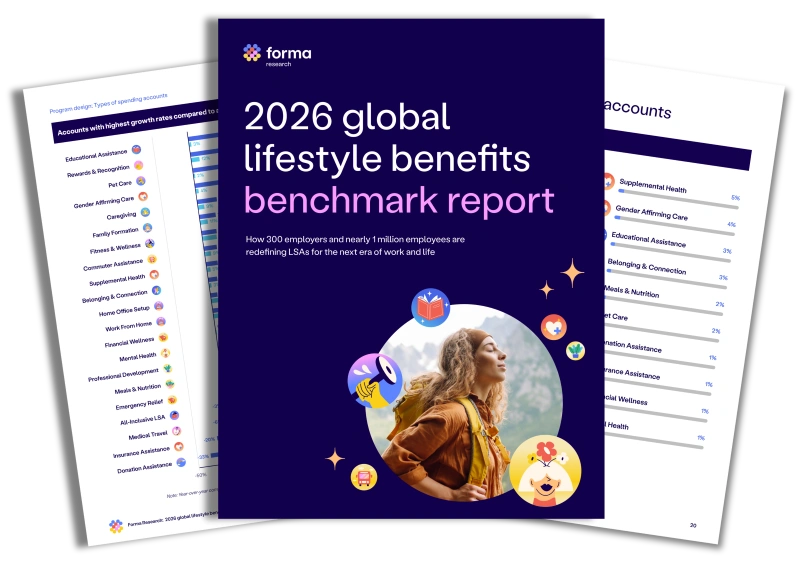
Our 2026 Forma Benchmark found that APAC markets lead all regions in all-inclusive LSA spending rates, with Australia at 90%, India at 92%, and Singapore at 95%. You can read more statistics like this in our 2026 Forma Benchmark report.
3 Types of global employee benefits
Not all benefits operate under the same rules or serve the same purpose. Breaking the category into three distinct layers makes it easier to decide what needs to be standardized, what should stay local, and where a platform decision really pays off.
Statutory and country-mandated benefits
These are the legal minimums. Social security contributions, national health schemes, paid maternity and sick leave, pension funding, and severance frameworks vary in every country and are usually administered through local payroll.
They are non-negotiable and form the floor that voluntary programs sit on top of.
Supplemental health and financial benefits
This is the middle layer: private medical insurance where public coverage has gaps, life and disability insurance, retirement top-ups above mandatory contributions. Global employee benefits providers in this space tend to be regional.
Most large employers end up with a patchwork of carriers coordinated by a broker like Mercer, Aon, or WTW.
Flexible and lifestyle benefits
This is the layer where localization pays off most and where platform decisions actually matter. Lifestyle Spending Accounts, wellness allowances, caregiving stipends, professional development funds, and work-from-home support all fit here.
Because these programs are funded directly by the employer rather than running through an insurance carrier, they can be designed and redesigned quickly in response to what employees actually use.
Forma gives global teams one platform for benefits in any currency
Running flexible benefits across more than a few countries without a unified system usually means tracking funding in spreadsheets, reconciling reimbursement claims in multiple currencies, and asking employees to file expenses through processes that feel nothing alike in London, Mumbai, and Mexico City.
Forma was built for this. The platform is live in 100+ countries with automatic currency conversion, local cost-of-living adjustments, and a single admin dashboard that gives HR teams one source of truth regardless of where employees sit.
Employees get a global Visa card that works the way they expect, with an auto-substantiation rate above 85% and claims reimbursement backed by human support when needed. HR teams get eligibility controls, utilization analytics, and compliance guardrails that adapt by country without creating parallel programs.
Ready to see how it works for your team? Schedule a demo today and walk through a build specific to your footprint.
How to create a global benefits strategy
The difference between a strategy that works and one that collapses under its own weight usually comes down to sequencing. Teams that start with a vendor shortlist tend to regret it. The steps below reflect what works in practice across companies with anywhere from five to fifty country footprints, and they track closely with the newest global employee benefits trends we see in client rollouts.
Start with an employee listening audit by region
Before designing anything, run qualitative sessions or short surveys by country, not by program type. The goal is to find out what employees actually want and what existing gaps feel most painful.
A stipend for a benefit nobody values is still waste, regardless of how equal the allocation is.
Set a clear funding philosophy
Decide whether you are funding employees equally in dollar terms, adjusting for purchasing power parity, or using cost-of-living multipliers by country. Each approach has trade-offs.
Equal-dollar funding is easy to explain and hardest to defend in high-cost markets. PPP adjustments feel fair but are harder to communicate internally.
Map the statutory floor in each market
Before adding any voluntary benefit, confirm what is already mandated locally. Offering a caregiving stipend in a country with generous statutory leave is fine, but it changes the design.
Ignoring the statutory layer creates duplication and sometimes tax headaches down the road.
Choose a centralized platform or regional vendor stack
This is the single most consequential design decision. A centralized global employee benefits platform simplifies administration but requires vendor consolidation.
A regional stack preserves local preferences at the cost of heavier ongoing management and fragmented data, which is the same point solutions stack problem that pushes most HR teams to consolidate in the first place.
Build a governance model for ongoing changes
Benefits are not a one-time design exercise. Eligibility changes, new markets, tax rule updates, and vendor transitions are constant.
A small cross-functional governance team, usually HR plus finance plus legal, should own change decisions by country rather than letting each market improvise.
Plan for tax treatment by country
Tax treatment varies enormously. A wellness stipend is fully taxable in the UK, sometimes tax-advantaged in Singapore, and falls under different rules in every Latin American market.
This matters for cost modeling and for employee communications, since gross-up calculations often need to happen before payroll close.
Set a reporting cadence that captures utilization by country
Global programs tend to report by total spend or by program type, which hides the country-level variance that actually matters. A quarterly report that breaks out funding versus utilization by market surfaces problems early, before teams feel neglected.
This is the same logic that applies to any flexible benefits strategy at scale.
Why offer global employee benefits?
The business case comes down to three things: retention in markets where local competitors pay more but offer less, equity signaling to employees who never see headquarters, and the compounding financial value of programs that are actually used.
Cross-border talent increasingly expects consistency in employer-funded programs, not just base pay. Research from Gallup on global workforce engagement shows that employees outside headquarters cite recognition and well-being support as top drivers of retention.
Those are exactly the categories where flexible benefits tend to close gaps that traditional programs cannot. This plays directly into employee benefits ROI calculations for global HR teams trying to justify spend to finance.
The equity signal is just as important. Non-headquarters employees often feel like second-class citizens when benefits programs are visibly more generous in the home market.
A well-designed global program reverses that signal and tells every employee that the company thought about them specifically, not just about Delaware and California.
The adoption data reinforces the point. Our 2026 Forma Benchmark found that 50% of employers now run spending accounts in more than one country, and 4% operate programs across more than 30 countries.
This is a meaningful shift from the country-by-country vendor model that dominated a decade ago.
The financial logic is straightforward. Median funding per employee, times utilization rate, times headcount, gives a more realistic cost than assuming everyone uses their full allocation.
A $600 fitness and wellness allocation at 71% utilization costs $426 per employee, not $600. For a 5,000-person workforce, that is roughly $900,000 less than the naive forecast, which changes the conversation with finance entirely. Further analysis from Mercer on global talent trends supports the same shift toward outcomes-based benefits design.
Why Forma works for global teams managing benefits across markets
Running benefits for a distributed workforce without the right platform usually means maintaining separate programs in every country, reconciling payments in multiple currencies, and answering HR tickets that all sound the same but have different answers.
Forma replaces that with a single platform live in 100+ countries, with automatic currency conversion, local cost-of-living adjustments, and compliance guardrails that adapt to each market. HR teams get one dashboard for eligibility, funding, and utilization data, without sacrificing local relevance.
Employees spend allocated funds through a global Visa card, claims reimbursement, or the Forma Store, with human support available around the clock. Lululemon has used Forma to deliver wellness benefits across dozens of countries at the pace their business demands, and hundreds of other global employers run similar programs at scale.
Ready to simplify your global benefits footprint? Schedule a demo today and see the platform in action.
Frequently asked questions about global employee benefits
How do you handle currency fluctuation in global benefit allowances?
Most platforms use automatic currency conversion at the point of spend, based on real-time or monthly-averaged FX rates. Some employers adjust allocations annually based on cost-of-living indices. The main trade-off is between predictable employer cost and predictable employee purchasing power, since one of the two has to absorb volatility.
Are employee benefits taxed differently across countries?
Yes. Tax treatment varies dramatically. A wellness stipend may be fully taxable income in the UK, tax-advantaged in Singapore, and have yet another treatment in Brazil. Most employers work with local tax counsel or a provider that handles gross-up calculations by country to avoid surprises during payroll close.
Should companies standardize or localize benefits by region?
The practical answer is both. Funding philosophy, platform selection, and reporting should be standardized at the global level. Eligibility lists, vendor choices, and communication should be localized. Companies with the highest engagement scores tend to decide centrally but execute locally.
What are common mistakes when expanding benefits to new countries?
The most frequent mistake is rolling out a headquarters-designed program without an eligibility review. Other common issues include missing the statutory floor, ignoring tax treatment differences, underestimating the effort to onboard local vendors, and failing to translate communications into the primary local language.
How do statutory benefits interact with supplemental global offerings?
Statutory benefits form the legal floor. Supplemental benefits sit on top. The interaction matters for tax treatment, since some countries require gross-up on voluntary benefits that duplicate statutory coverage. It also matters for employee communication, since employees often do not separate the two layers.
Is there a minimum headcount needed to offer benefits in a country?
There is no universal minimum. Most traditional vendors prefer at least 10 to 25 covered employees per country, though flexible platforms and LSAs can scale down further. Tax registration and local compliance costs often drive the real minimum, not vendor thresholds themselves.
How long does it take to launch benefits in a new country?
Typical timelines range from 4 to 12 weeks, depending on local vendor availability, tax registration requirements, and payroll integration complexity. Countries with well-established benefits infrastructure like the UK, Canada, or Singapore are faster. Markets with heavier compliance requirements or less mature provider networks take longer.
This document is for informational purposes. Forma is not engaged in the practice of law. Nothing contained herein is intended as tax or legal advice nor to replace tax or legal advice from counsel. If you need tax or legal advice, please consult with counsel or a certified tax professional.
.png)


.png)