









How to manage benefits compliance across multiple countries
How to manage benefits compliance across multiple countries: taxability, payroll reporting, and documentation per market.
In this piece
Quick answer: Managing benefits compliance across multiple countries means separating statutory obligations from the supplemental programs you design, then settling tax treatment, documentation, and review ownership per market before launch.
The program is live in 18 markets. The compliance answer for each one lives in a different place: a folder from implementation, a regional vendor's contract, an email thread with local counsel from two years ago. The honest internal answer to "are we compliant in Germany" is that someone checked once, during setup, and nobody has looked since.
This accumulates rather than resolves, and the reason is structural. Statutory obligations are the part everyone plans for, because payroll and legal own them and they are documented. The supplemental layer is where exposure quietly builds, because a well-being reimbursement that is untaxed in one market is imputed income in another, and nobody owns the difference until an audit or a works council asks.
The fix is not encyclopedic country knowledge. Compliance across countries is less about knowing every rule and more about having an operating model that surfaces the rules that changed.
Key takeaways
- Benefits compliance across countries splits into two layers: the statutory floor that local employment law dictates, and the discretionary layer of supplemental programs where benefits teams hold the design decisions and the exposure.
- Tax treatment of employer-funded reimbursements varies by country, expense type, and account structure, which means taxability and payroll reporting have to be settled per market before a program launches rather than after the first claim.
- Documentation standards carry more audit weight than most teams expect, since substantiation rules, retention periods, plan documents, and local-language communication are where multi-country programs are most often found short.
- Regulatory change is the recurring cost rather than the initial setup, so programs that hold up have a named owner per market and a fixed review cycle tied to the benefits calendar.
- Planning a multi-country program for the 2027 plan year? Schedule a demo today to see how Forma supports configurable account structures, local tax handling, and consolidated reporting across 110+ countries.
What benefits compliance across multiple countries covers
The work becomes manageable once it is split into two layers, because the layers have different owners, different rules, and different consequences. Competing advice tends to collapse them into one undifferentiated compliance problem, which is exactly why it feels unmanageable.
The statutory floor is what local employment law requires: social insurance, pension participation, statutory leave, family entitlements. It is enforced through labour inspectorates and payroll reporting, and it usually sits with legal, payroll, and local entity teams rather than with benefits.
The discretionary layer sits above that floor. Well-being, Caregiving, Professional Development, Home Office, Family Formation, and other employer-funded benefits the company chooses to offer all live here. Nothing in this layer is legally mandated, which is exactly why it gets less governance, and it is where a benefits team's own exposure concentrates.
To manage benefits compliance across multiple countries, the discretionary layer needs attention on four surfaces:
- Tax Treatment And Payroll Reporting: Whether an employer-funded reimbursement is taxable to the employee, and how it reaches local payroll.
- Substantiation And Documentation: What evidence supports each reimbursement, and how long records are retained.
- Consultation And Communication: Employee representative consultation and local-language communication requirements in certain markets.
- Cross-Border Data Handling: Where claims data containing personal information can move and be stored.
Treatment on every one of these surfaces depends on the country, the expense type, and the account structure, so program design should be reviewed with local tax and legal counsel rather than assumed from any general rule. In the US alone, the IRS position is that fringe benefits are taxable wages unless a specific exclusion applies, set out in Publication 15-B, and other jurisdictions draw their own lines in their own places.
The compliance considerations for Lifestyle Spending Account benefits illustrate how much variation one account type carries, and the mechanics of how Lifestyle Spending Accounts are taxed shift by jurisdiction and expense type. Employee benefits across countries multiply that variation by every market a global employee benefits program touches.
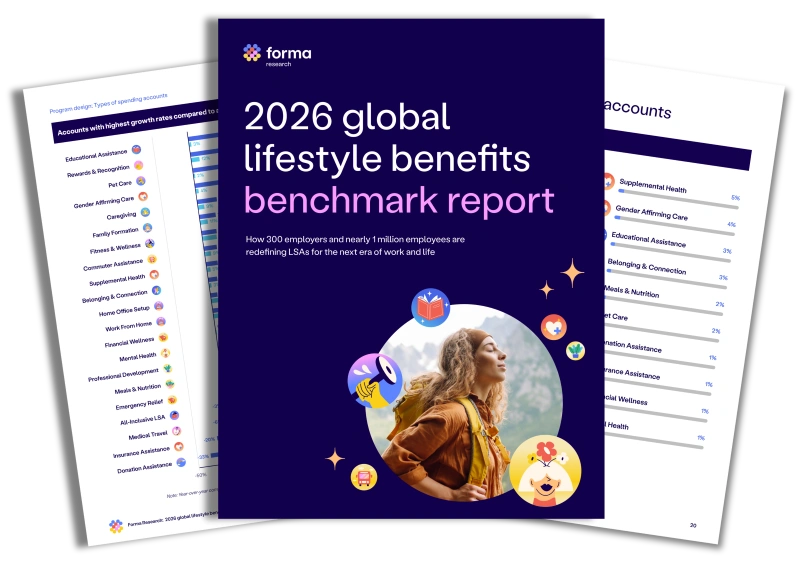
This surface area is now common rather than exceptional. Forma's 2026 global lifestyle benefits benchmark report shows that half of employers offering customizable spending accounts run them in more than one country, and 4% operate across more than 30, which signals that multi-market discretionary programs have become a mainstream benefits reality rather than an enterprise edge case. You can read more statistics like this in our 2026 lifestyle benefits benchmark report.
How to manage benefits compliance across multiple countries in 5 steps
The teams that stay compliant across markets are not the ones with the most country knowledge. They are the ones who settled five questions before launch and built a way to know when the answers change.
Step 1: Separate the statutory floor from the layer you control
Scope comes before anything else. The statutory floor is owned elsewhere in the business, and the benefits team's job there is confirmation rather than design. The discretionary layer is where your design decisions and your accountability sit.
This separation is what makes the work finite. A benefits leader does not need to become an expert in local pension law. They need a clear line around what their program touches and a named owner for each side of it.
The common inversion is worth guarding against. Teams spend review cycles re-confirming statutory items that payroll already handles, while the supplemental program's tax treatment goes unexamined for years because nobody was assigned to it.
Step 2: Settle tax treatment and payroll reporting per market before launch
This step carries the most weight, because it is where the first-claim surprise originates. Whether an employer-funded reimbursement is taxable to the employee, whether the employer withholds, and how the amount reaches local payroll as imputed income are three separate questions, and they resolve differently by country and expense type.
The operational consequence is the part most teams miss. Even where treatment is settled on paper, the reporting path has to exist in practice: someone has to move claim-level data into the local payroll cycle, on the local calendar, in a format the local provider accepts. A correct answer with no pipeline behind it is still a compliance gap.
Account structure changes the answer too. A benefit delivered through a tax-advantaged structure in one market may be a taxable reimbursement in another, and the same use case can sit in different structures across a footprint. The question of whether stipends are taxable has different answers by structure and market, work from home expense reimbursement carries its own compliance guidelines, and US structures bring FSA and HRA legal document requirements that have no equivalent elsewhere.
None of this should be resolved from a template. Treatment per market belongs in a documented matrix, reviewed with local tax and legal counsel for your specific program.
Step 3: Set substantiation, documentation, and data handling standards
An auditor or local authority will typically ask three documentation questions: what evidence supports each reimbursement, how long records are retained, and where the records physically live. Cross border employee benefits programs need a written answer to all three per market, not a practice that varies by whoever processed the claim.
The data dimension deserves explicit attention, since it is the surface most benefits teams have not mapped. Claims data contains personal and sometimes health-adjacent information, and moving it across borders raises handling questions in markets with strict transfer rules. Where that data is stored and processed is a compliance decision, not a technical detail.
Eligibility definitions belong here as well. A documented, consistent standard for what qualifies as an eligible expense under each account is the difference between a defensible program and a set of case-by-case decisions, which is why published LSA eligibility standards exist as a reference point. When an employee benefit plan audit arrives, consistency is what gets examined.
Step 4: Build in consultation and local communication requirements
Some markets require employee representative or works council consultation before benefits change, and the timeline for that consultation is not something a launch date can compress. Finding this out after announcing a date is how programs end up paused mid-rollout.
Communication is a compliance matter here rather than a marketing one. Local-language materials, clear eligibility descriptions, and accurate tax implications for employees are part of what makes a program defensible, and native language support does that job better than automated translation.
The scheduling point is concrete: consultation requirements are the reason a global program calendar has to run further ahead than a single-market one. Treat it as a planning input rather than an obstacle, and build the calendar backward from the longest consultation timeline in your footprint.
Step 5: Assign ownership and set a fixed review cycle
Regulatory change is the recurring cost. Statutory thresholds move, tax treatment gets clarified, reporting formats change, and none of it announces itself to the benefits team.
A working model has a named owner per market or region, a documented source of truth for each country's treatment, a mid-year read, and an annual review timed ahead of open enrollment compliance preparation and January 1 program changes. Review cadence built into how the benefits program is designed survives staff turnover in a way that individual diligence does not.
One measurement note connects compliance to program health. Engagement, the percentage of eligible employees using a benefit at all, and utilization, the percentage of allocated funds spent, are separate metrics, and unexpected movement in either can be the first visible signal that something changed in a market.
How Forma supports the discretionary layer across markets
Forma makes the discretionary program administrable across markets rather than a per-country negotiation. Account structures are configurable across 110+ countries, with the appropriate structure per market and use case, and LSAs, HRAs, and pre-tax accounts are supported through one unified employee experience with purpose-built wallets underneath.
In-house compliance expertise, including ERISA counsel, supports plan documentation and eligibility standards, and AI-assisted claims review applies documented substantiation standards behind each account. Local currency and native language support keep employee-facing materials accurate in each market.
Consolidated reporting gives benefits teams a market-level record on demand instead of one assembled from regional vendor exports. Forma supports the compliance work and reduces the administrative burden of running it; it does not replace counsel or the employer's own obligations.
Schedule a demo today to see how that model fits your footprint.
What benefits teams gain from a single compliance model across markets
Running one compliance model for benefits across countries instead of one per market sounds like a consolidation argument. The practical payoff is narrower and more useful than that: fewer places for an answer to go stale.
- One Documented Source Of Truth: Treatment, eligibility standards, and retention rules for benefits across countries live in one place instead of across regional vendor contracts.
- Audit Readiness: A market-level record can be produced on request rather than assembled from separate exports under deadline.
- Fewer Disconnected Vendor Relationships: Each regional workaround carries its own compliance posture, contract, and renewal, and increasing vendor complexity is what makes the picture unknowable.
- Faster Response To Regulatory Change: One configuration change reaches every affected market rather than one conversation per vendor.
- Cleaner Reporting: Engagement and spend visible by market and category, which makes both the compliance review and the funding conversation shorter.
- Consistent Employee Experience: Eligibility rules and communications stay coherent across markets even where the underlying account structures and tax treatment differ.
The staleness risk is not hypothetical, because the rules genuinely keep moving. The OECD's latest review of employment protection legislation documents a clear wave of recent reforms across member countries since 2020, and every reform cycle in a market is a chance for a per-country compliance answer to quietly expire. The point solutions fatigue that builds around regional vendor sprawl makes those expirations harder to see, since each vendor holds its own piece of the picture.
How Forma supports benefits compliance across multiple countries
Benefits teams that manage benefits compliance across multiple countries need an execution layer for steps two through five, not another regional vendor to reconcile. Forma provides configurable account structures across 110+ countries, with the appropriate structure per market and use case, so local rules shape the program design rather than fighting it.
In-house compliance expertise supports plan documentation and eligibility standards, claims substantiation runs against documented standards behind each account, and local currency and native language support keep employee communications accurate in every market. Consolidated reporting gives benefits teams a market-level record on demand, the same model Stripe runs across the Americas, APAC, and EMEA.
Forma reduces the administrative burden of a multi-market program and supports the compliance work behind it. It does not remove the employer's obligations or replace counsel.
Build the multi-country program your 2027 plan year needs on a platform designed for it. Schedule a demo today.
Frequently asked questions about benefits compliance across multiple countries
What is the difference between statutory and supplemental benefits compliance?
Statutory compliance covers what local employment law requires, such as social insurance, pensions, and statutory leave, and is usually owned by legal and payroll. Supplemental compliance covers employer-funded programs the company chooses to offer, where the benefits team owns tax treatment, documentation, and communication decisions per market.
Are employer-funded lifestyle benefits taxable to employees in every country?
Treatment varies by country, expense type, and account structure. The same reimbursement can be tax-free in one market, fully taxable in another, and taxable above a threshold in a third. Taxability and payroll reporting should be confirmed with local tax counsel for each market before a program launches.
Who typically owns benefits compliance in a multi-country program?
Ownership is usually split. Legal, payroll, and local entity teams own the statutory floor, while benefits and total rewards teams own the supplemental layer. Programs that hold up name an owner per market for the supplemental side and document a source of truth for each country's treatment.
What documentation should employers keep for cross border employee benefits?
Cross border employee benefits programs generally need documented substantiation evidence for each reimbursement, defined retention periods, written eligibility standards per account, and clarity on where records containing personal data are stored. Specific requirements vary by market, so retention and data handling should be confirmed with local counsel.
Do employers need employee representative consultation before changing benefits?
In some markets, works councils or employee representative bodies must be consulted before benefits change, and timelines vary by country and by the nature of the change. Requirements depend on local law and any collective agreements in place, so consultation obligations should be confirmed locally before setting launch dates.
How often should a multi-country benefits program be reviewed for compliance?
A fixed cycle works better than ad hoc checks. Many teams run a mid-year read plus an annual review timed ahead of open enrollment preparation and January 1 changes, with a named owner per market. Regulatory change between reviews is the main risk the cadence exists to catch.
Does one account structure work for the same benefit in every market?
Not reliably. A benefit delivered through a tax-advantaged structure in one market may need a different structure elsewhere, and the right choice depends on the country, covered expenses, compliance requirements, and employer program design. Structure decisions should be made per market and reviewed with counsel.
This article is for informational purposes. Forma is not engaged in the practice of law. Nothing contained herein is intended as tax or legal advice nor to replace tax or legal advice from counsel. If you need tax or legal advice, please consult with counsel or a certified tax professional.
.png)

.png)