









Why benefit consultants are recommending LSAs after the 2027 renewal process
When increased medical costs force budget cuts or plan design changes, using notionally funded LSA wallets to offset cost shifting can be an attractive choice for benefits teams.
In this piece
Quick answer: Consultants are increasingly guiding employers on Lifestyle Spending Accounts, especially after a challenging benefits renewal process. When increased medical costs force budget cuts or plan design changes, using notionally funded LSA wallets to offset cost shifting can be an attractive choice for benefits teams.
The 2027 renewals are landing hard. Mercer projects health benefit cost per employee will rise 8.2% next year after the plan changes employers are already making, and roughly 11% if they made none, which means most of your clients are walking into the renewal meeting expecting to take something away from employees.
That puts benefit consultants in a familiar bind. The carrier quote, the network, the deductible, and the contribution split are the only levers the standard benefits renewal process offers, and every one of them lands on the employee's side of the ledger. Cutting cost without gutting the package looks impossible when those are the only tools on the table.
There is a fifth lever that almost no renewal guide mentions.
Lifestyle Spending Accounts give the client customizable, flexible dollars to put back into the package, often funded with budget already being spent on point solutions, and it does not touch the medical plan at all. Used well, it has a specific place in the renewal calendar, a different design for each client moment, and numbers attached when it reaches the meeting.
Key takeaways
- Medical renewals for 2027 are forcing plan design changes at most employers, and a Lifestyle Spending Account is the one cost lever that adds value to the package rather than taking it away.
- Forma has found that close to 80% of employers are able to fund an LSA by repurposing budget they already have.
- Notional funding means the client pays only for dollars employees use, so a consultant can bring finance a forecast built on median funding, expected utilization, and headcount.
- Forma gives benefit consultants’ employer clients one platform where purpose-built wallets sit next to HRAs and pre-tax accounts, with benchmark data for client meetings across 110+ countries. Schedule a demo today to plan LSAs into your 2027 renewals.
What the benefits renewal process looks like for the 2027 plan year
The employee benefits renewal calendar has not changed much, but the numbers inside it have. Marsh's preliminary 2026 National Survey of Employer-Sponsored Health Plans, released in September, found that 59% of employers plan cost-cutting changes to health benefits in 2027, and a separate Marsh survey found about two-thirds of large employers expect to raise the employee share of premiums.
Those changes are what bring the projected 2027 increase down from roughly 11% to 8.2%, and the baseline they build on is already steep, with KFF putting the average family premium at $26,993 for 2025.
For a January 1 plan year, the process runs on a rough six-month clock. Claims and utilization data arrive in late spring, carrier quotes and alternate funding options come back over the summer, plan design decisions get locked in August or September, and open enrollment runs in October and November with communications, legal notices, and enrollment confirmation packed into the same window.
The consultant sits at the center of every one of those steps, which is also why the renewal meeting is the right place to raise flexible benefits. By the time plan design changes are presented to the client, you already know the cost gap, the claims drivers, and the employee groups most affected, and that is exactly the information an LSA design needs.
Why medical renewals open the door to Lifestyle Spending Accounts
Cost shifting does something to a benefits package that the spreadsheet does not show. A higher deductible or a larger premium contribution reads to employees as a cut, even when the employer's total spend went up, and the package they valued in January feels thinner by the time the new plan year starts.
A Lifestyle Spending Account answers that in the one place the medical plan cannot: dollars employees see, control, and spend on what they actually need, from well-being to caregiving to professional development and more. The money is generally taxable to the employee, which is what lets the employer define eligible categories broadly, and it lives entirely outside the carrier relationship.
The funding question is usually easier than clients expect. In Forma's recent webinar recap, close to 80% of the employers it works with fund their LSA by repurposing budget they already have, most often the gym subsidies, learning platforms, and other point solutions that renew on their own schedules and rarely get used by more than a fraction of the workforce.
WTW's 2025 Benefits Trends Survey found 63% of employers plan to reallocate or rebalance benefit spend within three years, and the renewal meeting is where that reallocation gets decided.
Five renewal moments where an LSA changes the conversation
The same LSA does not fit every renewal. Each of these five moments starts with a specific client concern, and the design response, from wallet structure to funding level, should match it, which is why a benefits consultant should treat the LSA as five designs rather than one product.
- When the client raises deductibles or employee premium share
This is the most common 2027 scenario and the one where a well-designed LSA earns its place. A Well-being wallet funded at a visible level gives employees something new in the same enrollment cycle that takes something away, and it lets the client say the package was redesigned rather than reduced.
The guardrail matters here: medical expenses stay in an HRA, never in the LSA. If the client wants to soften a higher deductible directly, that is an HRA design conversation, and the LSA sits alongside it covering the non-medical categories that support health without reimbursing care. Keeping those two accounts separate is what protects the tax treatment of each and, for employees on a high-deductible plan, their HSA eligibility.
- When clients’ needs have evolved beyond their current point solutions
Most clients carry a layer of point solutions that were each a good idea on their own: a fitness subsidy, a meditation app, a learning platform, a tuition program, a meal benefit. Each serves a purpose, but businesses are not static and workforce needs and priorities are always evolving. This means the point solutions your client chose in years past might not be the right fit forever.
When two or three of those contracts fall in the same renewal window, the consultant can propose folding them into purpose-built wallets on one platform. Employees keep the categories they used, the ones they never touched stop costing money, and the client gets budget visibility across the whole lifestyle spend for the first time. The funding for the LSA is frequently sitting in those contracts already.
- When the client needs a retention story without a raise
Compensation budgets are tight in the same years that health costs climb, and clients often come to renewal asking for something that signals investment in people without a salary increase. Targeted wallets do that with precision because each one is aimed at a workforce priority the client can name.
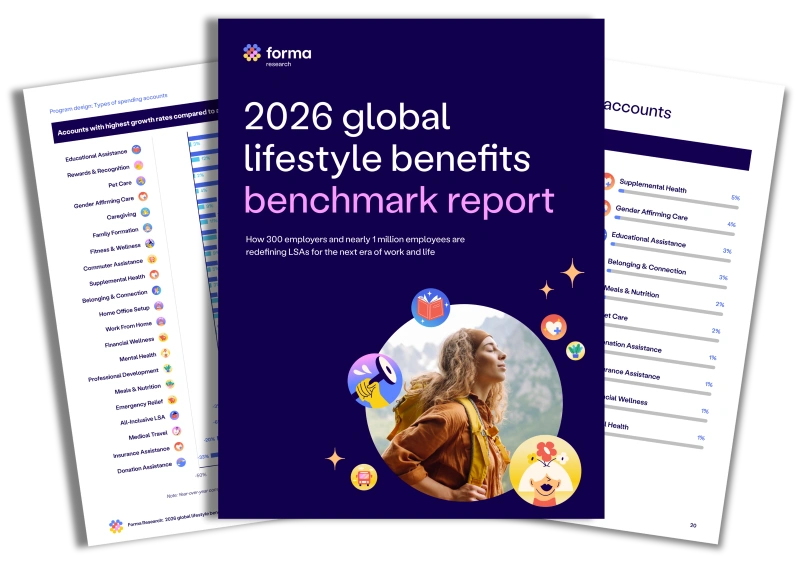
The 2026 benchmark gives you the medians to anchor those conversations. Employers that fund a Caregiving account provide a median of $3,630 per employee a year, Professional Development accounts carry a median of $1,090, and Well-being accounts a median of $850.
Family Formation support, which in the U.S. is typically anchored in an HRA rather than an LSA, shows a median of $10,530 where it is offered. Those numbers let a client pick a funding level that reads as meaningful without guessing.
- When the workforce spans several countries
Global clients hit a renewal problem the medical plan cannot solve: the U.S. plan changes affect one population, while employees in other countries sit on local statutory or insured schemes the consultant does not control. A benefit that works everywhere is rare, and an LSA with country-level configuration is one of the few.
This is now standard practice rather than an edge case. Forma’s 2026 benchmark found that 50% of employers run spending accounts in more than one country, and the design questions are the same each time: which countries are live, whether funding adjusts for cost of living, how local currency is handled, and how tax treatment differs by market. Geographic equity, meaning funding that is equally meaningful relative to local costs, is the goal rather than identical dollar amounts.
- When finance wants a predictable number
The CFO's objection to a new benefit in a cost-cutting year is predictability, and this is where the mechanics of an LSA do the persuading. Notional funding means the employer allocates an amount per employee but only pays for the dollars actually spent, so the budget line is a ceiling rather than a check written on day one.
The forecast you bring is simple: median funding per employee multiplied by expected utilization multiplied by headcount. Using the benchmark's worked example, a $600 allocation with 71% utilization is $426 of actual spend per employee, or about $2.13 million for 5,000 employees rather than the $3 million a full-use assumption would show.
Keep engagement, meaning the share of employees who use the account, separate from utilization, meaning the share of allocated dollars spent, because finance needs the second number to forecast and the client needs the first to judge whether the program reached people.
Every one of those responses depends on a platform that can run multiple purpose-built wallets with separate funding and reporting, next to the HRA and pre-tax accounts the client already has. Forma is built for exactly that, which is why consultants bring it into renewals where the client wants dedicated wallets rather than one all-inclusive account.
Employers configure dedicated benefits wallets for Well-being, Caregiving, Professional Development, and more, each with its own funding level, eligibility rules, and reporting, inside one unified employee experience that also runs HRAs, HSAs, FSAs, Commuter, and COBRA. Funding is notional, eligibility standards keep medical expenses out of the LSA, and dashboards report engagement and utilization separately by wallet and by country across 110+ countries.
Working on 2027 renewals now? Schedule a demo today and see how all five renewal responses look on one platform.
How to time an LSA alongside the medical renewal
An LSA does not have to start on January 1, and in a heavy renewal year it is often better if it does not. Open enrollment is already crowded with plan changes, new contribution amounts, and carrier communications, and a new benefit introduced in the same packet competes for attention it will not win.
The employee benefits renewal calendar still decides when to raise it, and the LSA has a place at each stage:
- Six months out: Claims data and point-solution renewal dates are reviewed, so put the LSA on the agenda as the consolidation and cost-shifting response.
- Four to five months out: Carrier quotes and alternate funding options come back, and the point-solution spend that will fund the LSA gets confirmed.
- Three months out: Plan design changes are locked, so the LSA funding source and wallet structure should be agreed alongside them.
- Open enrollment: Announce the LSA as part of the redesigned package story, even if the account opens later.
- First or second quarter: Launch off-cycle, when employees have the attention to learn a new account and the client's fiscal calendar makes budget approval cleaner.
The case for off-cycle LSA launches comes down to attention: the LSA gets the focus it deserves when it is not fighting the health plan renewal for it, and the client presents a full redesign rather than a cut followed by a later add-on.
Compliance guardrails consultants should raise early
Three points belong in the first LSA conversation rather than the last, because each one shapes the design. LSA dollars are taxable to the employee in most program designs, so the client's payroll team needs an imputed income feed and year-end reporting support, and the tax treatment should be confirmed with counsel for each country in scope.
Medical reimbursement belongs in an HRA. LSA benefits compliance means excluding medical expenses altogether. Keeping LSA spend off medical categories also protects HSA eligibility for employees on a high-deductible plan, and a platform that administers both accounts can enforce that boundary in the eligibility rules.
How to report LSA results at the next renewal
The LSA launched in a renewal year will be judged at the next one, so the reporting plan should be set before launch. Two numbers carry the conversation, and they answer different questions.
Engagement is the share of eligible employees who used the account at all, which tells the client whether the benefit reached people. Utilization is the share of allocated dollars spent, which tells finance whether the forecast held.
The goal is not simply more usage. A program that forecast 70% utilization and delivered 72% is performing well, while one that delivered 90% has a budget conversation coming, so the numbers should be read against the forecast rather than in isolation. Spend by wallet shows which categories employees valued, and that is the figure that shapes next year's funding levels and the next round of point-solution renewals.
Bring those three numbers, engagement, utilization against forecast, and spend by wallet, into the next renewal alongside the claims data, and the LSA stops being a line item and becomes part of how the client designs its package.
How Forma helps benefit consultants bring flexible benefits into every renewal
Forma gives consultants one platform for every renewal moment. Employers build a connected portfolio of dedicated benefits wallets, each configured around a specific use case and funding strategy, next to HRAs, HSAs, FSAs, Commuter, and COBRA in one unified employee experience.
The Well-being wallet that softens a deductible change and the Caregiving wallet that carries a retention story run on the same system as the client's pre-tax accounts.
Funding is notional, so the forecast you bring to finance is the number the client pays. Eligibility standards keep medical expenses out, and reporting separates engagement from utilization by wallet and by country. With configurable account structures, cost-of-living adjustments across 110+ countries, and nearly 1 million members, Forma turns the complexity of global benefits program design into a straightforward, data-backed process.
Planning for 2027 and beyond? Schedule a demo today and see how an LSA fits the package you are designing.
Frequently asked questions about LSAs in the context of benefits renewals
When should a benefits consultant introduce an LSA in the renewal cycle?
A benefits consultant should introduce an LSA before plan design is final, typically when claims data and point-solution renewals are reviewed about six months before the plan year. That timing lets the LSA be presented as part of the redesign rather than an add-on, while the launch can follow at open enrollment or off-cycle in the first quarter.
Can an LSA offset a higher health plan deductible?
An LSA cannot reimburse medical expenses, so it does not offset a higher deductible directly. An HRA is the account designed to reimburse qualified medical costs. An LSA can sit alongside an HRA and fund non-medical categories such as fitness, caregiving, or professional development, which gives employees visible value in the same year the deductible rises.
Do LSAs have to start on January 1?
LSAs do not have to start on January 1 because they sit outside the medical plan and the carrier relationship. Many employers announce the LSA during open enrollment and launch it off-cycle in the first or second quarter, when employees are not overwhelmed by plan changes and the budget can align with the company's fiscal calendar.
How do employers fund an LSA in a tight renewal year?
Employers in a tight renewal year usually fund an LSA by repurposing budget they already spend, most often on point solutions such as fitness subsidies, learning platforms, and meal benefits that renew separately and see limited use. Notional funding helps as well, because the employer pays only for dollars employees actually spend rather than the full allocation.
Is an LSA part of the health plan renewal?
An LSA is not part of the health plan renewal. It is a separate, employer-funded account administered outside the medical plan and the carrier relationship, with its own vendor, funding, and reporting. Consultants raise it during the renewal process because that is when plan design changes and point-solution budgets are decided, rather than because it renews with the carrier.
This article is for informational purposes. Forma is not engaged in the practice of law. Nothing contained herein is intended as tax or legal advice nor to replace tax or legal advice from counsel. If you need tax or legal advice, please consult with counsel or a certified tax professional.