










Well-being benefits programs in 2026: A global playbook
Most global well-being programs fail at the border. Here's a practical framework for building programs that work across every market you operate in.
In this piece
Imagine this: You rolled out a well-being benefits program your team spent months designing. The budget was approved, the vendors were onboarded, and the internal comms went out. Six months later, utilization numbers in half your markets are barely worth reporting.
This is one of the most common frustrations facing global total rewards and benefits leaders right now.
The problem is rarely effort or intent. It's that well-being programs built for one country tend to quietly fail in others, and the reasons why are structural, not motivational. Regulatory differences, cultural gaps, and the operational weight of managing a dozen regional vendors all compound over time.
This article breaks down why global programs stall, what the highest-performing ones actually do differently, and how to build a program that holds up across every market you operate in.
Key takeaways
- Most global well-being programs fail not because of lack of investment, but because they prioritize uniformity over relevance across markets.
- Regulatory fragmentation, cultural mismatch, and vendor sprawl are the three structural barriers that keep multinational programs from performing consistently.
- The most effective global programs set consistent funding and standards at the corporate level, then give employees local control over how they spend.
- Brokers like Mercer, Aon, and WTW are increasingly recommending consolidated benefits platforms as the infrastructure layer for global program delivery.
- Ready to build a well-being program that actually works across every market you operate in? Schedule a demo today and see how Forma helps global teams design, manage, and scale flexible benefits from a single platform.
Why most well-being programs fall apart at the border
Designing a well-being program for a distributed, multi-country workforce is a fundamentally different problem than designing one for a domestic team. Most program guides gloss over this distinction entirely. The truth is that global programs fail for structural reasons that no amount of good messaging or incentive design can fix.
Here are the four structural barriers that most multinational HR teams run into.
- Regulatory fragmentation: Tax treatment for employer-funded benefits varies dramatically across countries. A wellness stipend that flows through payroll cleanly in the U.S. may trigger taxable income in Germany, require specific documentation in Japan, or need to be structured as a separate reimbursement arrangement in Mexico. Without a country-specific compliance architecture built into the program, HR teams end up doing manual workarounds that don't scale.
- Cultural mismatch: What counts as a wellness benefit is deeply cultural. Mental well-being apps resonate strongly in the U.S. and U.K. but carry stigma in many Southeast Asian markets. Fitness reimbursements are popular in Western Europe. Family and caregiving support ranks highest in markets like India and Japan. Programs that offer identical categories globally end up relevant to some employees and irrelevant to many others. Utilization suffers accordingly.
- Vendor sprawl: A common pattern among growing multinationals is that each regional office has sourced its own wellness vendors over time. By the time the central HR team audits the stack, there are 12 to 20 point solutions running in parallel, none of which talk to each other. Finance can't see consolidated spend, employees get a fragmented experience, and HR is stuck managing relationships instead of strategy. Employee benefits management at this scale becomes a full-time coordination exercise.
- Measurement gaps: Because regional programs use different tools and different metrics, it becomes nearly impossible to compare performance across markets. A utilization rate in EMEA means something different than one in APAC if they're tracked differently. Global program decisions end up being made on incomplete data, which compounds the structural problems over time.
Organizations scaling globally often face a choice between running dozens of local vendor contracts or defaulting to a lowest-common-denominator program. A unified benefits platform eliminates that trade-off by centralizing administration while keeping the employee experience locally relevant.
When you're building or redesigning a global employee benefits program, this is the architectural decision that matters most.
Do corporate well-being programs work across borders?
This is a fair question, and the honest answer is: it depends entirely on how the program is designed. Domestic wellness programs have a mixed track record to begin with. Cross-border programs add several additional layers of complexity that, if unaddressed, make weak programs weaker and only the best-designed programs consistently effective.
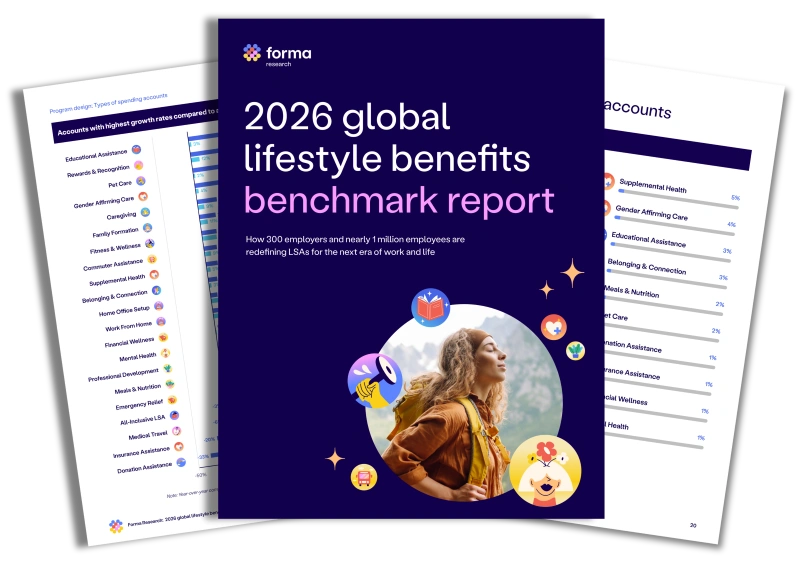
Forma’s 2026 benchmark research found that Total Well-being was the breakout use case of the year. Already 10% of employers offer this type of account, and the trend is rapidly going up. Couple this with the finding that 50% of employers offer lifestyle benefits programs in multiple countries, and it’s clear that global well-being programs are on the rise.
Research from Gallup shows that only 21% of employees globally are engaged at work, and well-being and engagement are tightly linked. The gap between what employers invest in wellness and what employees actually value is a global phenomenon, not a domestic one. The programs that do work share a common trait: they give employees meaningful choice over what counts as a benefit in their own lives.
When employees have control over how they spend their well-being dollars, utilization goes up. When companies assign static categories that don't match employees' real priorities, utilization drops.
This dynamic is even more pronounced in global programs, where the distance between what corporate designs and what employees actually need is wider. A working parent in London has different priorities than a single professional in Mumbai, and a benefits program that treats them identically will serve neither of them particularly well.
There is also a cost efficiency argument. Studies show that well-designed wellness programs produce measurable returns in reduced absenteeism, lower turnover, and improved productivity. The catch is that "well-designed" is doing a lot of work in that sentence.
Programs that employees don't use don't produce those returns. The investment in getting program design right, especially at a global level, is exactly what separates programs that show ROI from those that appear as a line item with no clear business case.
For more on evaluating that return, the analysis behind wellness programs ROI is worth reviewing before making structural program decisions.
The global consistency vs. local relevance structure
The central design tension in any global well-being program is not how much to spend. It's how to balance corporate-wide consistency with market-level relevance.
Push too hard toward consistency, and you end up with programs that feel fair on paper but irrelevant in practice. Push too hard toward local customization and you create an administrative nightmare with no shared infrastructure or reporting.
The best-performing global programs solve this with a layered architecture: set the standards and funding centrally, then let employees and local teams control the spending layer. Here is how that breaks down in practice.
Set global minimum standards
Every market should be covered by a defined minimum set of well-being categories, regardless of what else is available locally. These typically include mental well-being access, preventive care coverage, parental support, and an employee assistance program of some kind. Global minimums are not about identical benefits.
They're about ensuring that no employee in any market is excluded from a baseline of support because of where they happen to work. This is also the layer where equity decisions live: if your U.S. employees have access to mental well-being resources and your APAC employees don't, that's an equity gap, not a regional customization.
Research consistently shows that certain well-being categories drive meaningful engagement regardless of geography. These are worth treating as non-negotiable floors in any global program:
- Mental well-being access: Confidential counseling and EAP services show high engagement across markets when offered through digital-first, stigma-neutral platforms.
- Caregiver and family support: Childcare assistance, elder care resources, and parental leave top-ups are broadly appreciated across age groups and regions.
- Financial wellness tools: Budgeting resources, retirement planning guidance, and emergency savings programs address stress that cuts across income levels and cultures.
- Preventive care reimbursement: Coverage for routine health screenings, dental, and vision consistently ranks among the most-used benefit categories worldwide.
- Learning and development funding: Professional development stipends perform well globally, particularly among employees early in their careers or navigating role transitions.
Build flexibility into the delivery layer
Once global minimums are established, the delivery layer should be as flexible as possible. This is where Lifestyle Spending Accounts become a structurally important tool. An LSA allows employers to define eligible spending categories centrally while giving employees the autonomy to choose what they spend on within those categories.
A company might define categories like wellness, learning, caregiving, and home office across all markets. An employee in Germany chooses gym membership. An employee in India chooses caregiving support. An employee in Brazil chooses professional development. The program is consistent. The experience is personal.
For health-related reimbursement needs, Health Reimbursement Arrangements offer a tax-advantaged structure that can be adapted to specific use cases like vision, dental, or preventive care.
Combined with pre-tax accounts for U.S.-based employees, a layered platform approach covers the full spectrum of well-being spending. The LSA guide breaks down the mechanics for benefits teams building this kind of program for the first time.
Consolidate technology, not programs
One of the most common mistakes in global benefits is trying to consolidate the programs themselves rather than the technology infrastructure. Trying to force a single wellness program into 30 countries creates compliance risk and low adoption.
Consolidating onto a single platform that supports multi-currency, multi-language, and region-specific compliance gives you administrative efficiency without the cultural problems. Central HR teams get unified reporting. Regional teams and employees get experiences that fit their context. Both objectives are met without compromise.
Based on platform benchmarks, organizations that consolidate their global benefits onto a single flexible platform see higher utilization rates, lower administrative overhead, and more consistent employee satisfaction scores across regions. The unified benefits platform checklist is a useful starting point for evaluating whether your current tech stack can support this kind of architecture.
Five practices that separate high-performing global programs
Global well-being programs that consistently perform well share identifiable operational patterns. These are not generic best practices. Each one addresses a specific failure mode common to multinational program design.
1. Measure regionally, report globally
High-performing programs do not apply a single measurement framework uniformly across markets. They track utilization, satisfaction, and cost-per-employee at the regional level, then aggregate into a global view.
This matters because a 60% utilization rate in one region and a 30% utilization rate in another represent completely different problems requiring completely different responses. Aggregated averages hide those signals.
2. Fund equitably, not identically
Identical dollar amounts across all markets is not equity. A $100 monthly benefit goes much further in some markets than in others. Programs that apply cost-of-living adjustments to funding tiers see meaningfully higher satisfaction scores in high-cost markets and avoid the perception that certain employees are being underserved. Equity in global programs means access to equivalent value, not identical amounts.
3. Let employees self-direct
Employer-designed programs that assign specific benefits without employee input consistently underperform employee-directed programs. This pattern holds globally.
When employees choose their own allocations within employer-defined categories, utilization goes up and so does the likelihood that employees cite their benefits as a meaningful part of their compensation.
The data on this is consistent enough that it should be a structural design decision, not an optional feature. The lifestyle benefits guide for employers covers this in detail.
4. Involve brokers early
Brokers like Mercer, Aon, and WTW have benchmarking data that most internal HR teams simply don't have access to. Engaging them early in program design, rather than at the vendor selection stage, means the program architecture reflects current market standards before commitments are made.
Brokers are also increasingly familiar with flexible benefits platforms and can help build the business case for consolidation with CFO-level language. Following employee benefits strategies informed by broker benchmarking gives HR teams a much stronger foundation for internal approvals.
5. Combine systemic and individual interventions
The most effective global programs work at two levels simultaneously. At the systemic level, they address structural barriers to well-being: workload norms, manager behavior, and leave policies.
At the individual level, they give employees resources they can actually use. Programs that only operate at the individual level end up as perks on top of broken systems, and employees see through that quickly. Programs that combine both layers generate durable engagement. How flexible benefits support employees covers the individual layer in more depth.
What global-first companies are getting right
A clear pattern has come up among people-first multinationals over the past several years. The companies consistently recognized for their benefits programs, including Forma clients like Lululemon, Stripe, and Peloton, share a common operating philosophy: they treat benefits as a strategic talent investment, not a compliance checkbox.
These organizations have moved away from static, employer-designed packages toward employee-directed programs where the company sets the funding and the framework, and employees make the choices. This shift is not just philosophically appealing. It produces measurable outcomes. When employees choose benefits that reflect their actual lives, satisfaction compounds. Organizations that adopt employee-directed spending across global markets consistently report that employees rank their flexible benefits as the top benefit in annual surveys.
Benefits consultants and brokers at Mercer, Aon, WTW, Lockton, Sequoia, Brown & Brown, Gallagher, Alliant, and more are echoing this shift in their own advisory work. The recommendation to consolidate onto flexible platforms has moved from an emerging idea to standard strategic guidance for companies managing distributed global workforces. For companies with employees across multiple currencies and locales, the value of a unified platform with local flexibility is immediately clear and easy to build a business case around.
A global well-being design checklist for benefits leaders
For HR, total rewards, benefits, and wellness leaders who need a fast reference for program design (or redesign), here is a practical checklist:
- Audit current spend: Map every benefit vendor, program, and budget line by region and category before making any structural decisions.
- Define global minimums: Set 3 to 5 non-negotiable categories that all markets must include, typically mental health access, parental support, preventive care, and an EAP.
- Select a unified platform: Choose a platform that supports multi-currency, multi-language, and region-specific compliance out of the box.
- Adjust funding for cost of living: Set funding tiers by market rather than applying identical dollar amounts globally.
- Configure categories centrally, spend locally: Use LSA category configuration to maintain corporate standards while giving employees local spending choice.
- Build in a compliance review cycle: Schedule regional compliance reviews quarterly to account for changes in tax treatment, data privacy rules, and local labor law.
- Track at the regional level: Report utilization, satisfaction, and cost-per-employee by region, not just globally.
- Partner with a broker: Engage Mercer, Aon, or WTW early for benchmarking data and business case support.
The unified benefits platform checklist is a useful companion resource when evaluating technology vendors against these criteria.
Why Forma is built for global well-being programs
Designing a global well-being program that holds together across dozens of markets, currencies, and compliance environments is genuinely hard. Most platforms were built for domestic use and retrofitted for global delivery, which is exactly where the operational cracks show up.
Forma was built from the start to support global benefits programs at scale. The platform centralizes administration across all markets while giving employees in each country a locally relevant spending experience. HR teams configure LSA categories, funding tiers, and eligibility rules from a single admin dashboard.
Employees in any of Forma's 100+ supported countries access their benefits through a unified portal and spend via the Forma Card or claims reimbursement. Compliance, tax treatment, and currency conversion are handled within the platform, not through manual workarounds.
Companies like Lululemon, Stripe, and Zoom have used Forma to move from fragmented regional programs to a single flexible platform without sacrificing the local relevance that drives utilization. The result is higher engagement, simpler administration, and a benefits program employees actually talk about.
If your current program is producing inconsistent results across markets, we can help. Schedule a demo today to see how Forma supports global well-being programs from a single platform.
Frequently asked questions about well-being programs in the workplace
What is the difference between a wellness program and a well-being program?
Wellness programs traditionally focus on physical health, like fitness reimbursements or smoking cessation. Well-being programs take a broader view that includes mental health, financial security, caregiving, professional development, and social connection. Most modern employer programs use "well-being" as the umbrella term because it better reflects the full range of employee needs that benefits programs are expected to address.
How do you measure the effectiveness of a global well-being program?
The most reliable indicators are utilization rate by region, employee satisfaction scores tied specifically to benefits, and downstream HR metrics like turnover and absenteeism. Effective measurement requires tracking at the regional level before rolling up to global aggregates. Uniform global averages often mask significant regional variation that requires different responses.
What is a Lifestyle Spending Account and how does it fit into a global program?
A Lifestyle Spending Account is an employer-funded benefit that gives employees a set amount of money to spend across eligible categories like wellness, learning, caregiving, and home office expenses. In a global program, LSAs are particularly useful because employers can define categories centrally while employees make locally relevant spending choices. This makes them a strong tool for balancing corporate consistency with cultural fit.
How should multinational companies handle tax compliance for well-being benefits?
Tax treatment for employer-funded benefits varies significantly by country. Some markets treat wellness stipends as taxable income, while others allow pre-tax treatment under specific conditions. The safest approach is to work with a benefits platform that handles country-specific tax and compliance rules within the product architecture, rather than managing exceptions manually. Consulting local legal counsel for each market remains important for complex programs.
Do employees in different countries value the same types of well-being benefits?
No, and designing programs as if they do is one of the most common global benefits mistakes. Mental health support, family benefits, fitness, financial wellness, and professional development all vary significantly in importance by market and demographic. The most effective programs use employee surveys and utilization data at the regional level to continuously refine what categories and vendors are most relevant in each market.
How can HR leaders build a business case for consolidating onto a single benefits platform?
The business case for consolidation typically rests on three pillars: administrative cost savings from reducing the number of vendor contracts and manual processes, utilization improvements from giving employees a single, easier-to-use portal, and data quality improvements from having unified reporting across all markets. Brokers like Mercer, Aon, and WTW can provide benchmarking data that strengthens each of these arguments for CFO-level approval.
What role do brokers play in global well-being program design?
Brokers bring benchmarking data, market knowledge, and strategic advisory capabilities that most internal HR teams don't have access to in-house. In global program design, they can identify what peer companies in each market are offering, flag compliance risks, and help structure the vendor selection process. Many brokers also have existing relationships with flexible benefits platforms and can accelerate the evaluation and implementation process.
This article is for informational purposes. Forma is not engaged in the practice of law. Nothing contained herein is intended as tax or legal advice nor to replace tax or legal advice from counsel. If you need tax or legal advice, please consult with counsel or a certified tax professional.
.png)


.png)