









What 300 organizations and nearly 1 million employees taught us about benefits in 2026
An overview of the key findings from Forma's 2026 global lifestyle benefits benchmark report
In this piece
For years, Lifestyle Spending Accounts occupied a predictable spot in the benefits hierarchy: valued, but vulnerable. Nice to have, but not seen as strategic or essential.
In 2026, that’s changing.
The data from Forma's 2026 global lifestyle benefits benchmark report — built from 300 organizations representing nearly 1 million employees across 110 countries — tells a new story: LSAs aren't just surviving scrutiny. They're being reimagined to meet it.
Here are the five headline findings from our 2026 benchmark research that benefits and total rewards leaders need to understand now:
1. The "spend on anything" version of LSAs is evolving into something new
Despite record-high LSA adoption overall, All-inclusive LSAs — the broad, spend-on-anything accounts that defined the category for nearly a decade — declined 3% year-over-year. What's growing in their place is a curated approach: employers building portfolios of two to five focused accounts, each aligned to a specific workforce need or business priority.
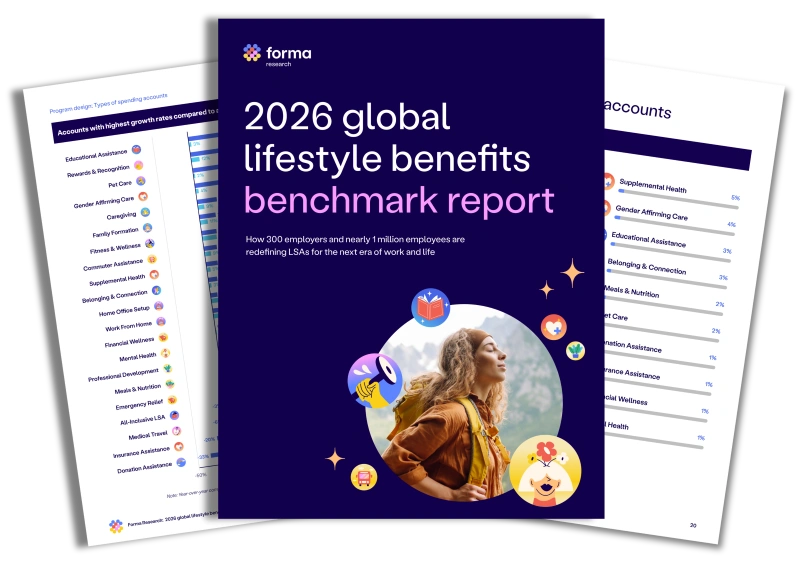
The account types gaining ground tell the story clearly. Education assistance accounts surged 233%. Rewards & Recognition accounts grew 192% year-over-year. Caregiving and Family Formation accounts grew 29% and 24%, respectively.
These aren't vanity benefits. They're targeted investments in outcomes employers actually care about: retention, skills development, workforce productivity, and talent competitiveness. The era of "give employees everything" is giving way to the era of "give employees exactly what they need."
2. Total rewards teams are using lifestyle benefits to respond to business priorities in real time
One of the most striking findings in this year's data involves organizational agility. Benefits teams operating LSA infrastructure report standing up new programs or spending categories in days — not the months that a traditional RFP cycle would require.
That speed matters because the business priorities LSAs are being deployed against are themselves moving fast. In 2025 and into 2026, employers used LSAs to respond to emerging needs like AI readiness and reskilling pressures, RTO mandates, and healthcare cost containment — often deploying lifestyle benefits solutions faster than a vendor evaluation process could even begin.
This is a fundamental reframe for the category. LSAs aren't just a benefits vehicle. In the hands of forward-thinking benefits teams, they've become an operational capability for responding to workforce challenges as they emerge.
3. Total Well-being has evolved from a strategy into an account type
Ten percent of all accounts in this year's benchmark study fall into a new category: Total Well-being. This isn't simply Fitness & Wellness with a new name. It's a distinct and intentional approach that focuses on areas that include physical, mental, financial, and social well-being.
The emergence of Total Well-being as a standalone account type reflects a maturation in how employers think about well-being investment. Rather than treating these areas as separate initiatives with separate vendors and separate budgets, leading employers are integrating them, which reduces administrative burden while creating a more cohesive experience for employees.
4. Employees are spending on services, not products
Employee spending behavior has shifted decisively over the past year. Caregiving services, connectivity, and skills development are all trending upward. Simultaneously, spending on products — fitness equipment, clothing, lifestyle accessories — is declining.
The shift signals something important: employees are using their benefits dollars for essential, high-cost needs rather than just discretionary perks. They're covering expenses that directly affect their ability to show up and perform — childcare, internet access, professional development. Employee priorities have matured, and the best benefits programs are following them there.
5. LSAs have become the global standard for benefits equity
Perhaps the most significant structural shift in this year's data: 50% of all employers studied now operate LSAs across multiple countries — without having to navigate country-by-country vendor complexity.
This solves a problem that has historically plagued global benefits teams: how do you deliver equitable, meaningful benefits at scale when purchasing power, local regulations, and employee expectations vary dramatically by market? The LSA model, deployed globally, is increasingly the answer. It provides a consistent benefits infrastructure while allowing local flexibility in how employees actually use their funds.
The practical result is that a VP of Total Rewards in San Francisco and a team member in Singapore or São Paulo can access the same benefits platform, with the same simplicity, calibrated to their local context.
The bottom line
What emerges from Forma's 2026 benchmark data isn't a list of trend updates — it's a fundamental reconceptualization of what LSAs are for. The most effective benefits programs in 2026 treat LSAs as strategic infrastructure: customizable, scalable, and capable of responding to business priorities faster than any other benefits vehicle.
The question for benefits and total rewards leaders isn't whether to offer LSAs. It's whether you're deploying LSAs, HRAs, and other spending accounts strategically to realize the full value of what the lifestyle benefits category has become.
.png)


.png)