











How to build a global employee benefits strategy that works in every market
Build a global employee benefits strategy with a 5-step framework covering funding, governance, compliance, and platform choice.
In this piece
Quick Answer: A global employee benefits strategy coordinates how a company funds, delivers, and administers benefits across every country where employees work. Building one requires five steps: auditing local needs, defining a funding philosophy, layering voluntary benefits over statutory minimums, selecting the right platform architecture, and establishing governance. The goal is equitable value across markets, not identical programs.
Benefits leaders at multinational companies face a quiet but growing problem. A program designed at headquarters works beautifully for employees there and falls flat everywhere else. The gym reimbursement that signals premium culture in San Francisco means little to an engineer in Mumbai who walks to work, and the mental well-being stipend that made sense in London feels redundant in Paris, where similar support already runs through statutory coverage.
Most people leaders know this intuitively. What's harder is turning that intuition into a defensible plan that finance will fund, regional HR teams will execute, and employees in twenty countries will actually use. The common fallback is to copy the HQ program, translate the policy document, and hope for the best. Utilization data almost always shows that approach failing.
This article lays out a practical benefits strategy framework for building something that treats international employees as first-class participants rather than afterthoughts, and that holds up under scrutiny from finance, legal, and regional people leaders.
Key takeaways
- A global employee benefits strategy is about equitable value, not identical programs. The goal is consistent outcomes across markets, not matching dollar amounts.
- Funding philosophy comes before vendor selection. Equal dollars, purchasing power parity, and cost-of-living adjustments each send different equity signals.
- Statutory benefits vary dramatically by country, so voluntary programs should layer on top of legal minimums instead of duplicating them.
- Platform architecture determines administrative efficiency. A single global platform with local flexibility typically outperforms a patchwork of country-specific vendors.
- Ready to consolidate your global benefits onto one platform with automatic currency conversion and cost-of-living adjustments built in? Schedule a demo today with Forma.
What are global employee benefits?
Global employee benefits are the non-salary forms of compensation a company provides to employees across multiple countries, designed to work within each market's legal, cultural, and economic context. They sit on top of statutory benefits (the ones a government requires, like national health coverage, social security contributions, and mandated leave) and include voluntary programs such as lifestyle spending accounts, supplemental health coverage, retirement matching, and family support.
The category is distinct from country-specific programs in one important way. Global benefits are coordinated at the corporate level with shared design principles, even when execution happens locally. That coordination is what separates a genuine global program from a loose collection of country programs that happen to share a logo.
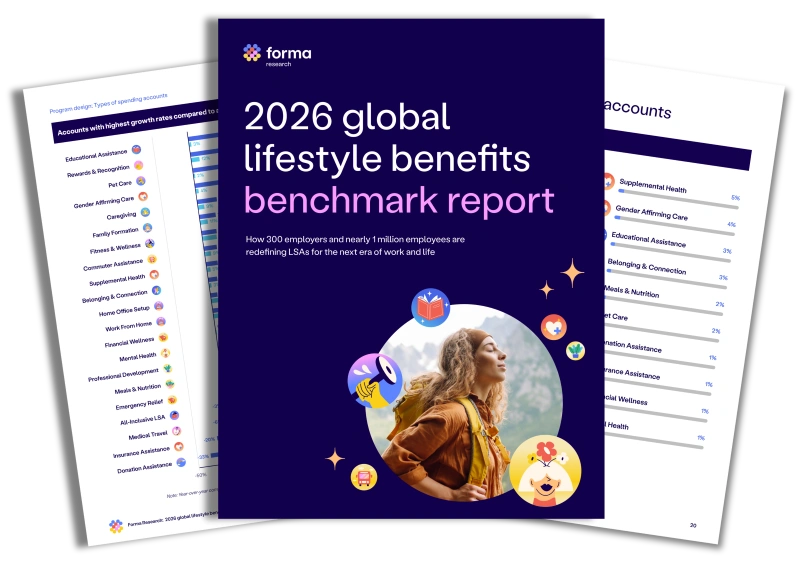
The 2026 Forma Benchmark report shows that 50% of employers now run spending accounts in more than one country, and about 4% operate across 30 or more countries. You can read more statistics like this in our 2026 Forma Benchmark report.
That shift reflects a real tension. Companies want to signal fairness and equity to every employee, but employees in different markets want different things. What registers as premium support in one country often goes unused in another where similar coverage already comes through statutory programs.
How to build a global employee benefits strategy in 5 steps
Most strategies fail because they start with the wrong question. Teams jump straight into "which vendors do we need in each country" before answering "what are we actually trying to fund, and why." The five steps below reverse that order, starting with employee needs and funding philosophy before touching platform or vendor decisions.
Step 1: Run an employee listening audit by region, not by program
Skip the temptation to assume that what HQ wants is what every office wants. Before reviewing a single vendor, talk to employees in each major market.
Interview small groups in each country about where current benefits fall short, what statutory coverage already handles, and what out-of-pocket spending feels most painful. The findings are rarely what headquarters expects.
A common pattern: what HQ calls a "wellness" gap is actually a caregiving or meals need in APAC markets, or a commuter and housing affordability concern in parts of EMEA. Designing a fitness stipend when employees needed grocery support is how utilization ends up at 30% instead of 80%.
Document what you hear and look for patterns. Three or four themes usually emerge that cut across multiple countries, and those themes should shape your funding categories.
Step 2: Define your funding philosophy before picking vendors
Before any vendor conversation, decide how you'll set funding amounts across countries. There are three viable models, and each sends a different equity signal.
- Equal dollar amounts: every employee gets the same allocation regardless of location. Signals fairness in raw terms but creates unequal purchasing power.
- Purchasing power parity (PPP): funding adjusts based on the cost of equivalent goods in each country. Signals equity in outcomes but is complex to communicate.
- Cost-of-living adjusted (COLA): funding scales to local costs using published indices. The middle ground most global employers settle on.
None of the three is objectively right. The question is which signal you want to send, and whether your workforce will interpret it the way you intend.
Document the rationale in plain language so regional HR teams can defend it when employees ask why the India allocation differs from the US one. Published LSA cost-of-living adjustment guidelines are a useful starting point for the ongoing maintenance work.
Step 3: Map statutory floor vs. voluntary layer in each market
Every country sets a legal floor: national health, mandatory pension contributions, paid leave, parental leave, and sometimes commuter reimbursements or meal vouchers. Your voluntary employee benefits strategy should build on that floor, not compete with it.
France illustrates one end of the spectrum. Strong statutory health coverage means supplemental medical budget goes further when shifted toward lifestyle, family formation, or professional development. The US sits at the other end. A weaker statutory floor pushes supplemental benefits toward health, financial well-being, and caregiving.
Work with local tax counsel early. Benefit taxability varies widely. A home office stipend that's tax-free in one country may be fully taxable income in another, which changes both the economics and the employee communication. Treat compliance considerations as a design input, not a final-stage review.
Step 4: Choose your platform architecture
After funding philosophy and statutory mapping comes the platform decision. Two architectures dominate.
The first is a centralized global platform with local flexibility. One vendor, one employee experience, one admin dashboard, with currency conversion and local eligibility rules built in. Administration is simpler and benchmarking across markets is easier because the data lives in one place.
The second is a regional vendor stack with a shared reporting layer. Multiple vendors, often more local expertise per country, but harder to benchmark and substantially more work to administer. Point solutions fatigue is the predictable result, and it drags utilization down across every program.
Decision drivers include headcount per country, internal HR capacity to manage vendor relationships, and appetite for multi-vendor oversight. Small global footprints can sometimes justify regional stacks. Organizations with 20+ countries almost always benefit from consolidation.
This is where a platform like Forma earns its place in a global benefits strategy. Forma operates in 100+ countries and handles the infrastructure that makes step 4 work at scale: automatic currency conversion, cost-of-living adjustments applied by rule rather than spreadsheet, localized eligibility for every market, and a unified admin dashboard that captures utilization data by country. HR teams get one vendor relationship instead of fifteen.
Employees get one experience instead of learning a different benefits portal every time they transfer offices. Finance gets one source of truth for forecasting, audit, and regional cost allocation. Companies including Lululemon, Stripe, and Zoom use Forma as their global benefits backbone.
Schedule a demo today to see how Forma simplifies multi-country benefits.
Step 5: Build governance for eligibility, vendors, and reporting
A global benefits strategy without governance drifts into chaos within 18 months. Someone owns this function, or it fails.
Designate a global benefits owner at the corporate level, with regional leads in each major market who have authority over local eligibility and communication. Establish a quarterly review cycle covering eligibility updates, vendor performance, utilization data by country, and any regulatory or tax changes that affect taxability.
Set reporting standards that capture utilization at the country level, not just aggregated global numbers. Global averages hide the countries where programs are failing. Plan for GDPR and data privacy reviews on an annual cadence, and build vendor compliance audits into the governance calendar.
Benefits of building a global benefits program
A coordinated global benefits program delivers several outcomes that piecemeal country programs cannot match.
Talent recruitment gets easier in competitive international markets. Candidates comparing offers in Singapore or Berlin notice when benefits look like an afterthought, and they notice when programs look designed. Retention follows the same logic. Non-HQ employees frequently report feeling like second-class citizens when HQ gets the premium program and other countries get the basics. A real global benefits strategy closes that gap.
Administrative efficiency is often the most tangible gain. Managing fifteen country-specific vendors across payroll, reimbursement, and communication is a full-time job for multiple FTEs. One platform with local flexibility typically cuts that overhead by 60-70% while improving the employee experience.
Cost forecasting gets sharper, too. The Forma 2026 Benchmark uses a simple model: median funding per employee × utilization rate × headcount = forecasted program cost. Applied to a 5,000-employee fitness allocation with a $600 budget at 71% utilization, the forecasted spend is $2.13M. Assuming full budget use would overstate that by nearly $900K, which is a meaningful gap in any annual planning cycle.
Global benefits solutions also unlock utilization patterns that traditional programs miss. The 2026 Forma Benchmark shows all-inclusive LSA spending rates reaching 90-95% in Australia, India, and Singapore, well above global averages. That variance is a planning input, not noise.
Industry research from MetLife's Employee Benefit Trends Study consistently shows that employees in global organizations rank benefits transparency and equitable treatment among their top drivers of engagement. Separate findings from Mercer reinforce that benefits consistency across markets is a rising expectation for multinational workforces, not a nice-to-have.
How Forma powers global benefits strategies across 100+ countries
Designing a global benefits strategy is the planning work. Executing it is the platform work, and that's where Forma comes in.
Forma operates in 100+ countries with automatic currency conversion, cost-of-living adjustments applied programmatically, and localized eligibility rules that keep programs compliant in every market. The platform consolidates lifestyle spending accounts, pre-tax accounts, HRAs, commuter benefits, and rewards and recognition into a single employee experience and a single admin dashboard. Reporting is global or country-specific with two clicks.
Lululemon uses Forma to deliver wellness benefits across its international workforce, with equitable funding that adjusts by market and a single employee experience regardless of country. Other global employers use Forma the same way: as the execution layer that turns a strategy document into a program employees actually use. The result is higher utilization, cleaner governance, and a defensible cost model that finance can stand behind.
Schedule a demo today to see how Forma can power your global benefits program.
Frequently asked questions about global employee benefits strategy
How long does it take to build a global benefits strategy?
From kickoff to rollout, most global benefits strategies take 6 to 9 months. The listening audit and funding philosophy decisions typically take 2 to 3 months. Platform selection and vendor contracting add another 2 months. Implementation and country-by-country rollout usually fills the remaining months, with phased launches by region rather than a simultaneous global cutover.
What's the difference between a global benefits strategy and a country-specific one?
A country-specific strategy optimizes for one market's laws, culture, and employee expectations. A global benefits strategy coordinates principles and funding philosophy across all markets while allowing local execution to vary. The goal of a global approach is equitable value across countries, not identical programs, and that distinction shapes almost every design decision.
Should HR or finance own the global benefits strategy?
HR typically owns the strategy, but finance has to co-own the funding model. The best governance splits responsibility: HR owns program design, employee communication, and vendor management; finance owns funding philosophy, budget allocation, and forecasting. A global benefits strategy without finance buy-in rarely survives its first budget cycle.
How do you measure success of a global benefits strategy?
Utilization by country is the primary metric. Global averages hide struggling markets. Secondary measures include employee satisfaction scores segmented by region, cost per participant, retention rates in key markets, and administrative hours per 1,000 employees. Successful strategies show utilization above 60% in most countries and narrow variance between HQ and non-HQ satisfaction scores.
What's the biggest mistake companies make with global benefits?
Copying the HQ program and translating the policy document. Employees in other markets see it immediately and disengage, and utilization data confirms the problem within a quarter or two. The second most common mistake is picking vendors before defining funding philosophy, which results in programs that cannot be defended when regional HR teams get fairness questions.
Do you need different vendors for different countries?
Not necessarily. Single-platform global providers now operate in 100+ countries with localized compliance, currency conversion, and eligibility rules. Multiple vendors were standard five years ago because platform options were limited. Today, the vendor decision is about headcount per country and administrative capacity, not a default assumption that global requires fragmentation.
How do you budget for global benefits when currencies fluctuate?
Most global employers budget in a single reporting currency (usually USD or EUR) but fund in local currency at the employee level. Forecasting accuracy improves when you use realized utilization rates rather than full budget assumptions. Quarterly FX reviews and a currency volatility buffer of 5-10% handle most scenarios without forcing mid-year budget reallocations.
This document is for informational purposes. Forma is not engaged in the practice of law. Nothing contained herein is intended as tax or legal advice nor to replace tax or legal advice from counsel. If you need tax or legal advice, please consult with counsel or a certified tax professional.
.png)


.png)