









Why fertility benefits shouldn’t be treated as an isolated experience
Standalone fertility vendors can create friction. See how connected Family Formation benefits improve employee experience, reporting, and program design.
In this piece
Quick Answer: Fertility and Family Formation benefits work better when they are part of a connected benefits experience, not isolated in a standalone vendor portal. Forma helps employers support Family Formation through purpose-built account structures that fit the use case, country, compliance needs, and broader benefits strategy.
Fertility treatments can cost tens of thousands of dollars per cycle. For employees already navigating one of the most emotionally demanding experiences of their lives, the last thing they need is a disjointed benefits experience that adds paperwork, confusion, and delays on top of the stress they're already carrying.
And yet, that's exactly what most employer fertility benefits programs deliver. A standalone vendor with its own login, its own claims process, its own support team, and its own set of rules that don't connect to anything else in the employee's benefits package. HR teams, meanwhile, inherit another vendor relationship, another integration, and another reporting dashboard to manage.
The irony is that most companies add fertility support because they want to show employees they care. But when fertility coverage lives in isolation, employees struggle to find it, struggle to use it, and often leave money on the table because the experience is too fragmented to be worth the effort.
There's a better approach, and it starts with rethinking where fertility benefits at work should live within your broader benefits ecosystem.
Key takeaways
- Fertility and Family Formation benefits are growing in demand, but standalone vendors can create fragmented experiences during an already sensitive life stage.
- Family Formation benefits require careful account design. In the U.S., they are typically structured through an HRA, while international programs may be handled differently depending on local rules.
- Forma gives employers one platform where multiple purpose-built benefits wallets and account structures can live together, including Family Formation, Caregiving, Well-being, and other support categories.
- A one-platform, multi-wallet approach gives employees one familiar experience while helping employers customize funding, manage compliance considerations, and improve reporting across benefit categories.
- Forma helps companies bring Family Formation support into a connected benefits experience without treating it as a single all-inclusive LSA wallet. Schedule a demo to see how Forma supports purpose-built benefits wallets and account structures through one platform.
The fertility benefits landscape is expanding, but fragmented
More employers are adding fertility support every year. That's the good news. The bad news is that most of them are defaulting to standalone vendors that operate entirely outside the rest of their benefits ecosystem. The result is a growing patchwork of disconnected programs that create friction for employees and complexity for HR teams. At Forma we call this the “more is more paradox.”
Before jumping into solutions, it helps to understand what's driving the growth in the first place, and where the structural problems start to show up.
Why more employers are adding fertility support
The demand side of employer fertility benefits is clear. Employees increasingly expect family-building support as part of a competitive total rewards package, and employers are responding. According to the International Foundation of Employee Benefit Plans, 42% of U.S. employers now offer fertility benefits, up from just 30% in 2020.
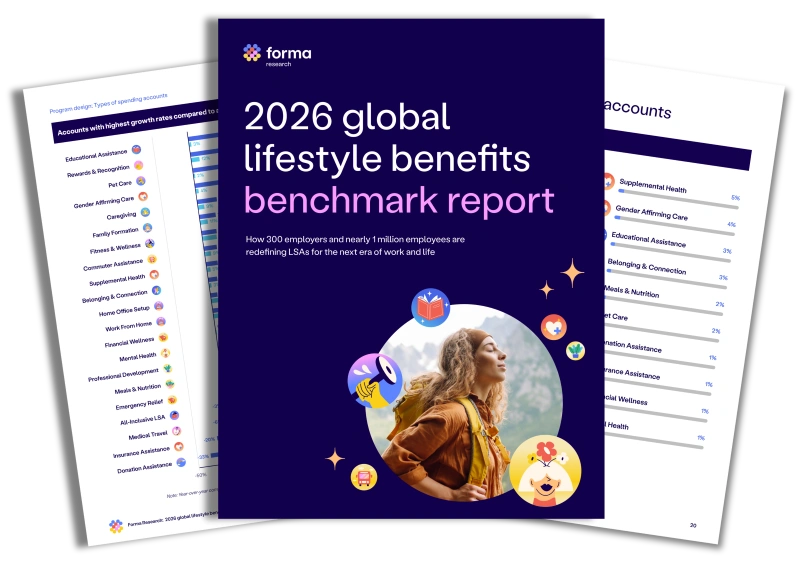
Financial services companies are leading the charge. Forma’s 2026 global lifestyle benefits benchmark report found that financial services allocates 2x more to family formation than any other industry, with some employers funding up to $42,000 per employee annually. The median annual funding for family formation benefits sits at $10,530 per employee across all industries.
This isn't a fringe benefit anymore. When nearly half of employers offer some form of fertility coverage, the conversation shifts from "should we offer this?" to "how should we structure it?"
The problem with treating fertility as an isolated program
When fertility or Family Formation support lives in its own silo, it is disconnected from the rest of the employee’s benefits experience. Employees may not see how that support relates to Caregiving, Well-being, parental leave, or other life-stage benefits. HR teams, meanwhile, are left managing another point solution with its own reporting, HRIS integration, renewal cycle, and employee support process.
That disconnection has real costs, both in dollars and in employee trust.
What employees experience with point solutions
It's easy to talk about program architecture in the abstract. But the real test of any benefit is what happens when an employee tries to use it. For fertility benefits at work, the experience with standalone vendors often falls short of the intention behind them.
Multiple logins, multiple vendors, multiple friction points
Picture an employee beginning a fertility journey. She's already managing appointments, medications, insurance pre-authorizations, and the emotional weight that comes with all of it. Now add a separate fertility vendor portal she's never used before.
She needs to create a new account, learn a new interface, figure out a new claims process, and call a different support team when something does not work. This is all separate from the platform where she manages the rest of her benefits. If she also needs Caregiving support, Well-being support, or postpartum resources later, that could mean yet another system.
Every additional login and vendor is a barrier. And for employees going through one of the most demanding periods of their lives, even small barriers can feel overwhelming enough to abandon the benefit entirely.
How a unified benefits platform handles fertility differently
There is a structural alternative to standalone fertility vendors: a unified benefits platform that brings Family Formation support into the same employee experience as other benefits, while still allowing each account or wallet to be designed for its specific purpose.
That distinction matters. Forma is not advocating for one broad all-inclusive LSA where fertility, caregiving, Well-being, meals, home office, and every other category all share the same catch-all wallet. The stronger model is one platform with multiple purpose-built accounts, each configured around a specific use case, funding strategy, compliance need, and employee population.
Family formation as a purpose-built account structure
Instead of treating fertility support as an isolated vendor experience, employers can design Family Formation benefits as a dedicated account structure within the Forma platform. That account can live alongside other benefits wallets, such as Caregiving, Well-being, Professional Development, or Home Office, while still giving employees one familiar place to access their benefits.
Family Formation is also more compliance-sensitive than many other benefits categories. In the United States, these benefits are typically structured through an HRA because they may involve medical expenses, tax considerations, and more complex reimbursement rules. In other countries, Family Formation support may be structured differently, including as an LSA where appropriate.
Forma supports program design so employers can structure Family Formation benefits based on country, covered expenses, compliance needs, and workforce priorities. The result is not one huge wallet for every possible benefit. It is one connected experience where each wallet or account has a clear purpose.
The simplicity is the point. When employees can access support through a familiar benefits experience, there are fewer barriers between the employee and the benefit. For employers, a connected platform also creates clearer visibility into how Family Formation support is being used and how it fits into the broader benefits strategy.
One employee experience across all life-stage benefits
The value of a unified platform becomes even more obvious when you zoom out across an employee's career. The same person who uses fertility support this year may need childcare assistance next year and flexible benefits for working parents support the year after that.
If each of those needs is served by a different vendor, the employee is learning a new system during every major life transition. That's exactly the wrong time to introduce friction.
A platform-based approach means one learning curve, one support team, and one claims flow across every life stage. The employee already knows how the system works. They just direct their spending toward a different category as their needs change.
How forma supports connected family formation benefits through one platform
Forma helps employers bring Family Formation benefits into a connected benefits experience without forcing every use case into one broad all-inclusive LSA. Employers can design purpose-built account structures for Family Formation while keeping the employee experience connected to other benefits, including Well-being, Caregiving, Professional Development, and other support categories.
That one-platform, multi-wallet approach gives employees a simpler experience and gives employers more control over funding, eligibility, reporting, and program design. Instead of managing Family Formation as an isolated point solution, benefits teams can see how it fits into the broader employee experience.
Forma helps companies deliver configurable benefits across 110+ countries through one platform. Schedule a demo to see how your team can bring Family Formation support into a more connected, employee-friendly benefits experience with purpose-built account structures, stronger reporting, and support across 110+ countries.
How to evaluate fertility benefits as part of a broader program
Whether you're evaluating a new fertility vendor or reconsidering the one you have, the questions you ask should reveal how well the program integrates with the rest of your benefits ecosystem. The right questions expose whether you're buying a standalone tool or a building block of a connected employee experience.
Questions to ask your current fertility vendor
Before renewing or expanding a standalone fertility vendor contract, ask questions that reveal whether the program supports a connected employee experience or creates another disconnected point solution:
- Does this integrate with our HRIS? If the vendor requires manual enrollment or separate file feeds, you're adding administrative work every pay period.
- Can employees access fertility benefits through our existing portal? If the answer is a separate app or website, that's a friction point employees will feel immediately.
- What happens when an employee needs fertility support and caregiving in the same year? If those are handled by two different systems, the employee is navigating two different claims processes during overlapping life events.
- How do you handle global workforces? If the vendor only operates in the U.S., your international employees are excluded from coverage.
- Can we customize eligibility criteria for non-traditional family building? If the vendor's eligible expense list is fixed, you may be excluding employees whose family-building paths don't fit a narrow definition.
- What does consolidated reporting look like? If you cannot see Family Formation benefit performance alongside other benefits in one place, you are making decisions with incomplete data.
Any "no" in that list is a signal that you're managing a point solution rather than an integrated program.
What to look for in a platform that supports family formation holistically
The evaluation criteria for a unified platform look different from what you'd ask a standalone vendor. Focus on:
- Single employee-facing interface: Employees should be able to access Family Formation support and other benefits from one familiar platform, even when those benefits are structured through different wallets or account types.
- Admin visibility across account types: HR teams should be able to see utilization, spending, and balances across benefit categories in one place.
- Flexible account configuration: The platform should support purpose-built wallets or account structures based on use case, country, eligibility rules, funding strategy, and compliance needs.
- Compliance-aware program design: Family Formation benefits should not be treated as a generic LSA category. The structure should reflect the country, covered expenses, tax treatment, and reimbursement requirements.
- HRIS and payroll integration: Benefits data should sync cleanly so HR teams are not managing manual file uploads or disconnected systems.
- Global capability: If you have international employees, the platform should support multi-country, multi-currency deployment and local program variation.
- Consolidated reporting: Tracking Family Formation benefit performance means seeing it in context alongside other benefits, not in a siloed vendor dashboard.
Why Forma is the right partner for fertility benefits that employees actually use
Family Formation support only creates value when employees can find it, understand it, and use it without unnecessary friction. Forma makes that possible by bringing Family Formation benefits into the same platform employees already use for other support, while still allowing employers to design the right account structure for the use case, country, and compliance requirements.
That is the difference between a standalone fertility vendor and a unified benefits platform. A point solution may solve one need in isolation. Forma helps employers connect Family Formation to the broader benefits experience, with purpose-built wallets or account structures, consolidated reporting, configurable eligibility, and global support across 110+ countries.
Research from Maven Clinic found that 81% of workers who use fertility benefits report higher engagement and productivity. The platform you use to deliver those benefits helps determine whether employees can actually access that support when they need it. Schedule a demo today to see how Forma helps companies bring Family Formation benefits into a more connected, flexible, and employee-friendly experience.
FAQs about fertility benefits
How should employers structure Family Formation benefits?
Family Formation benefits need careful account design because they can include fertility treatment, adoption, surrogacy, donor expenses, and other sensitive categories. In the U.S., these benefits are typically structured through an HRA, while some international programs may use an LSA or another structure depending on local rules. The right model depends on country, covered expenses, compliance needs, and employer program design.
How much do employers typically fund fertility benefits?
According to Forma’s 2026 global lifestyle benefits benchmark report, the median annual funding for Family Formation benefits is $10,530 per employee. Funding varies by company size, industry, geography, account structure, and covered expenses, with some employers allocating up to $42,000 per employee annually.
What's the difference between fertility benefits and family formation benefits?
Fertility benefits are one part of Family Formation support. They typically refer to services related to conception, such as IVF, egg freezing, fertility medications, and related care. Family Formation is broader and can include fertility support alongside adoption, surrogacy, donor costs, and other paths to parenthood. Because these benefits can involve medical, tax, and compliance considerations, employers should structure them carefully based on location and covered expenses.
Do fertility benefits improve employee retention?
Fertility and Family Formation benefits can support retention when employees can easily find, understand, and use them. These benefits signal that an employer supports people through major life events, which can strengthen trust and loyalty. The structure matters, though. A benefit that lives in a disconnected vendor portal may create friction, while a unified platform can make support easier for employees to access and easier for HR teams to manage.
This article is for informational purposes. Forma is not engaged in the practice of law. Nothing contained herein is intended as tax or legal advice nor to replace tax or legal advice from counsel. If you need tax or legal advice, please consult with counsel or a certified tax professional.
.png)


.png)