









Lifestyle Spending Accounts: Pros, cons, what the data reveals
Considering Lifestyle Spending Accounts? Discover their benefits, potential drawbacks, and how LSAs can add value to employee perks. Read more here
In this piece
Benefits leaders are under more pressure than ever to justify every line item. Employees want flexibility. Finance teams want predictability. And the sprawling stack of point solutions most companies are managing has become harder to defend at renewal time.
The result is a growing number of HR and total rewards professionals landing on the same question: is a Lifestyle Spending Account actually worth building a program around, or do the tradeoffs outweigh the upside?
The honest answer is that LSAs have advantages that get talked about constantly, and a few that almost never come up. They also have genuine drawbacks that deserve more than a footnote. What tends to get lost in most pros-and-cons breakdowns is the actual utilization data, which is where the real decision-making signal lives.
This article covers both sides without the spin, including some of the less-talked-about structural advantages that only surface when you're already deep into program design.
Key takeaways
- Lifestyle Spending Accounts give employers full control over budget, eligible categories, and funding cadence without tying them to annual open enrollment windows.
- The most underrated pros of LSAs aren't about flexibility in the abstract. They're structural features like HSA eligibility preservation, ERISA non-applicability, and multi-wallet architecture that most benefits buyers don't learn about until they're already in implementation.
- Utilization data from real LSA programs should drive how you fund these accounts. The gap between allocated budget and actual spend is often significant, and in a notional funding model, that's not a problem. It's a feature.
- LSAs do carry genuine drawbacks, including post-tax treatment and misuse risk, that require proactive program design and clear employee communication.
- Forma's flexible benefits platform helps HR teams design, launch, and optimize LSA programs that drive real utilization. Schedule a demo today to see how leading companies are building benefits employees actually use.
What is a Lifestyle Spending Account (LSA)?
A Lifestyle Spending Account is an employer-funded benefit that lets employees spend on categories the employer defines. The employer sets the contribution amount, determines eligible expense categories, and establishes the funding cadence and rollover policy. Employees then spend those funds on what matters to them within those parameters.
Unlike Health Savings Accounts or Flexible Spending Accounts, LSAs are post-tax and carry fewer regulatory restrictions. That means employers can structure them around fitness and well-being, professional development, caregiving, remote work support, meals and nutrition, or virtually any other lifestyle category without triggering IRS pre-tax rules. The tradeoff is that LSA reimbursements are generally treated as taxable income for employees.
What separates an LSA from a simple payroll stipend is the infrastructure. Purpose-built LSA platforms give employees a structured way to spend, give HR teams real-time visibility into utilization, and automate the compliance and claims process that a spreadsheet-and-reimbursement workflow cannot replicate.
10 Pros of Lifestyle Spending Accounts
There's no shortage of reasons why teams are moving toward LSAs. The more useful question is which of those reasons are actually decision-making factors versus which ones are just something everyone writes in a listicle.
The 10 advantages below cover both the well-known and the genuinely underappreciated, including several that only come up when you're already building the program.
1. Employer-controlled flexibility, not just employee-facing choice
Most coverage of LSA flexibility focuses on the employee side: employees can spend on what they want. That's true, but the more operationally significant flexibility sits on the employer side. You define the eligible categories, the funding amount, the cadence, and whether funds roll over or expire at period end.
That means you can design a program around what your workforce actually needs, adjust categories at any time, and retire ones that aren't getting used. No contract renegotiation. No vendor lock-in. Just a configuration change in the admin dashboard.
2. No open enrollment dependency
FSAs and HSAs are tethered to plan year elections and open enrollment windows. LSAs are not. An employer can launch an LSA program mid-year, add a new wallet for a specific use case, or adjust eligible categories on a rolling basis without waiting for November.
For organizations going through rapid growth, acquisition, or workforce restructuring, this off-cycle launch flexibility is a significant operational advantage that almost never appears in standard pros-and-cons comparisons.
3. HSA eligibility preservation when structured correctly
One of the most common concerns benefits teams have when adding new accounts is whether doing so will interfere with employees' HSA eligibility. A well-structured LSA avoids this problem entirely.
As long as the LSA does not reimburse medical care, it does not constitute disqualifying coverage under the IRS rules governing Health Savings Accounts.
Employers can run an LSA alongside an HDHP without forcing employees to choose between their HSA contributions and their lifestyle benefit. The key is that the eligible expense list needs to be deliberately scoped to exclude first-dollar medical reimbursement.
4. ERISA non-applicability for non-medical programs
LSAs designed to avoid medical reimbursement are generally not subject to ERISA, and that's a meaningful administrative advantage. ERISA compliance brings Form 5500 filing requirements, Summary Plan Descriptions, COBRA obligations, and ongoing legal exposure.
By keeping the LSA clearly in non-medical territory, employers avoid triggering those requirements entirely. This is one of the structural reasons HR and legal teams with deep traditional benefits package experience often prefer LSAs for lifestyle-category spending.
5. Multi-wallet architecture for targeted programs
A single LSA can function as multiple distinct benefit programs through sub-account or wallet segmentation. An employer might run one wallet for general well-being and a separate one for professional development, each with its own budget, eligible categories, and funding schedule.
This approach lets companies address specific workforce populations, such as caregivers, remote employees, or new parents, without building separate point solutions for each group. It also creates a natural framework for piloting new categories with a subset of employees before an org-wide rollout.
6. Talent attraction and retention with a quantifiable edge
The retention argument for LSAs isn't just that employees prefer flexibility. It's that the cost of replacing an employee is substantially higher than the annual cost of an LSA contribution.
According to Gallup research, the cost of voluntary turnover runs into the trillions annually, with individual replacement costs routinely exceeding 50% of a departing employee's salary.
A $1,000 LSA allocation is not a standalone retention strategy, but as part of a competitive total rewards package, the math favors the investment clearly. You can see how companies are structuring these programs in our 2026 Forma Benchmark Report.
7. Cost control through notional funding
Unlike a gym membership subsidy or a wellness vendor contract, LSA spend is demand-driven. Employers allocate a budget, but they only pay when employees actually claim or spend. This notional funding model means that utilization below 100% reduces employer cost rather than representing wasted spend.
The 2026 Forma Benchmark Report illustrates this directly: a $600 Fitness & Wellness allocation with a 71% utilization rate produces $426 in actual spend per employee. At 5,000 employees, that's nearly $900,000 in savings against a full-budget assumption. That's not a failure of program design. That's the model working as intended.
8. Inclusive benefits design at scale
A single benefits structure cannot address the needs of a workforce that spans different ages, family situations, cultural backgrounds, and geographies. LSAs sidestep this by making the benefit the mechanism rather than the outcome.
One employee uses their allocation for fertility support. Another uses it for elder care. A third puts it toward a language learning platform.
The same program budget, funded equitably, produces outcomes that match each employee's actual life. This is especially relevant for companies managing global employee benefits programs across multiple countries and employee profiles.
9. Point solution consolidation that reduces administrative load
For benefits teams managing six, eight, or ten separate vendor relationships for perks, LSAs represent a consolidation opportunity that goes beyond convenience. Each point solution carries its own renewal negotiation, utilization reporting cycle, employee communication effort, and support queue.
Replacing several of those with a single LSA platform reduces the total administrative surface area significantly. This is one of the primary reasons companies managing point solutions fatigue across their HR stack move toward LSA-first benefits strategies.
10. Consistent access for distributed and global teams
Office-centric perks like catered lunches, on-site gyms, and commuter subsidies create a two-tier experience for remote employees. LSAs resolve this structurally. Every employee, regardless of location, receives the same funded account and spends it on what's available and meaningful in their local context.
For companies managing remote and distributed teams, this isn't only an equity argument. It's a practical one. A single consistent program can scale across dozens of countries without building market-by-market benefit structures for each region.
What the utilization data actually tells you
Benchmark data on how employees use LSAs changes the way effective benefits leaders think about program design. Most organizations set a budget and assume high engagement will follow.
The more useful question is which account types are driving the highest utilization, and whether your eligible categories are actually aligned with where employees want to spend.
Which account types see the highest engagement
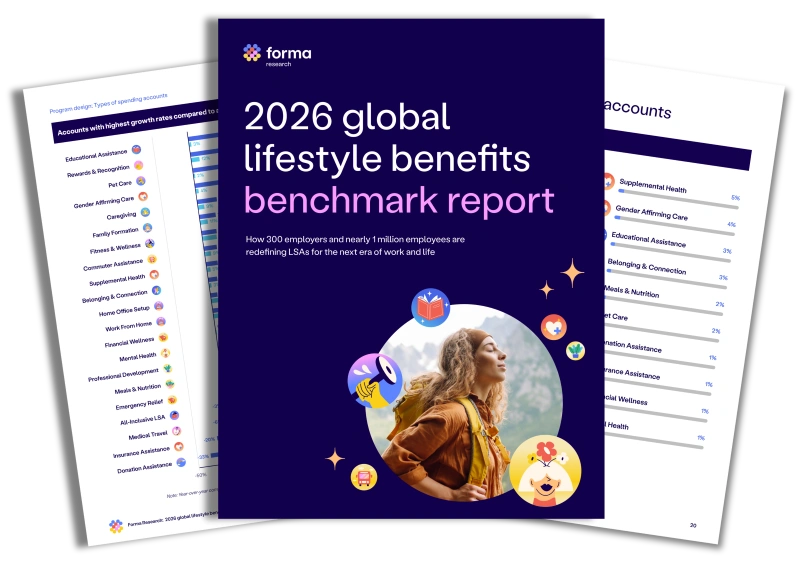
According to Forma’s 2026 global lifestyle benefits benchmark report, which draws on data from nearly 1 million employees across 300 companies and 110 countries, Rewards & Recognition leads all account types with 89% budget utilization. All-inclusive LSAs follow at 85%, and Meals & Nutrition comes in at 80%.
These aren't outliers. They reflect a consistent pattern: programs with broad eligibility and low friction at the point of spending consistently outperform narrowly scoped accounts.
The top five account types by utilization rate from the 2026 data:
- Rewards & Recognition: 89% utilization
- All-inclusive LSA: 85% utilization
- Meals & Nutrition: 80% utilization
- Work from Home: 76% utilization
- Home Office Setup: 74% utilization
The bottom of the list is equally instructive. Professional Development shows only 8% utilization despite a $1,090 median annual allocation. That's not a sign that employees don't value professional development.
It's a sign that the program design, whether eligibility scope, claims friction, or category communication, isn't matching how employees actually want to spend.
Where the biggest year-over-year funding shifts are happening
Funding levels tell a different story from utilization. Mental well-being accounts, while offered by only 1% of employers in the dataset, carry a median annual allocation of $5,000 per employee.
That's a 525% year-over-year increase, and it signals where employer intent is heading even if broad adoption hasn't caught up yet. Meals & Nutrition funding increased 458% year-over-year to a median of $1,340 annually. Rewards & Recognition more than doubled, with median funding up 104%.
The categories growing fastest in funding are largely the same ones showing the highest utilization. That alignment is the most useful signal in the dataset. If you're designing a new program or refreshing an existing one, it tells you which bets other organizations are placing and where employee engagement has already validated them.
The utilization gap is a feature, not a failure
One of the most persistent misconceptions about LSA programs is that low utilization represents a problem.
In a notional funding model, it doesn't. If you fund a $600 Fitness & Wellness account and utilization runs at 71%, your actual cost is $426 per employee. The 29% who didn't fully draw down their allocation didn't cost you the full budgeted amount. That's structurally different from a subscription wellness vendor, where you pay the contract value regardless of whether employees log in or not.
Benefits leaders who frame the utilization gap as budget efficiency rather than program underperformance are using LSA economics the way they're designed to work. And with real-time reporting, that efficiency can be tracked and communicated to finance teams with actual numbers, not estimates.
Managing an LSA program at this level requires more than a reimbursement tool. It requires a platform that surfaces utilization data by account type, automates claims adjudication, and handles compliance across different geographies without creating manual review queues.
Forma gives HR teams exactly this infrastructure. The platform's Forma Visa Card delivers an auto-substantiation rate above 85%, reducing the manual claims load significantly.
Real-time analytics in the admin dashboard let benefits leaders see utilization by category, by segment, and by market, so program adjustments happen before the next renewal conversation, not after it.
Companies like New Balance, Instacart, and Logitech use Forma to consolidate their benefits spend and sustain a 78% monthly utilization rate across their programs.
Schedule a demo today to see how Forma's LSA infrastructure can simplify your program design and move your utilization numbers.
Cons of Lifestyle Spending Accounts
While Lifestyle Spending Accounts offer significant advantages, they may present challenges that employers must carefully consider to ensure successful implementation and ongoing management.
Potential for misuse
Without robust guidelines and clear communication, there is a risk that employees may misuse their LSA funds. For instance, employees might inadvertently use their accounts for non-eligible expenses, leading to frustration and potential disputes. Misuse does not necessarily mean mal-intent; this often stems from a lack of understanding about what qualifies for reimbursement.
Partnering with a third-party administrator can help mitigate this risk. A TPA can provide comprehensive training, resources, and materials for HR, benefits teams, and employees. In addition, ongoing education, such as training sessions and written guides, can help employees maximize their LSA benefits. Regular reminders and updates can help ensure that employees remain informed about the program's rules and stay aligned with the program's intended use.
Tax implications
Since LSA funds are generally considered taxable income for employees, it's crucial for employers to communicate this clearly to avoid unexpected tax liabilities. Employees must report LSA reimbursements on their tax returns, which can come as a surprise if not effectively explained early and often. Employers should provide detailed guidance on how these funds will impact employees' tax filings and outline any exceptions that may apply based on the account type or nature of the claims.
To minimize tax-related issues and to ensure regulatory compliance, many organizations choose to consult a tax professional during program setup. This step can help structure the program correctly and address potential tax challenges and complexities. Thoughtful planning and clear communication foster trust in the program, ensuring employees feel confident and informed.
How to implement a Lifestyle Spending Account that focuses on the pros
Getting the structural decisions right before launch is what separates LSA programs with 80%+ utilization from ones that sit underused and get quietly cut at renewal. The steps below aren't a generic rollout checklist. They're the operational decisions that actually determine whether your program delivers on the advantages outlined above.
1. Set your utilization target before your budget ceiling
Most implementations start with "how much can we spend?" The better starting point is "what utilization rate do we consider a success?"
Working backwards from a target utilization rate, using notional funding assumptions, lets you right-size the per-employee allocation against realistic engagement expectations. A $1,000 allocation at 75% utilization costs $750 per employee in actual spend.
Building your budget model around projected spend rather than maximum possible spend gives finance a more accurate number, and it gives you room to fund the program more generously than a flat-budget approach would allow.
2. Decide on wallet structure before finalizing eligible categories
Before you determine which expenses are eligible, determine how many distinct accounts or wallets you want to run. A single all-inclusive LSA is simpler to administer and consistently produces higher utilization because there's less friction at the point of spending.
Multiple targeted wallets give you more program specificity but add employee-facing complexity. The right answer depends on your workforce demographics, but the structural decision should come first. Categories are easier to adjust later. Wallet architecture is harder to change without re-communicating the whole program.
3. Align funding cadence with how employees actually spend
Annual funding tends to create end-of-year spending rushes and lower engagement during the first three quarters. Quarterly funding keeps the benefit top-of-mind throughout the year and gives employees a regular cadence that matches how they actually plan and spend.
If you're running a dedicated professional development wallet, annual funding may still make sense because course enrollment follows a different cycle. The principle is to match cadence to category behavior, and utilization will improve without any change to total budget.
4. Make the tax treatment part of the launch communication, not the follow-up
The biggest source of post-launch confusion about LSAs is the tax treatment. Employees receive reimbursements and then find out at tax time that the amounts were added to their W-2.
Handling this proactively in the launch communication, before the first reimbursement hits, prevents the perception that the benefit was taken back. A single clear paragraph explaining that LSA reimbursements are included in taxable income, paired with context about why the net value is still meaningful, eliminates most of this friction.
For a deeper look at how LSA compliance and tax treatment interact, the LSA benefits compliance guide on Forma's resource library is worth reviewing.
5. Use the first 90 days of data to make your first program adjustment
No program launches with perfect category alignment. The first 90 days of claim and spending data will tell you which categories employees are actually using, which are sitting empty, and where your eligible expense list has gaps.
Building a 90-day review into the program calendar, with a defined process for making category adjustments, turns your LSA into a living program rather than a set-it-and-forget-it benefit.
It also gives you concrete utilization data to bring to the first finance review, which is the fastest way to secure continued investment before the year-one renewal conversation.
Why Forma makes LSA implementation easier to get right
Designing an LSA that performs means more than selecting a vendor with a clean portal. It requires infrastructure that handles notional funding mechanics accurately, automates compliance without generating manual claims review queues, and gives HR teams the real-time data they need to make program adjustments before the next budget cycle.
Forma brings all of this into a single platform. The Forma Visa Card handles spending at point of purchase with an 85%+ auto-substantiation rate, eliminating the bulk of manual claims review from the start.
Forma's admin dashboard gives benefits leaders real-time visibility into utilization by account type, category, and employee segment. And because Forma operates in 100+ countries with built-in currency support and local compliance handling, global employers don't need to build separate benefit structures for each market.
The result is a program that runs at scale without the administrative overhead that typically grows alongside it.
Schedule a demo today to see how Forma gives HR teams the infrastructure to run LSA programs that deliver real utilization from the start.
Frequently asked questions about Lifestyle Spending Accounts
Are LSAs considered taxable income for employees?
Yes. LSA reimbursements are generally treated as taxable income and should be reported on employees' W-2s. Unlike HSAs or FSAs, LSAs do not carry a tax-advantaged status under the IRS code. This is the most important compliance point to communicate before launch, since employees often don't expect to see the reimbursed amounts reflected in their taxable wages when tax season arrives.
Can employees use an LSA if they also contribute to an HSA?
Yes, as long as the LSA is structured to exclude first-dollar medical reimbursement. An LSA that reimburses medical expenses can disqualify an employee from making HSA contributions by triggering coverage under a non-HDHP plan. Employers running both an HDHP and an LSA should work with their provider and legal counsel to ensure the LSA's eligible expense list does not inadvertently create this conflict.
What's the difference between an all-inclusive LSA and a targeted wallet?
An all-inclusive LSA gives employees a single funded account they can spend across a broad range of eligible categories. A targeted wallet narrows the eligible categories to a specific use case, such as professional development or caregiving. All-inclusive programs tend to produce higher utilization because there are fewer restrictions at the point of spending, while targeted wallets allow employers to direct funding toward specific outcomes or workforce priorities.
How often should employers fund a Lifestyle Spending Account?
Quarterly funding tends to produce the strongest utilization outcomes for most account types. It keeps the benefit relevant throughout the year and creates a predictable spend cadence for employees. Annual funding can work for specific categories like professional development or home office setup, where purchases happen on a less frequent cycle. The right cadence depends on the account type and how employees in your specific workforce tend to plan and spend.
Can an LSA trigger ERISA obligations?
An LSA can become subject to ERISA if it reimburses medical care, since that would make it look like an employer-sponsored health plan under federal law. Most employers structure LSAs specifically to avoid medical reimbursement for this reason. Keeping the eligible expense list outside of medical care generally keeps the plan outside of ERISA, which means no Form 5500 filing, no Summary Plan Description requirement, and no COBRA administration obligation.
What happens to unused LSA funds at the end of the plan year?
The rollover and forfeiture policy is entirely up to the employer. Some programs allow unused balances to carry forward into the next period, while others expire unused funds at the end of each quarter or year. Forfeited funds typically return to the employer rather than to the employee. Because LSA balances are not tax-advantaged, there's no IRS rule requiring a use-it-or-lose-it structure the way there is with healthcare FSAs. Employers should communicate their chosen policy clearly in the launch materials to set accurate expectations.
How does notional funding work in an LSA program?
Notional funding means the employer allocates a budget per employee but only incurs actual cost when employees spend or claim against that balance. If an employee has a $600 annual allocation and uses $400 of it, the employer's cost is $400, not $600. This structure differs from prepaid vendor contracts or subscription-based wellness programs, where the employer pays the full contracted amount regardless of engagement. Notional funding makes LSA costs more predictable and aligns employer spend directly with employee utilization.
This article is for informational purposes. Forma is not engaged in the practice of law. Nothing contained herein is intended as tax or legal advice nor to replace tax or legal advice from counsel. If you need tax or legal advice, please consult with counsel or a certified tax professional.
.png)

.png)