









Why traditional employee benefits packages fall short in 2026
The traditional employee benefits packages are no longer suitable for the modern workforce. Rigid, one-size-fits-all options is an antiquated approach.
In this piece
You've signed the vendor contracts, opened the enrollment window, and technically made benefits available to every employee. But then utilization reports come in, and the picture isn't flattering.
Large portions of your benefits budget sit untouched. The same questions flood the HR inbox every open enrollment cycle. Employees who leave still cite compensation and benefits as a reason they looked elsewhere, even when the per-employee spend on your end was substantial.
The problem isn't effort. It's architecture. Most traditional benefits packages were designed for a workforce that no longer exists: relatively uniform in age, geography, and life stage, with predictable healthcare needs and a single career path.
That model doesn't hold in a world where five generations share the same org chart, where distributed global teams span multiple time zones and tax jurisdictions, and where employees have sharply different financial priorities depending on where they are in life.
This piece breaks down the structural flaws in traditional benefits packages, not the surface-level ones, but the ones that show up in your cost-per-benefit-used, your exit data, and your HR team's workload.
Key takeaways
- Traditional benefits packages are designed around a single employee profile, which means they reliably fail large portions of any diverse workforce
- Low utilization isn't just an engagement issue. It's a budget efficiency issue that drives up your real cost per benefit used
- Point solution sprawl is a predictable outcome of patching holes in a rigid benefits model, and it creates its own administrative and engagement problems
- A multigenerational, globally distributed workforce requires personalization at scale, which the traditional package model can't structurally provide
- Forma replaces the traditional patchwork model with a single, flexible platform that drives real utilization across your workforce. Schedule a demo today.
What a traditional employee benefits package actually includes
Most HR leaders know the list by heart. Medical, dental, vision. A 401(k) or pension plan with an employer match. Paid time off, life insurance, short and long-term disability.
Often, a wellness incentive program and maybe some form of commuter or transit support. This combination has been the standard for decades and while it covers foundational needs, it was never designed to address the full range of what a workforce actually values.
These benefits aren't inherently flawed. Health coverage and retirement savings remain the highest-priority benefits for most employees, and no serious employee benefits strategy proposes removing them. The flaw is in treating this list as comprehensive when it functions more like a starting point.
Why this model worked in a different era
The traditional package crystallized during a period when employers competed for workers who were demographically similar: comparable age brackets, stable career trajectories, and predictable family structures. A company offering health coverage and a retirement match could reasonably bet that combination would work for most of its workforce because the workforce was, by and large, homogeneous.
That assumption has been eroding for decades and is now largely obsolete. A 2026-era workforce includes employees with student debt, employees who are primary caregivers, employees who are remote contractors in other countries, and employees at the tail end of their careers prioritizing wealth preservation.
One plan cannot serve all of those needs, and yet the structure of the traditional package hasn't fundamentally changed.
The basic components most companies still rely on
To understand where the gaps form, it helps to look honestly at what each standard benefit is actually designed to do and who it serves best:
- Medical, dental, and vision coverage: Broad by intent, but plan design rarely accounts for the range of employee health needs and often excludes whole categories of care
- 401(k) or pension plans: High value for mid-to-late career employees; low perceived value for early-career workers prioritizing debt repayment or near-term financial stability
- Paid time off: Structured around a fixed policy that doesn't adapt to how different employees manage caregiving, burnout, or personal circumstances
- Life and disability insurance: Meaningful income protection, but low salience for younger employees who don't yet feel the risk acutely
- Commuter benefits: Built for employees who commute to a fixed office, rendering them largely irrelevant for remote and international workers
The real problems with traditional employee benefits packages
HR professionals often describe their benefits stack as a work in progress. But this often turns into the “more is more” paradox we see in benefits. They’ll add a vendor here, renegotiate a contract there, and try to improve enrollment communication each year. What rarely gets examined is why those incremental fixes keep falling short. The problems with traditional benefits aren't execution problems. They're design problems.
1. Low utilization turns budget into waste
The most quantifiable issue is straightforward: employees don't use benefits they don't value or can't access easily, but employers pay for them regardless. Premiums, vendor licensing, and admin overhead continue whether utilization is 90% or 9%.
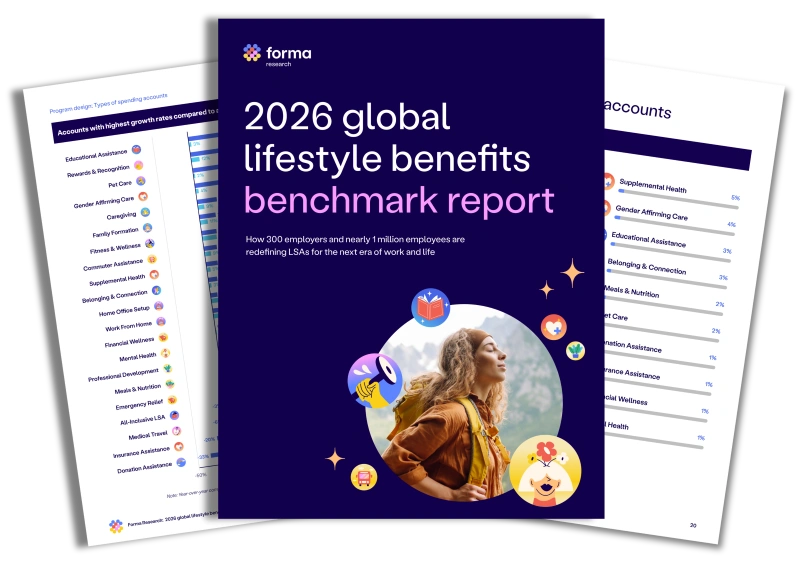
According to the Forma’s 2026 benchmark report, all-inclusive Lifestyle Spending Accounts achieve 85% average budget utilization among employees, a figure that reflects what happens when benefits are flexible enough to match how people actually live.
By contrast, traditional benefits programs routinely see EAPs with single-digit utilization and wellness programs that the majority of eligible employees never touch.
You can read more data like this in our 2026 global lifestyle benefits benchmark report, built on data from 300 employers with nearly 1 million employees across 110 countries.
The budget math matters here. According to BLS compensation data, benefits represent roughly 30% of total employee compensation costs. When a meaningful portion of that spend is going toward programs employees aren't using, the real cost per utilized benefit is significantly higher than the budget line suggests.
2. Point solution sprawl is a predictable outcome
When HR teams recognize that the traditional package isn't meeting employee needs, the natural response is to add more programs. Mental well-being support? Add a vendor. Financial coaching? Add a vendor. Student loan repayment, fertility coverage, backup childcare? Add, add, add.
This approach is well-intentioned and completely understandable — but it produces a benefits stack that is expensive to administer, nearly impossible for employees to navigate, and still doesn't solve the underlying personalization problem. The result is what many benefits leaders call point solution fatigue: a fragmented collection of tools that individually serve narrow needs but collectively overwhelm both employees and HR.
Every additional vendor means another contract renewal, another billing relationship, another employee communication, and another login employees may never use. The complexity compounds, and utilization often stays low because no single employee knows what they have access to across a dozen platforms.
3. A multigenerational workforce gets a single-generation solution
Five generations are actively working right now — Gen Z, Millennials, Gen X, Baby Boomers, and the Silent Generation's remaining workforce. The financial realities, health priorities, and lifestyle needs across those groups are almost entirely different. A 27-year-old managing $60,000 in student debt is not looking for the same benefits as a 52-year-old focused on retirement planning and dependent care.
Traditional packages attempt to serve all of these groups simultaneously with the same menu, which means serving none of them particularly well. The employee benefit programs that generate the highest satisfaction scores are consistently the ones that give employees some degree of choice in how their benefits dollars are used — not the ones that offer the longest list of predetermined options.
This is partly why high benefits spend and high benefits satisfaction don't always correlate. You can spend more per employee on traditional benefits than your competitors and still score worse on benefits satisfaction surveys, simply because the programs you're funding don't match what your specific workforce values.
4. Global teams are structurally excluded
Traditional benefits are built around U.S. regulatory frameworks, tax rules, and vendor networks. FSAs, HSAs, COBRA, and similar programs are defined by IRS guidelines and don't exist in most other countries. Health plan designs, commuter benefits structures, and EAP providers often have limited or no international coverage.
For companies with employees in the UK, India, Germany, or anywhere outside the U.S., this creates an immediate equity problem. U.S. employees receive a robust package. International employees receive something far more limited, often cobbled together from local providers with no unified experience.
As organizations become more globally distributed, this inequity becomes harder to defend internally and more damaging to international retention. A thoughtfully structured global employee benefits program requires a platform designed to handle cross-border complexity from the start.
5. The enrollment comprehension gap compounds every other problem
Even when traditional benefits are well-structured, the way they're communicated undermines them. Research from MetLife's annual benefits trends study found that nearly half of employees say there are elements of their benefits package they don't fully understand.
Employees who don't understand their benefits are significantly less likely to use them and significantly more likely to feel their employer doesn't care about their well-being.
This isn't just a communication challenge. It's a symptom of benefits that are too complex to explain simply. When a plan requires a 40-page summary of benefits and coverage document to understand, and employees only interact with enrollment once a year, comprehension will always be low.
Low comprehension means low utilization. Low utilization means poor ROI — and employees who feel their benefits aren't worth the effort to figure out.
The cost math behind traditional benefits inefficiency
The business case for rethinking traditional benefits isn't just about employee satisfaction, it's about spend efficiency. HR leaders are often asked to do more with flat or shrinking budgets, and benefits represent one of the largest controllable cost centers in total compensation.
The core issue is that traditional benefits are priced on participation projections, not actual usage.
When a wellness vendor charges per enrolled employee rather than per active user, the employer absorbs the full cost whether that employee logs in once or fifty times. Multiply that dynamic across a dozen point solutions, and the effective cost per utilized benefit becomes substantially higher than the per-employee budget suggests.
How notional funding changes the cost model
One of the less-discussed advantages of moving to a flexible benefits plan is the shift to notional funding economics. Instead of paying for access to a set of programs, employers set a per-employee budget and only realize costs when employees actively spend. If an employee doesn't use their full allocation, the employer doesn't pay for the unused portion.
Forma’s 2026 benchmark report illustrates this clearly with a worked example: a $600 fitness and wellness allocation, combined with 71% average utilization, produces $426 in actual realized spend per employee.
For an organization with 5,000 employees, that difference between budgeted and actual cost represents nearly $900,000 in savings compared to assuming full budget use. Employers who rely on traditional benefits, where cost is fixed regardless of engagement, don't have access to that kind of flexibility.
Why benchmarking your current program matters
Most HR teams don't benchmark their benefits against utilization data. They benchmark against peer company plan designs. That tells you what your competitors are offering, but not whether those offerings are generating value.
Effective benchmarking of employee benefits compares your per-program utilization rates, your employee satisfaction scores by benefit type, and your cost per actively used benefit against industry data.
When you run that analysis, the gaps in a traditional benefits model become visible in ways they simply aren't when you're looking at plan design comparisons alone. Programs with high enrollment and low utilization are costing you significantly more than their utilization warrants. Understanding where that spend is going is a prerequisite for redesigning a benefits strategy that actually drives employee benefits ROI.
Why Forma helps companies move past the traditional benefits model
The challenge for most HR leaders isn't identifying the problem with their current benefits stack. It's figuring out how to fix it without creating a chaotic transition, overloading their team, or leaving employees with a benefits gap while the new model is implemented.
Forma is built to make that transition manageable. HR teams can start with an LSA or a targeted spending account for a specific use case, mental well-being, professional development, caregiving, and expand from there without changing their existing health and retirement infrastructure.
The platform consolidates administration into a single dashboard, gives employees an intuitive interface for claiming and spending, and provides HR with real-time visibility into utilization and spending patterns across every program.
The result is a benefits strategy that is genuinely responsive to workforce needs, rather than one that offers a fixed menu and hopes something on it resonates. When employees can direct their benefits dollars toward what actually matters to their lives, they use them, and that utilization is what turns benefits spend from a cost center into a retention and engagement driver.
Your benefits budget deserves better utilization than you're getting. Schedule a demo today to see how Forma replaces the traditional patchwork with a benefits model that works.
Frequently asked questions about traditional employee benefits packages
What are the biggest problems with traditional employee benefits packages?
The most pervasive problems are low utilization, poor fit for diverse workforces, and administrative complexity. Traditional packages are designed around a single employee profile, which means they systematically fail employees whose circumstances differ — whether by generation, family structure, health needs, or geography. Employers end up paying for programs employees don't use, and HR teams absorb the overhead of managing them.
Why do employees have low utilization even when benefits are technically available?
Two factors drive most utilization gaps. First, benefits don't align with what employees actually need — a commuter benefit is irrelevant to a remote worker, and a gym reimbursement misses employees who prefer home fitness. Second, comprehension is poor. Research shows nearly half of employees don't fully understand their benefits package, which suppresses engagement regardless of what's on offer.
How do traditional benefits fail remote and international employees?
Traditional packages are designed around U.S. regulatory frameworks and physical office environments. Commuter benefits, on-site perks, and U.S.-specific tax accounts like FSAs and HSAs don't apply to employees in other countries. This creates a two-tier benefits experience where international team members receive materially less value than their U.S.-based counterparts, which compounds retention challenges in global organizations.
What is the difference between traditional benefits and lifestyle spending accounts?
Traditional benefits provide a fixed set of coverage options with limited employee input. Lifestyle Spending Accounts (LSAs) give employees a defined budget to spend across eligible categories of their choosing — fitness, groceries, caregiving, professional development, and more. LSAs tend to produce significantly higher utilization because employees spend on what they actually value, rather than navigating a predetermined menu.
Does moving away from traditional benefits mean cutting health insurance or retirement plans?
No. Health insurance and retirement plans remain foundational — most employees still rank them as their top priorities, and removing them would create immediate retention and recruitment problems. The shift away from traditional benefits is about supplementing those foundations with flexible spending options that address the diverse needs traditional plans can't cover.
How does benefits complexity affect HR team productivity?
Complexity has a direct cost on HR bandwidth. Each point solution in a traditional benefits stack requires its own vendor relationship, renewal cycle, billing process, and employee communication. HR teams managing 10 or more benefits vendors spend significant time on administration that could go toward strategic work. Consolidating onto a unified platform reduces that overhead substantially while improving the employee experience.
This article is for informational purposes. Forma is not engaged in the practice of law. Nothing contained herein is intended as tax or legal advice nor to replace tax or legal advice from counsel. If you need tax or legal advice, please consult with counsel or a certified tax professional.
.png)

.png)