









Can you use one platform for HRAs and LSAs?
Can one flexible benefits platform handle both HRAs and LSAs? Here's what unified benefits administration actually requires.
In this piece
Managing employee benefits has gotten more complicated over the past few years. Total rewards teams are now expected to offer tax-advantaged benefits like HRAs alongside post-tax spending accounts like LSAs, and more often than not, those programs end up living on completely different platforms.
That means two vendor relationships, two sets of logins, two administration processes, and two places employees need to check when they want to use their benefits.
The frustration compounds fast.
And what adds insult to injury is that often these two benefit types are designed to address similar or complementary needs. The emerging best practice is that HRAs and LSAs belong together.
When your HRA vendor can't speak to your LSA platform, you end up doing manual data work that should be automated, and employees get a fragmented experience that quietly drives utilization down. The question isn't whether consolidation would help. It's whether a single platform can actually handle the compliance demands of HRAs alongside the flexibility demands of lifestyle benefits — without sacrificing either.
The short answer is yes, but only if you know what to look for.
Key takeaways
- HRAs are IRS-governed reimbursement accounts with strict documentation and compliance requirements, while LSAs are employer-defined, post-tax accounts with flexible eligibility. They've traditionally been managed on separate platforms because they were built by different vendors for different purposes.
- Running two systems creates real operational drag: duplicate admin work, fragmented reporting, and an employee experience that reduces engagement and utilization.
- A unified flexible benefits platform needs to handle both pre-tax compliance infrastructure and post-tax LSA flexibility within a single admin layer, not one bolted onto the other.
- When evaluating platforms, the key questions aren't just about features. They're about whether the platform was architected for both account types natively.
- Forma centralizes HRAs, LSAs, HSAs, FSAs, and more benefits into a single platform, giving HR and total rewards teams one place to manage everything — and employees one place to access everything. Schedule a demo today to see how it works.
What is a flexible benefits platform?
The term "flexible benefits platform" gets used loosely, and that's part of the problem. Before evaluating whether a platform can handle both HRAs and post-tax lifestyle benefits, you need a clear sense of what a true flexible benefits platform actually does and how it differs from the legacy tools most HR teams are still using.
How it differs from traditional benefits administration
Traditional benefits administration software was designed around a specific set of IRS-defined accounts: FSAs, HSAs, and commuter benefits. It was built for compliance first, with eligibility rules, documentation requirements, and IRS limits baked into the core architecture. These tools were never meant to support the open-ended, employer-defined spending categories that modern lifestyle benefits require.
A modern flexible benefits platform is different. It's designed to handle both the structured world of pre-tax accounts and the open eligibility framework of post-tax accounts, all within one system. That distinction matters a lot when you're trying to manage HRAs and LSAs under the same roof.
The different account types it needs to support
HRAs are employer-funded reimbursement accounts governed by IRS rules. Employers define what expenses are eligible, employees submit documentation for reimbursement, and the platform needs to handle claim substantiation, plan document requirements, and in some cases COBRA administration.
There's real compliance infrastructure involved.
LSAs work differently. They're also employer-funded, but they're post-tax accounts with no IRS restrictions on eligible expenses. Employers set the categories, employees spend freely, and the platform needs to support a wide variety of spending scenarios without the same documentation burden. With LSAs, employers get ultimate customization while employees get ultimate choice. It’s a win-win.
The reason these two account types end up on separate systems is that they were originally served by different vendor categories, each optimized for only one side of the equation.
Why HR teams end up with separate systems for HRAs and LSAs
Even when HR leaders recognize the inefficiency of running multiple platforms, switching to a unified system can feel like a significant undertaking.
Part of that is inertia, but part of it is a legitimate history: these account types were never designed to coexist on the same platform, and the vendors that emerged to serve them reflect that.
HRA platforms were built for compliance, not flexibility
Legacy HRA platform vendors built their products around IRS compliance. Their systems are strong at claim substantiation, documentation retention, and staying current with IRS guidance on eligible expenses. What they're not built for is the open-ended, employer-defined eligibility that makes LSAs valuable.
When HR teams try to manage lifestyle benefits through a traditional benefits administration tool, the rigidity shows immediately. You can't easily configure a "wellness wallet" or a "home office" category in a system architected around a fixed list of IRS-approved expenses.
LSA platforms were built for flexibility, not compliance
On the other side, early LSA platform vendors optimized for employee experience and spending flexibility. They built intuitive interfaces, broad merchant coverage, and employer-friendly configuration tools. But they didn't invest in the compliance infrastructure that HRAs require.
Without proper claim substantiation workflows, ERISA plan document support, or IRS-compliant reimbursement logic, an LSA-first platform can't serve as your HRA administrator. The result is that HR teams often end up with one vendor for their lifestyle spending account program and another entirely for their HRA.
The real cost of running two systems
The operational drag of running two separate platforms adds up quickly, and it shows up on both the HR side and the employee side. As mentioned in the 2026 Forma Benchmark report, benefits administration is one of the most time-intensive functions in HR. Splitting it across two vendors doesn't divide the work; it multiplies it.
- Duplicate data entry: Employee records, funding amounts, and eligibility changes need to be updated in two systems separately, creating more room for error and more time spent on tasks that should be automated.
- Fragmented reporting: Utilization data lives in two places, making it difficult to get a complete picture of how your benefits budget is actually being spent across programs.
- Reconciliation overhead: When payroll, HRIS, and two benefit platforms all need to stay in sync, the reconciliation burden falls on HR teams manually bridging the gaps.
- Employee confusion: When benefits live in two different portals, employees disengage. Low utilization isn't always a sign that employees don't value their benefits. It's often a sign that accessing them is too complicated.
- Vendor management complexity: Two contracts, two renewal cycles, two support relationships, and two sets of implementation requirements when something changes.
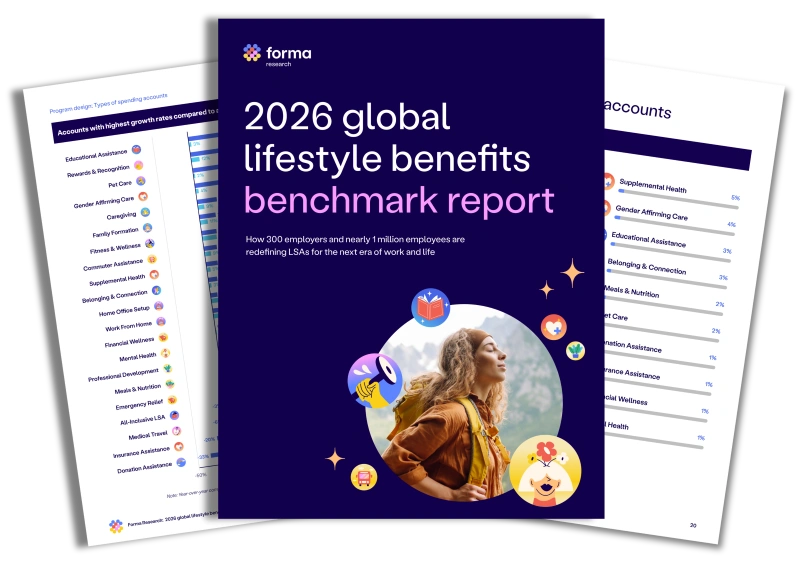
The utilization data backs this up. Forma's 2026 global lifestyle benefits benchmark report found that all-inclusive LSAs, where employees access a broad range of benefits through a single account, see 85% budget utilization. Platforms that make benefits simple to find and use see the engagement numbers to prove it.
What a unified benefits platform actually needs to handle both
Consolidating HRAs and lifestyle benefits onto one platform isn't just about having both account types available in the same login. The platform needs to be genuinely capable on both sides. Not a lifestyle tool with a compliance layer patched on, and not a compliance platform with an LSA feature tacked on as an afterthought.
Pre-tax account infrastructure
For HRAs, the platform needs real compliance infrastructure. That means claim substantiation workflows, documentation retention, ERISA plan document support, and the ability to administer COBRA when applicable. The FSA and HRA legal document requirements that govern these accounts are non-negotiable, and a platform that can't meet them creates liability exposure for the employer.
An HSA vs. HRA comparison shows just how different the compliance demands are across account types — which is why the pre-tax infrastructure can't be an afterthought in a platform that claims to handle everything.
Post-tax LSA infrastructure
For LSAs, the platform needs employer-configurable eligibility categories, wallet-based funding logic, and a spending experience flexible enough to cover everything from fitness memberships to childcare costs.
Employers need to be able to launch multiple sub-accounts, each with its own eligible categories and funding levels, without long implementation timelines or IT involvement.
For companies with a global workforce, the LSA infrastructure also needs to support local currencies and region-specific spend categories.
Running a global employee benefits program has different requirements than a domestic-only setup, and the platform needs to reflect that without requiring a separate vendor for each geography.
A single admin layer across both
The real value of a unified employee benefits management platform isn't just having both account types available. It's the single admin layer that sits on top of them.
HR teams should be able to fund accounts, configure eligibility, pull utilization reports, and manage employee records all in one place, without toggling between systems or exporting data into spreadsheets.
HRIS and payroll integrations need to be native, not patched in. When an employee is onboarded or offboarded, their benefit accounts should update automatically. When payroll runs, contribution logic should sync without manual intervention.
Here's what that infrastructure looks like across both account types on a well-built platform:
- Pre-tax compliance: claim substantiation, IRS contribution limit enforcement, ERISA documentation, COBRA administration, auto-substantiation for eligible card purchases
- Post-tax LSA flexibility: employer-configurable categories, multi-wallet setup, global currency support, broad merchant eligibility, minimal documentation friction
- Shared admin layer: single dashboard for funding and configuration, real-time utilization reporting across all account types, native HRIS and payroll integrations, one employee-facing portal and card
Employee benefits platform comparison: What to look for
Once you know what a unified platform needs to do, the next step is knowing how to evaluate what's actually on the market. Most vendors will tell you they can handle both HRAs and lifestyle benefits. The right questions cut past the marketing and into the architecture.
Compliance depth vs. flexibility breadth
The most important question in any employee benefits platform comparison is whether the platform was built for both account types natively.
A platform built first for pre-tax compliance and later extended to include LSAs may not have the employer-configurable flexibility that modern lifestyle programs require. The reverse is equally true.
Ask vendors directly:
- Was HRA administration part of your original product, or was it added later?
- How do you handle claim substantiation for medical HRAs?
- Can I configure multiple LSA wallets with different eligibility categories for different employee populations?
The answers will tell you where the platform's actual depth lies.
Employee experience across account types
A unified platform only delivers on its promise if employees actually use it. That means a single login, a single card, and a claims experience that feels consistent regardless of which account an employee is drawing from. Fragmented UX is one of the biggest drivers of low utilization, regardless of how generous the funding is.
Global capability
For companies with employees outside the US, global capability isn't optional. Local currency support for LSAs and region-specific spend categories need to be built into the platform, not handled through a patchwork of country-specific vendors. Comparing LSA, FSA, and HSA options for a global workforce reveals quickly how complicated multi-country benefits management becomes without a platform designed for it from the start.
Here are the key questions to bring into any benefits platform evaluation:
- Does the platform handle HRAs, FSAs, HSAs, and LSAs natively, or are some account types delivered through a third-party integration?
- How does claim substantiation work for IRS-governed accounts, and what's the auto-substantiation rate?
- Can you configure multiple LSA wallets with different eligibility categories for different employee populations?
- Does the platform support employees in multiple countries with local currency and region-specific spend categories?
- What HRIS and payroll integrations are available, and how does data sync work during onboarding and offboarding?
- What does the employee-facing experience look like across account types, and is there a single card and portal?
Why Forma is built to handle both HRAs and lifestyle benefits
Forma was built from the start to manage the full range of employer-funded benefits, pre-tax and post-tax, within a single platform. Unlike vendors that began as LSA tools and added compliance features later, or legacy FSA administrators that patched in lifestyle accounts, Forma's architecture was designed to support both from day one.
HR teams using Forma get one admin dashboard for all account types, real-time utilization analytics, and HRIS integrations that eliminate manual data work. Employees get a single Forma Visa Card, a unified portal, and a claims process with an auto-substantiation rate above 85% for eligible purchases. For global teams, Forma is live in 100+ countries with local currency support built in. The result is a benefits experience that doesn't ask HR teams to choose between compliance depth and benefits flexibility.
If your team is managing HRAs and LSAs with separate tools and you’re considering consolidation, we can help. Schedule a demo today to see how Forma brings it all together.
Frequently asked questions about flexible benefits platforms for HRAs and LSAs
What's the best benefits management platform?
The strongest benefits management platforms support both pre-tax accounts (HRAs, HSAs, FSAs) and post-tax lifestyle benefits (LSAs) within a single admin experience. Look for native compliance infrastructure, employer-configurable eligibility categories, strong HRIS integrations, and a unified employee-facing experience across all account types. The best option for your organization will depend on your program complexity, headcount, and global footprint.
How does a flexible benefits platform work?
A flexible benefits platform lets employers fund and configure multiple account types from a single admin dashboard. Employees access their benefits through a unified portal or card, and the platform handles claim processing, compliance documentation, and utilization reporting in the background. Employers can set different eligibility rules and funding levels for different employee groups or account types without managing separate vendor relationships for each.
How much does a benefits platform cost?
Benefits platform pricing varies based on the number of account types, employee headcount, and the level of support included. Most platforms charge a per-employee-per-month fee, sometimes with additional costs for implementation or international employees. For notional funding accounts like LSAs, actual program cost is typically calculated as median funding multiplied by utilization rate, meaning realized spend is often meaningfully lower than the stated budget.
Can an HRA and an LSA be offered at the same time?
Yes. Employers can offer both an HRA and an LSA simultaneously, and many do. HRAs reimburse employees for medical expenses under IRS guidelines, while LSAs cover a broader range of employer-defined categories like fitness, childcare, or home office expenses. The key is having a platform that can administer both account types natively without requiring separate vendor relationships or employee-facing portals.
What's the difference between an HRA platform and a flexible benefits platform?
An HRA platform is typically designed specifically for IRS-governed medical reimbursement accounts, with compliance workflows, claim substantiation, and documentation retention as its core features. A flexible benefits platform is broader and supports both pre-tax accounts like HRAs and post-tax accounts like LSAs within the same system. The distinction matters if you want to consolidate benefits administration without giving up compliance capability on either side.
How do employees access benefits on a unified platform?
On a unified platform, employees access all of their benefits through a single portal and a single payment card. When they make an eligible purchase, the card draws from the appropriate account automatically. For purchases that require manual review, employees submit a claim through the same portal. The experience is consistent regardless of whether the underlying account is an HRA, FSA, or LSA.
This article is for informational purposes. Forma is not engaged in the practice of law. Nothing contained herein is intended as tax or legal advice nor to replace tax or legal advice from counsel. If you need tax or legal advice, please consult with counsel or a certified tax professional.
.png)


.png)