









Incentives for employees: types, ideas, and how to implement them in 2026
10 employee incentive ideas for 2026 with types, costs, and implementation tips to boost retention and engagement.
In this piece
Quick Answer: Employee incentives are rewards and benefits beyond base salary that employers use to motivate performance, boost retention, and build stronger workplace culture.
Remember your first job? That moment when someone recognized your work with more than just a paycheck? That feeling still matters, perhaps now more than ever.
The method to building a thriving workplace in 2026 isn't hidden in complex algorithms or trendy office perks. It's about what genuinely motivates people to bring their best selves to work each day. Companies that crack this code aren't just surviving. They're creating environments where talented people choose to stay, even when competitors dangle higher salaries. According to Gallup, organizations with highly engaged employees see 23% higher profitability, making the business case for workplace incentives clear.
This article cuts through the noise around employee incentives to reveal what actually works now. You'll find straightforward advice on creating employee recognition that resonates, employee rewards that actually reward, and incentives that inspire rather than obligate.
Key takeaways
- Employee incentives boost employee motivation, retention, and workplace culture by recognizing contributions beyond salaries.
- Key types of employee incentives include financial benefits (bonuses, profit sharing), lifestyle perks (LSAs, flexible work), and career development opportunities.
- Popular employee incentive ideas for 2026 include performance bonuses, profit-sharing, LSAs, learning stipends, and leadership training programs.
- Effective incentives drive measurable business outcomes, including increased productivity, lower turnover, and stronger employee engagement.
- Customizable, transparent, and well-managed employee incentive programs deliver the best results while reducing administrative complexity.
- Forma simplifies incentive management with flexible LSAs, professional development funds, and employee wellness programs. Schedule a demo today.
What are incentives for employees?
Incentives for employees are rewards or employee benefits provided by employers to motivate employees and boost their morale. These incentives can take many forms, from employee bonus ideas to flexible work arrangements, and are designed to recognize employees for their hard work and contributions.
The goal of employee incentives is to create a positive feedback loop. When employees feel valued, they're more likely to go above and beyond. This leads to better business outcomes, which can then be reinvested into even more rewarding employee rewards programs and career development incentives.
Types of employee incentives
When it comes to rewarding your team, there are three main categories of types of employee incentives to consider: financial benefits, lifestyle benefits, and career development. Each offers unique advantages and can be tailored to fit your company's culture.
Financial benefits
Financial incentives are direct monetary rewards that recognize employees for their contributions.
- Bonuses: One-time payments given when employees meet or exceed performance targets.
- Profit sharing: A portion of the company's profits distributed to employees, fostering shared success.
- Pre-tax benefits: Health Savings Accounts (HSAs), Flexible Spending Accounts (FSAs), or commuter benefits that help employees manage expenses tax-free.
- Referral bonuses: Financial employee rewards for referring qualified candidates.
Lifestyle benefits
Lifestyle benefits offer flexibility and personalization, catering to employees' diverse needs.
- Lifestyle Spending Accounts (LSAs): Employers allocate funds for employees to spend on well-being programs, home office setups, fitness memberships, and more.
- Employee recognition programs: Systems that celebrate achievements through peer recognition, employee of the month awards, or leadership praise.
- Flexible work arrangements: Options such as remote work, flexible schedules, and compressed workweeks.
- Team events and employee perks: Company-sponsored activities, casual dress days, or wellness stipend programs.
Career development benefits
Investing in employee growth demonstrates a commitment to their long-term success.
- Learning and professional development stipends: Funds for courses, certifications, or industry events.
- Mentorship programs: Connecting junior employees with experienced colleagues.
- Leadership training programs: Resources to help employees develop leadership skills and prepare for managerial roles.
- Conference and networking support: Sponsoring employees to attend professional events.
10 ideas for employee incentives
Providing the right incentives can boost employee engagement, employee retention, and overall job satisfaction. Here are ten effective staff incentive ideas with details on cost and implementation.
1. Lifestyle spending accounts (LSAs)
Traditional table-stakes benefits rarely fit anyone perfectly. LSAs give employees the freedom to choose benefits that actually matter to them.
Employers allocate a set amount of funds for employees to spend on wellness programs, gym memberships, childcare, home office equipment, and other lifestyle expenses. This personalization demonstrates respect for individual choices and increases the perceived value of the benefit. LSAs also eliminate the waste inherent in traditional one-size-fits-all perks that go unused.
Cost: Typically $500 to $2,000 per employee per year.
How to implement: Set up LSAs on a digital benefits platform where employees can allocate funds and track spending. Partner with a third-party administrator that provides pre-approved vendors and automated reimbursement.
2. Performance bonuses
Nothing speaks louder than extra cash tied directly to achievement. Performance bonuses remain one of the most direct ways to connect effort with reward.
Employees receive a financial bonus when they reach specific targets such as sales goals, project completion, or productivity benchmarks. The direct connection between specific actions and financial rewards makes the structure transparent and fair, giving employees control over their earning potential.
Cost: Varies. Bonuses can be a fixed amount or a percentage of salary.
How to implement: Tie bonuses to specific performance metrics with clear documentation. Automate through HR software and conduct periodic performance reviews to communicate progress.
3. Profit sharing
When your company wins, shouldn't everyone share in that success? Profit sharing transforms employees from spectators into stakeholders.
A portion of the company's profits is distributed among employees based on tenure, position, or company performance. This creates genuine ownership and encourages employees to think like owners, finding efficiencies, suggesting innovations, and working collaboratively.
Cost: Typically 5 to 20 percent of annual profits.
How to implement: Set up a structured distribution formula integrated with payroll. Create a communication plan explaining how profits are calculated and when distributions occur.
4. Flexible work arrangements
Time has become the new currency in the workplace. Flexibility addresses one of the most persistent sources of workplace stress: the conflict between work demands and personal responsibilities.
Employees have the option to work from home, set flexible hours, or choose compressed workweeks. Giving employees control over their schedules reduces burnout while often increasing productivity.
Cost: Minimal to no additional cost. Companies may need to invest in remote work tools.
How to implement: Manage through scheduling tools that allow employees to request remote work or adjusted hours. Establish formal policies outlining eligibility and expectations.
5. Recognition and rewards programs
Sometimes the simplest acknowledgment has the biggest impact. Regular recognition satisfies a basic human need for acknowledgment and appreciation.
Employees are recognized through formal programs like Employee of the Month, peer recognition platforms, or leadership acknowledgments. Well-designed recognition programs highlight company values in action, reinforce cultural priorities, and create positive ripple effects throughout the organization.
Cost: Typically $50 to $500 per employee annually.
How to implement: Use a recognition portal or integrated HR platform with peer-to-peer recognition tools and automated milestone acknowledgments.
6. Learning and development stipends
Career growth doesn't happen by accident. Learning stipends invest in your employees' future while building your company's capabilities.
Employers provide funds for employees to enroll in courses, attend workshops, or earn certifications. This investment builds loyalty and reduces turnover by showing clear pathways for growth. As employees gain new skills, the entire organization becomes more capable.
Cost: Stipends usually range from $500 to $5,000 per employee per year.
How to implement: Automate through a reimbursement or prepaid credit system with guidelines for eligible courses and an approval workflow.
7. Referral bonuses
Your best employees know other great people. Employee referrals typically yield higher-quality hires who stay longer and perform better than candidates from other sources.
Employees receive a bonus when they refer a qualified candidate who gets hired and stays for a specified period. This reduces recruitment costs while demonstrating trust in employees' judgment.
Cost: Typically $500 to $5,000 per referral depending on the position.
How to implement: Build an internal tracking system that monitors referrals from submission to hire with clear payout timelines.
8. Team events and social perks
Relationships matter. Team events create spaces for authentic connections beyond daily work tasks.
Employers organize activities such as company outings, volunteer days, or wellness retreats. These shared experiences create common reference points that strengthen company culture. For remote or hybrid teams, intentional social events are even more important for combating isolation.
Cost: Ranges from $20 per employee for casual outings to $500 for elaborate retreats.
How to implement: Use event management tools or employee surveys to identify preferred activities. Allocate budgets by department and track participation.
9. Pre-tax benefits
Smart financial incentives multiply their impact. Pre-tax benefits help employees stretch their earnings further by reducing taxable income while covering expenses they'd pay for anyway.
Employees use pre-tax dollars for healthcare (FSAs, HSAs), commuting, and dependent care. This effectively increases purchasing power without requiring additional salary. For employees in higher tax brackets, the savings can be substantial.
Cost: Typical employer contributions range from $500 to $3,000 per employee annually.
How to implement: Administer through a third-party provider to handle compliance and claims processing. Create educational resources like FAQs and onboarding materials.
10. Leadership training and career growth programs
Great leaders aren't born. They're developed. Leadership training programs create clear pathways for advancement while building the management capabilities your company needs.
Employees participate in leadership development courses, mentorship programs, or executive coaching. These programs address one of the top reasons employees leave: lack of career advancement opportunities. Structured development also reduces the risks and costs of external leadership hires.
Cost: $1,000 to $10,000 per employee depending on the program.
How to implement: Embed leadership training into professional development programs with structured modules and coaching. Set up a nomination process and ongoing assessments.
How Forma makes incentive programs easier to manage
Managing multiple incentive programs across a diverse workforce creates real administrative strain, from tracking spending and processing reimbursements to staying compliant across states and countries. That complexity is exactly where many programs stall.
Forma eliminates that friction by consolidating incentives into one flexible platform. Whether you're running LSAs, wellness stipends, or professional development funds, Forma automates compliance, claims processing, and benefit distribution so your HR team can focus on strategy instead of spreadsheets.
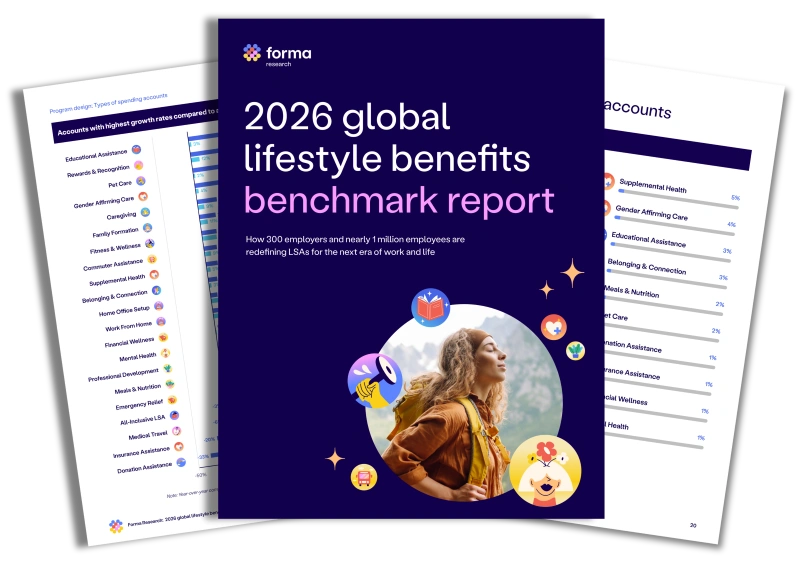
The 2026 Forma Benchmark Report shows that all-inclusive LSA median funding is $980 per employee with 85% utilization, while Rewards & Recognition funding grew 104% year over year with 89% utilization. These numbers prove that when benefits are easy to access, employees actually use them. You can read more statistics like these in our 2026 Forma Benchmark Report.
Ready to build an incentive program your team will actually use? Schedule a demo today to see Forma in action.
4 benefits of employee incentives
Offering incentives to your employees can have a profound impact on your organization's success.
1. Increased productivity
Incentives give employees a clear goal to work towards, motivating them to put in extra effort. This boost can lead to better business results, including increased sales, improved customer satisfaction, and faster project completion.
2. Improved employee retention
Rewards help employees feel valued, which can significantly reduce turnover rates. According to Gallup, well-recognized employees are 45% less likely to leave within two years. This saves the time and money associated with recruiting and training new hires.
3. Enhanced company culture
Incentives contribute to a positive work environment by fostering teamwork and healthy competition among colleagues. When employees are working towards common goals and celebrating each other's successes, it creates a more collaborative workplace culture.
4. Greater employee loyalty
Investing in your employees' success through incentive programs fosters dedication to the company. Loyal employees are also more likely to advocate for the organization and help attract top talent through referrals. When employees feel their employer cares about their well-being and growth, they stay motivated and go the extra mile.
How Forma simplifies employee incentive programs
Forma makes it simple to build and manage an employee incentive program that works. As a trusted third-party administrator, Forma handles everything from compliance and claims processing to benefit distribution and employee communication, eliminating the burden on HR teams.
The platform's flexible LSAs, pre-tax benefits, and career development stipends give employees real choice in how they use their incentives, driving the engagement and retention results that matter most. With 98% customer retention and support across 110+ countries, Forma is built for companies that want to reward their people without the administrative complexity.
Stop managing incentives through disconnected tools and manual processes. Schedule a demo today to see how Forma can power your incentive strategy.
Frequently asked questions about incentives for employees
What are the most cost-effective employee incentives?
Flexible work arrangements, peer recognition programs, and learning stipends consistently deliver strong results relative to their cost. Recognition programs in particular can start as low as $50 per employee annually while significantly impacting engagement and retention. The key is matching the incentive to what your workforce actually values.
Are employee incentives taxable?
It depends on the type. Cash bonuses, profit-sharing distributions, and many stipends are considered taxable income. Pre-tax benefits like HSAs and FSAs reduce taxable income. Non-cash incentives such as awards or gifts may also be taxable above certain thresholds. Consult a tax professional to ensure proper reporting.
How do you measure incentive program ROI?
Track metrics like employee retention rates, productivity benchmarks, engagement survey scores, and benefits utilization rates before and after implementing the program. Compare the cost of the incentive program against savings from reduced turnover and recruitment. Most organizations see measurable improvement within six to twelve months.
What incentives work best for remote teams?
Remote employees respond well to flexible scheduling, home office stipends, virtual recognition programs, and learning and development funds. The most effective remote incentives give employees autonomy over how they use the benefit rather than prescribing a specific perk.
How often should incentive programs be updated?
Review your incentive programs at least annually, ideally during benefits planning season. Use employee feedback surveys, utilization data, and industry benchmarks to identify what's working and what needs adjustment. Programs that stay static for too long risk losing relevance.
Do small businesses benefit from employee incentive programs?
Yes. Small businesses often see outsized returns from incentive programs because employees are closer to leadership and company outcomes. Low-cost options like recognition programs, flexible scheduling, and small learning stipends can meaningfully improve retention and morale without straining the budget.
This document is for informational purposes. Forma is not engaged in the practice of law. Nothing contained herein is intended as tax or legal advice nor to replace tax or legal advice from counsel. If you need tax or legal advice, please consult with counsel or a certified tax professional.
.png)


.png)