









Stipend vs salary: key differences for HR teams in 2026
Compare stipends and salary in 2026: tax treatment, structure, types, and how HR teams use stipends to extend compensation strategy.
In this piece
Compensation is no longer a single number on an offer letter. The strongest packages in 2026 stack salary on top of stipends, pre-tax accounts, and lifestyle benefits, and HR teams are increasingly asked to defend the logic behind every dollar in the mix.
That puts the stipend vs salary distinction at the center of compensation strategy. Get the structure right and you build a package that respects fiscal discipline while letting employees direct dollars toward what actually matters in their lives. Get it wrong and you end up with tax surprises, low utilization, and a benefits budget that drifts further from employee needs every year.
This guide walks through the practical differences between stipends and salaries, when each fits, what the IRS expects, and how HR teams can build a stipend program that holds up to finance, legal, and the employees actually using it.
Key takeaways
- A salary is regular taxable wages paid for work performed. A stipend is a fixed allowance for a defined category of expense like wellness, learning, caregiving, or remote work, usually paid alongside salary rather than in place of it.
- Salaries are always subject to income, Social Security, and Medicare withholding. Stipends may be taxable or excluded from wages depending on how the program is structured under IRS rules.
- Stipends widen what compensation can compete on without restructuring base pay, since they create personalization without adding to fixed salary costs.
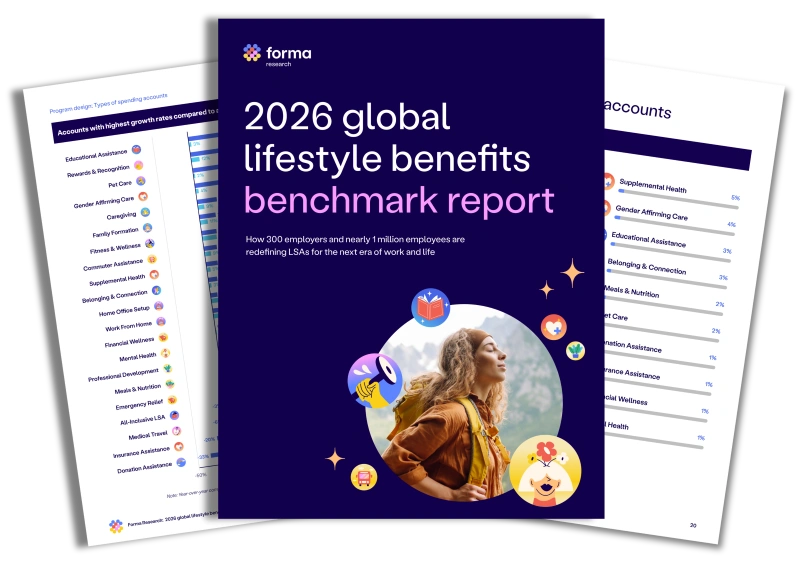
- The 2026 Forma Benchmark report shows the median annual all-inclusive Lifestyle Spending Account funds employees at $980 per year, with 85% of allocated budgets actually used.
- Forma helps HR teams design and run flexible stipend programs employees actually use, with multiple payment options, global compliance, and real-time analytics. Schedule a demo today.
What is a stipend?
A stipend is a fixed sum of money provided by an employer on a recurring schedule to help employees cover specific categories of expense. The categories are defined by the employer and can include things like remote work, transportation, wellness, professional development, and caregiving.
Stipends sit alongside salary rather than replacing it. They are typically funded outside the regular paycheck, often via a benefits debit card, a curated benefits store, or a claims reimbursement system, and modern programs run on flexible benefits software that handles funding, substantiation, and tax reporting in one place.
Learn more by reading our blog what is a stipend
What is a salary?
A salary is a fixed and regular form of financial compensation paid by an employer in exchange for work performed over a specified period, usually weekly, biweekly, or monthly. It is the primary form of income for most employees and is established in a formal employment contract.
Unlike stipends, salaries are not earmarked for any particular use. Employees can spend salary on whatever they choose, and the amount is shaped by job responsibilities, market rates, performance, and tenure.
Stipend vs salary: a side-by-side comparison
The fastest way to see how stipends and salaries fit together is to look at them across the dimensions HR and finance teams actually weigh. The table below summarizes the core differences. The notes that follow add the nuances HR leaders should consider when designing programs.
Purpose and scope
Salary compensates employees for the work they do. Stipends sit on top to cover specific categories the employer wants to support, like physical health, learning, or remote productivity. The two work together, which is why most modern stipend programs are built as additions to base pay rather than substitutes for it.
Taxation
Salaries are always taxable wages, with full FICA and income tax withholding. Stipend tax treatment is more nuanced and is governed by the IRS's Publication 15-B, the Employer's Tax Guide to Fringe Benefits. Some categories qualify for partial or full exclusion from wages when the underlying program meets IRS requirements, including educational assistance up to $5,250 per year, qualified transportation fringes within monthly limits, and certain working-condition benefits. Most general lifestyle and wellness stipends are taxable to the employee and reported on Form W-2.
Structure and performance
Salary is variable by design: bonuses, raises, overtime, and commissions all flex based on what the employee does. Stipends are intentionally flat, which keeps them equitable across the workforce and removes the complexity of tying lifestyle support to performance metrics.
When should you offer stipends?
Stipends fit best when an organization wants to support employees in specific dimensions beyond what salary alone can address. They are particularly useful when budget pressure makes salary increases harder to justify, since stipends extend the perceived value of compensation without inflating fixed wage costs.
Per the SHRM 2025 Benefits Survey, roughly half of employees would trade salary for greater flexibility, which makes the stipend layer a meaningful retention tool when cash budgets are constrained.
Below are six situations where a stipend program tends to deliver outsized value.
To make a benefits package competitive
Stipends are a clear way to differentiate a benefits package without overhauling base pay structure. They signal that the company invests in employees' lives outside of work, which is increasingly a deciding factor for candidates comparing offers.
To create tax-advantaged compensation
Some stipend categories carry tax benefits for both the employer and the employee when structured correctly. Educational assistance plans up to $5,250 annually, qualified transportation fringes, and dependent care FSAs all sit inside specific IRS exclusions and let dollars stretch further than equivalent taxable cash.
To extend benefits cost-efficiently
Stipends offset the cost of running multiple separate vendors. Replacing five point solutions (gym pass, learning platform, commuter benefit, wellness app, perk reimbursement) with one flexible stipend often costs less in software fees and significantly less in administrative time.
To attract and retain talent
Stipends signal that the company invests in employees as whole people, not just job descriptions. The retention effect compounds in tight labor markets, where flexibility and personalization matter as much as headline pay.
To reinforce company culture
Stipends communicate priorities. A learning stipend signals investment in growth, a wellness stipend signals care for health, a caregiving stipend signals support for life outside work. Each program reinforces what the organization actually values.
To support employee well-being and engagement
Programs that fund things employees actually want to use, like fitness, mental well-being services, and learning, drive engagement scores that traditional fixed perks rarely match. The flexibility itself becomes part of the employee experience.
How Forma helps companies run modern stipend programs
Designing a stipend in a spreadsheet is doable. Running one across hundreds or thousands of employees, in a dozen categories, in multiple countries, with clean tax handling and a usable employee experience, is where most programs break down.
Forma is a flexible benefits platform built for HR and finance teams who want real choice without inheriting administrative chaos. The platform combines Lifestyle Spending Accounts, pre-tax accounts, well-being stipends, and rewards into one experience, so employees see all their benefits in one app instead of logging into five vendor portals. HR teams get configurable categories, automated substantiation, real-time utilization data, and global support across 100+ countries.
Ready to see how a flexible stipend program could work in your organization? Schedule a demo today.
10 types of stipends
Stipends are flexible by design. The categories below are the most common in modern HR programs and can be combined to fit specific workforce needs.
1. Lifestyle Spending Accounts
LSAs allocate a fixed amount that employees can spend on a curated set of discretionary expenses based on personal preference. The 2026 Forma Benchmark report shows the median annual all-inclusive LSA funds employees at $980 per year, and employees use 85% of their allocated budgets on average. You can read more statistics like this in the 2026 Forma Benchmark report.
2. Wellness stipends
Wellness stipends support physical and mental well-being and can cover gym memberships, fitness classes, meditation apps, therapy sessions, ergonomic equipment, and meal delivery services. Wellness stipends are usually taxable but high-engagement, since employees see them as a tangible signal of care.
3. Healthcare stipends
Healthcare stipends help cover medical expenses not paid by insurance, such as deductibles, copays, prescriptions, vision care, and dental treatments. These differ from formal HRAs and HSAs, which sit inside specific IRS structures with separate eligibility and tax rules.
4. Child care assistance stipends
Child care assistance stipends fund daycare, babysitting, after-school programs, and summer camps for employees with dependents. Dependent Care FSAs are pre-tax and have separate IRS contribution limits, while general caregiving stipends outside the FSA structure are typically taxable wages.
5. Food and meal stipends
Food and meal stipends cover meal expenses during working hours and can include prepaid food delivery, on-site cafeteria credits, or per diem support during business travel.
6. Transportation stipends
Transportation stipends cover commuting expenses such as transit passes, parking, fuel, and bike maintenance. Qualified transportation fringes have specific monthly tax-exclusion limits set annually by the IRS.
7. Remote work allowances
Remote work allowances help employees set up and maintain a productive home workspace. Common eligible expenses include internet, phone service, utilities, and accessories tied to remote work.
8. Cell phone stipends
Cell phone stipends cover monthly service fees and device costs for employees who use personal phones for work. When set up as a working-condition fringe with reasonable substantiation, these can be excluded from wages.
9. Home office improvement stipends
Home office stipends fund desks, chairs, monitors, lighting, and other equipment that improves remote productivity. They are usually one-time or annually-refreshed allowances rather than monthly recurring stipends.
10. Professional development allowances
Professional development allowances fund online courses, certifications, conferences, books, and coaching. Qualified educational assistance programs that meet IRS requirements can be tax-free up to $5,250 per year, which makes this one of the more financially efficient stipend categories.
Are employee stipends taxable?
The short answer is that it depends on the type of stipend and how it is structured. Most cash or cash-equivalent stipends are taxable wages unless a specific exclusion applies under IRS Publication 15-B.
Educational assistance up to $5,250 annually, qualified transportation fringes within monthly limits, certain de minimis benefits, and working-condition fringes can be excluded from wages when the program meets IRS requirements. Most general-purpose lifestyle, wellness, and remote work stipends do not meet those requirements and are taxable to the employee. Tax-favored programs typically need a written plan document, substantiation through receipts, and non-discrimination testing to confirm the benefit does not favor highly compensated employees.
Always run program design past tax counsel before launching anything new. The cost of misclassifying a stipend program is significantly higher than the cost of getting it reviewed.
Why Forma is the right partner for stipend programs
Forma helps HR teams replace the patchwork of stipend vendors, expense reports, and one-off perks with a single platform that employees actually use. The platform combines flexible spending accounts, pre-tax benefits, well-being allowances, and rewards into one experience, which means a benefits team can launch a wellness stipend, a learning fund, a caregiving program, and a remote work allowance without onboarding five separate vendors.
What sets Forma apart is the depth of personalization paired with clean operations. Employees get genuine choice across categories the employer defines, from family formation to home office to weight management. HR teams get configurable categories, automated substantiation, real-time analytics, and global support across 100+ countries. Companies like Stripe, Lululemon, and Zoom rely on Forma to run their global benefits programs at scale.
Ready to design a stipend program your employees will actually use? Schedule a demo today.
Frequently asked questions about stipends and salary
What is the main difference between a stipend and a salary?
A salary is wages paid for work performed and is always taxable, tied to job duties, performance, and tenure. A stipend is a fixed allowance for a defined category of expense like wellness, learning, or caregiving, and it usually sits alongside salary rather than replacing it. Stipends may be taxable or partially excluded from wages depending on structure.
Are all stipends taxable income?
No. Most general-purpose lifestyle and wellness stipends are taxable wages, but specific categories like qualified educational assistance, transportation benefits within IRS limits, and working-condition fringes can be excluded from wages when the program meets IRS requirements. The key is whether the stipend fits a specific exclusion in IRS Publication 15-B.
Who is eligible to receive an employer stipend?
Eligibility is set by the employer but typically follows employment status. Most programs cover full-time employees, with some extending to part-time staff or contractors. Plans claiming tax-favored treatment usually have non-discrimination rules that prevent favoring highly compensated employees, so eligibility design needs to account for those tests.
How much should a stipend be?
Stipend amounts vary by category, industry, and workforce. The 2026 Forma Benchmark report shows a median annual all-inclusive LSA funding of $980 per employee, with category-specific stipends ranging higher or lower depending on intent. The right starting point is benchmarking against peer companies in your industry and segment, then iterating based on utilization data.
Can a stipend replace a salary?
No. Stipends are designed to supplement salary and traditional benefits, not replace them. Salary remains the primary form of compensation for most employees, and stipends layer on top to add personalization, well-being support, and learning support that salary alone does not address.
What is the difference between a stipend and a reimbursement?
A stipend is a fixed amount provided regardless of actual spend, while a reimbursement is tied to a specific receipt and matches the dollar amount spent. Stipends are simpler to administer and create a sense of ownership for the employee, while reimbursements offer cleaner tax treatment for some expense categories but require more substantiation work.
How do employers track stipend usage and stay compliant?
Most modern stipend programs run on a flexible benefits platform that handles funding, claims, substantiation, and reporting in one system. Documentation requirements depend on tax treatment: tax-free programs need receipts and a written plan, while taxable lifestyle stipends typically have lighter substantiation rules. Annual W-2 reporting captures the taxable portion automatically when the platform is integrated with payroll.
This document is for informational purposes. Forma is not engaged in the practice of law. Nothing contained herein is intended as tax or legal advice nor to replace tax or legal advice from counsel. If you need tax or legal advice, please consult with counsel or a certified tax professional.
.png)


.png)