








How benefit consultants evaluate and compare LSA vendors
Compare Lifestyle Spending Account vendors like an advisor. Use this scorecard to judge funding, tax handling and compliance.
In this piece
Quick answer: Consultants compare Lifestyle Spending Account vendors on seven criteria: account architecture, funding model, payroll and tax handling, compliance guardrails, claims and support, renewal-ready reporting, and global coverage.
A client asks which Lifestyle Spending Account vendor to recommend, and every list of the best LSA software vendors on the first page of results is written by a vendor. Each one ranks its author first, the criteria stop at certifications and integrations, and nobody mentions what happens to the client's cash or the client's W-2 process once the program goes live.
That used to be a nuisance. It is now a liability, because scrutiny of how advisors select and monitor benefit vendors is rising, and a recommendation you cannot document is a recommendation you may have to defend.
A scorecard built for advisors changes that. It covers the questions that separate a vendor that demos well from one that holds up at renewal, the red flags that show up in proposals, and a repeatable process you can run for any client.
Key takeaways
- Lifestyle Spending Account vendors differ most on funding model, payroll and tax handling, and whether they keep medical expenses out of the LSA, yet most vendor lists never mention those three criteria.
- A proposal that requires prefunding, reports utilization without engagement, or allows medical reimbursement through the LSA deserves a second look before it reaches your client.
- Forma delivers on every line of the LSA scorecard with purpose-built wallets, notional funding, published eligibility standards, and coverage in 110+ countries. Schedule a demo today to see how it holds up under your own questions.
What Lifestyle Spending Account vendors do
Lifestyle Spending Account vendors administer the employer-funded Lifestyle Spending Accounts that employees spend on eligible non-medical categories such as fitness, caregiving, home office equipment, or professional development.
Functionally, a vendor handles five jobs: setting eligibility rules for who gets funded and what they can buy, moving money into accounts on a schedule, giving employees a way to pay through a card, a marketplace, or claims, feeding taxable reimbursements back to payroll, and supporting members when a claim is questioned.
The category grew out of research from Gartner, a Glassdoor survey, and MetLife's Benefit Trends Study showing that employees valued flexible, non-medical support, and the vendor field expanded quickly to meet that demand.
The leading providers of Lifestyle Spending Accounts fall into three groups, and the differences matter for your client:
- LSA-only startups: Built around the lifestyle account, often with a strong marketplace, but with no pre-tax or HRA capability if the client later wants to consolidate.
- Legacy pre-tax administrators adding LSAs: Deep on FSA and HSA compliance, but the LSA is frequently bolted onto a claims workflow designed for medical expenses.
- Platforms running both: One portal where LSAs, HRAs, and pre-tax accounts sit side by side with separate rules, which is the structure most mid-market and global clients end up needing.
Why vendor evaluation is now part of the consultant's job
For years, picking an LSA vendor was a low-stakes task that landed on a benefits team or an advisor almost as an afterthought. Two developments in early 2026 changed that, and both reward consultants who can show their work.
CAA 2026 expanded compensation disclosure
The Consolidated Appropriations Act, 2026, signed on February 3, 2026, broadened the ERISA 408(b)(2) disclosure requirement that previously applied to brokers and consultants. According to Groom Law Group, the expanded rule reaches virtually all group health plan service providers, including TPAs and ancillary vendors, each of which must disclose all direct and indirect compensation received in connection with the plan.
There is no statutory transition period, so absent Department of Labor relief the rule applies to contracts entered into or renewed after enactment, as Trucker Huss notes. An LSA that excludes medical expenses is usually not a group health plan component, so most standalone LSAs sit outside this requirement.
The exposure comes when a vendor also runs HRAs or pre-tax accounts for the same client, or when medical reimbursements creep into the LSA, which is why the structure of the program determines the compliance question.
Late-2025 litigation targeted consultant diligence
In December 2025, a plaintiffs' firm filed several ERISA complaints against plan sponsors and their consultants over voluntary benefits. As Ropes & Gray summarizes, the allegations center on broker compensation built into premiums and on employers lacking a process to select, monitor, and benchmark vendors.
Whether or not those cases succeed, the theory of liability is now public: a benefits consultant who cannot show a repeatable selection process is exposed. An LSA recommendation that rests on a vendor's own ranking page does not meet that bar, and a documented scorecard does.
The consultant's scorecard for comparing LSA vendors
These seven criteria are ordered by how much they change a client's cost and risk rather than by how often they appear in vendor marketing. Account structure and funding come first because they determine everything from cash flow to what the renewal report can show.
Account architecture and the rest of the benefits stack
Ask whether the vendor supports purpose-built wallets, each with its own funding amount, eligibility rules, and reporting, or whether every category runs through one all-inclusive account. A client that funds Well-being, Caregiving, and Professional Development separately can see which program employees value and adjust funding for each, while a single all-inclusive account shows total spend without that breakdown.
Then ask whether HRAs and pre-tax accounts can run on the same platform. If the client already has an HSA or FSA administrator and a separate recognition tool, a vendor that only runs LSAs adds a login rather than removing one, and the LSA providers that run both account types tend to win the consolidation conversation two years later.
Funding model: notional funding vs prefunding
This is the criterion vendor lists skip, and it is the one finance teams care about most. Under notional funding, the employer allocates an amount per employee but only pays for dollars actually spent, so a $1,200 allocation with $900 used costs $900. Under prefunding, the employer transfers the full allocation to the vendor up front, and unused balances sit with the vendor until they are reconciled or forfeited.
Ask each vendor three things: when money leaves the client's account, where unused funds sit mid-year, and how forfeitures are returned or credited. Notional funding keeps the cash with the employer until it is spent, which matters at scale and makes the program easier to forecast using median funding, expected utilization, and headcount.
Payroll and tax handling
In most program designs, LSA reimbursements are taxable income to the employee. Mercer's Law & Policy Group notes that LSAs with a broad range of eligible expenses are a taxable benefit, so someone has to get the imputed income into payroll correctly, and your client should not be the one building that process.
Ask how imputed income reaches payroll (API, SCIM, or file feed), how often the file runs, whether the vendor supports year-end W-2 reporting, and how tax treatment is handled country by country for employees outside the U.S. Treatment varies by jurisdiction and program design, so any vendor that gives one blanket answer for every country should be pressed for specifics, and the client's tax counsel should confirm the final approach.
Compliance guardrails and security documentation
The fastest way for an LSA to become a compliance problem is to let it reimburse medical care. Plans that cover medical expenses pick up group health plan obligations that an LSA is not built to meet, which is why the guidance on LSA benefits compliance recommends excluding medical expenses altogether.
Ask whether the vendor publishes a defined eligibility standard, such as the LSA Eligibility Standards, that lists covered categories and keeps medical care out by design. Then request current security documentation: a SOC 2 Type II report, ISO 27001 certification with its statement of applicability, and GDPR documentation for any client with employees in Europe. Certification dates matter as much as the certificates, so ask when each was last renewed.
Claims, substantiation, and member support
Employees judge the whole program by what happens when a claim is questioned. Ask for the vendor's auto-substantiation rate on card transactions, how quickly a submitted claim is reviewed, whether members reach a human, and in which hours and channels.
Ask also how denials are communicated, because a terse rejection with no explanation generates the support tickets your client will hear about. WTW's 2025 Benefits Trends Survey found that only 42% of employees feel confident working through their benefits, so support quality is not a soft criterion. Independent reviews on G2 and similar sites are worth reading for the complaints as much as the ratings.
Reporting a consultant can take to renewal
The report you bring to renewal needs two numbers kept apart: engagement, meaning the share of eligible employees who used the account at all, and utilization, meaning the share of allocated funds actually spent. Vendors that report only utilization make it impossible to tell whether 70% of funds were spent by 90% of employees or by 40% of them, and those are very different programs.
Ask for spend by wallet, by category, and by country, exportable without a support request. Ask too whether the vendor publishes benchmark data you can compare the client against, since a program with no external reference point is hard to defend when the CFO asks whether the funding level is right. LSA benchmarks have been published annually since the 2022 report, and the current edition draws on nearly 1 million employees.
Global coverage and country-level funding
"Global" on a vendor's site can mean anything from a card that works abroad to full country-level configuration. Ask how many countries are live today with local currency support, whether funding can be adjusted for cost of living, and whether tax handling is configured per country. Published cost-of-living guidelines describe the three conversion methods clients typically use.
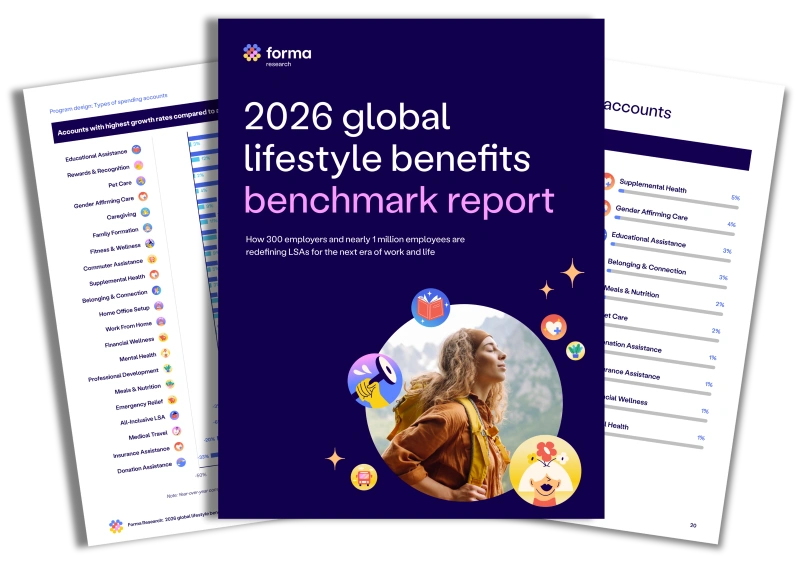
Multi-country programs are no longer the exception. Forma's 2026 benchmark, drawn from 300 companies, found that 50% of employers now run spending accounts in more than one country. You can read more statistics like this in our 2026 global lifestyle benefits benchmark report.
Most vendors pass three or four of these lines and go quiet on the rest. Forma was built to answer all seven, which is why consultants bring it into evaluations where the client wants dedicated wallets rather than one broad account.
Employers configure dedicated benefits wallets for Well-being, Family Formation, Caregiving, Professional Development, and more, each with its own funding and reporting, inside one unified employee experience that also runs HSAs, FSAs, and HRAs.
Funding is notional, so clients pay only for what employees spend. Eligibility follows published standards that keep medical expenses out, payroll feeds carry imputed income on a defined cadence, and dashboards report engagement and utilization separately, by wallet and by country, across 110+ countries.
Evaluating LSA vendors for a 2027 plan year? Schedule a demo today and run the scorecard against Forma live.
Red flags in LSA vendor proposals
Proposals are written to pass a scorecard, so the problems tend to hide in what is omitted rather than what is stated. These are the patterns worth flagging to a client before the finalist meeting:
- Prefunding requirements: The client transfers full allocations up front, and the proposal is vague about where unused balances sit or how forfeitures come back.
- Vague tax handling: The proposal says reimbursements are "handled" or "reported" without naming the payroll feed, its cadence, or who owns W-2 reporting.
- Medical expenses allowed in the LSA: Copays, prescriptions, or therapy sessions appear in the eligible list, pulling the account toward group health plan obligations it cannot meet.
- Utilization-only reporting: The sample dashboard shows percent of funds spent with no participation figure, which hides how many employees the program actually reached.
- Global claims that only cover U.S. cards: "Available worldwide" turns out to mean a U.S.-issued card that works abroad, with no local currency, no country-level funding, and no local tax treatment.
- No benchmark data: The vendor cannot show how the client's funding, categories, or engagement compare with similar employers, so the renewal conversation has no external reference.
- Compensation that is not itemized: With CAA 2026 disclosure in force, any proposal that bundles platform fees, interchange, and marketplace revenue into one line should be unbundled before signature.
How to run an LSA vendor evaluation for a client
Interest in LSAs has run ahead of adoption for years, which means many clients are choosing a vendor for the first time without an incumbent to compare against. WTW data reported by SHRM found that 7% of employers offered LSAs, 7% planned to, and 31% were considering adding them, so a structured process matters more than it would for a mature category. Six steps produce a decision you can document:
- Define use cases and wallets before you shortlist. Agree with the client which workforce priorities the program serves, whether those become separate wallets, and whether pre-tax accounts or HRAs should move to the same platform. Vendors look very different once the account structure is fixed.
- Shortlist against the structure before the brand. Drop any vendor that cannot support the wallet design, the client's countries, or the funding model the client wants, before investing time in demos.
- Send a written Lifestyle Spending Account RFP that mirrors the scorecard. The guide to a benefits administration RFP and the flexible benefits RFP toolkit include question sets that cover funding, tax, compliance, and reporting, so the responses line up as a Lifestyle Spending Account platform comparison rather than a stack of unrelated decks.
- Demo from the employee's seat. Have each finalist run a real claim, a card purchase, a denial, and a mid-year funding change on screen, using the client's categories rather than a canned script.
- Check references mid-contract rather than at launch. Ask for two clients of similar size and footprint who are at least a year in, and ask them about the renewal report, the payroll feed, and support response times.
- Document the decision. Record the scorecard results, the compensation disclosures received, and the reasons the recommended vendor won. That file is what answers a fiduciary question later.
For clients with employees in several countries, the guide to designing a global LSA program adds the country-level funding and configuration questions to ask at step three. The same discipline applies when you evaluate well-being platforms that overlap with an LSA, since the client should not pay twice for the same category.
Why consultants recommend Forma for Lifestyle Spending Accounts
Consultants recommend Forma because it answers the scorecard rather than reframing it. Account architecture: a connected portfolio of dedicated benefits wallets, each built around a specific use case and funding strategy, with HRAs and pre-tax accounts on the same platform. Funding: notional, so clients pay only for dollars employees actually use.
Payroll and tax: imputed income flows to payroll through API, SCIM, or file feeds, with tax treatment configured by country. Compliance: published LSA Eligibility Standards keep medical expenses out, backed by SOC 2 Type II, ISO 27001, and GDPR documentation.
Support: human claims review for members. Reporting: engagement and utilization tracked separately, by wallet and by country, against benchmarks drawn from nearly 1 million members.
With configurable account structures, cost-of-living adjustments across 110+ countries, and a consulting toolkit built for advisors, Forma turns global LSA program design into a data-backed process you can stand behind. Building 2027 recommendations? Schedule a demo today and put every line of the scorecard to Forma directly.
Frequently asked questions about Lifestyle Spending Account vendors
What should consultants look for in a Lifestyle Spending Account vendor?
Consultants evaluating a Lifestyle Spending Account vendor should check seven things: support for purpose-built wallets alongside pre-tax accounts, notional versus prefunded funding, how imputed income reaches payroll, whether medical expenses are excluded and certifications are current, how claims and member support work, whether engagement and utilization are reported separately, and how many countries are live with local currency.
How are LSA vendors priced?
LSA vendors are usually priced on a per-employee-per-month platform fee, sometimes with a one-time implementation charge and add-ons for additional wallets, countries, or payroll integrations. Some vendors also earn card interchange or marketplace revenue, so consultants should ask for every revenue stream to be itemized and compare total cost of ownership rather than the headline platform fee alone.
Do LSA vendors need to follow ERISA?
LSA vendors usually do not need to follow ERISA when the account excludes medical expenses, because a lifestyle account that reimburses only non-medical categories is typically not a group health plan. If an LSA reimburses medical care, group health plan rules can apply, so eligible expense lists should be reviewed with benefits counsel before launch.
Can the same vendor run an LSA and an HSA or FSA?
Some vendors can run a Lifestyle Spending Account alongside an HSA or FSA on one platform, while LSA-only providers cannot. When one vendor runs both, consultants should confirm that pre-tax and post-tax accounts keep separate eligibility rules, separate funding, and separate reporting, and that the pre-tax side carries the substantiation and compliance support those accounts require.
Do CAA disclosure rules apply to LSA vendors?
CAA disclosure rules apply to LSA vendors only when the vendor provides services to a group health plan. A standalone LSA that excludes medical expenses is usually not a group health plan, so the requirement typically does not reach it, but a vendor that also administers HRAs or pre-tax accounts for the same employer may be covered. Counsel should confirm.
How do you switch LSA vendors without disrupting employees?
Switching LSA vendors without disrupting employees usually means aligning the cutover with the start of a plan year, deciding in advance how unused balances and pending claims transfer, and testing the payroll feed before go-live. Clear employee communication about what changes, including new cards or claim processes, should go out before the old platform closes rather than after.
This article is for informational purposes. Forma is not engaged in the practice of law. Nothing contained herein is intended as tax or legal advice nor to replace tax or legal advice from counsel. If you need tax or legal advice, please consult with counsel or a certified tax professional.