













For total rewards leaders: 5 benefits of an employee perks platform
Discover the modern way to administer HR flexible benefits. See 5 benefits of using an employee perks platform.
In this piece
Most HR teams inherit a benefits stack that was never really designed. It was assembled over time, one point solution at a time, until managing it became a second job. Gym reimbursement goes through one vendor. Commuter benefits through another. FSA administration through a third. Meanwhile, employees are barely using any of it.
The problem isn't that companies aren't spending enough on benefits. It's that the way benefits are structured makes them hard to access, hard to manage, and nearly impossible to measure. When employees can't easily engage with their benefits, utilization suffers, and the ROI question becomes uncomfortable to answer in front of a CFO.
An employee perks platform changes the structure entirely. This article breaks down five benefits that go well beyond the usual "it's convenient" talking points and gets into what these platforms actually do for benefits programs that are built to perform.
Key takeaways
- Employee perks platforms replace fragmented point solutions with a unified experience that employees actually use.
- Personalization drives utilization. When employees choose their own benefits, they spend the funds.
- Real-time analytics let HR teams course-correct mid-cycle instead of waiting for annual reviews.
- Notional funding models mean companies only pay for what gets used, not what gets allocated.
- Schedule a demo today to see how Forma helps benefits leaders build programs that perform on every metric that matters.
What is an employee perks platform?
An employee perks platform is a centralized system that lets employers fund, manage, and distribute a range of employee benefits from a single interface. Rather than running each benefit type through a separate vendor, the platform consolidates everything so that employees access it in one place and HR administers it from one dashboard.
This is a meaningful structural shift away from how most mid-to-large employers still operate. The traditional model is vendor-by-vendor, benefit-by-benefit, which creates administrative fragmentation on the employer side and a confusing experience on the employee side.
How perks platforms differ from traditional benefits packages
Traditional benefits packages typically come in two flavors: fully prescribed plans where employees choose from a narrow menu, or direct-to-payroll stipends that lack any real spending controls or reporting. Neither approach gives employers visibility into what's actually being used or why.
Perks platforms operate differently. Employers define funding amounts and eligible spending categories. Employees then direct their own dollars based on what matters to them, whether that's fitness, caregiving support, professional development, or home office equipment.
The key distinction is that the platform mediates every transaction, which means every dollar spent generates a data point. That data feeds back into program design in ways that traditional benefits packages simply can't match.
Who manages a perks platform day to day?
The primary users on the employer side are HR managers, benefits administrators, and total rewards leads. They set program rules, monitor utilization, and make configuration changes without needing to route every request through a vendor account rep.
Employees interact with the platform independently, which is the point. A well-designed perks platform reduces the volume of one-off questions HR teams field every open enrollment season, freeing up time for more strategic work.
The 5 benefits of an employee perks platform
Employee perks platforms are often pitched on surface-level convenience, but the real value runs deeper. These platforms change how benefits data flows, how costs are structured, and how programs adapt over time. Here's what that actually looks like in practice.
1. Personalization at scale drives real utilization
When every employee gets the same standard benefits package regardless of their life stage or situation, a significant portion of that spend is going to be irrelevant to a significant portion of your workforce. A 28-year-old software engineer and a 45-year-old working parent have almost nothing in common when it comes to what they need from their employer.
Perks platforms solve this by letting employees self-direct their spending within employer-defined parameters. The result is personalized benefits at scale that don't require HR to manually configure a unique plan for every individual.
The utilization numbers tell the story. Broad, flexible account types consistently see the highest engagement when employees have a genuine choice in how they spend. And the stakes are real: research from Gallup has found that only one in three U.S. workers strongly agrees their benefits package meets their needs, which means most employers are leaving utilization on the table.
- All-inclusive LSAs: 85% budget utilization rate, according to Forma's 2026 benchmark data
- Fitness & Wellness accounts: 71% utilization when eligibility is clear and accessible
- Rewards & Recognition programs: 89% utilization, the highest of any account type tracked
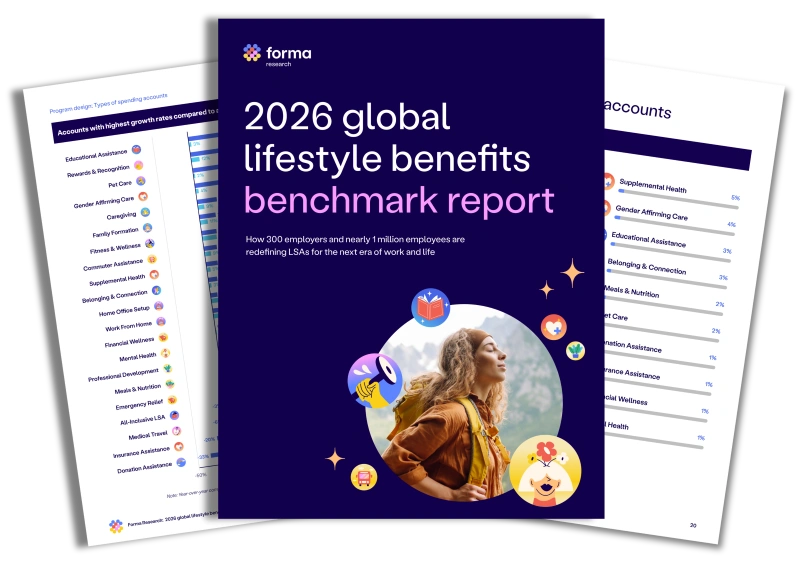
You can read more data like this in Forma's 2026 global lifestyle benefits benchmark report, which draws on data from nearly 1 million employees across 300 companies worldwide.
2. Real-time analytics replace annual guesswork
One of the most overlooked costs in benefits management isn't what companies spend on benefits. It's the time spent trying to figure out whether those benefits are working. Without a centralized platform, that analysis requires pulling data from multiple vendors, reconciling formats, and still ending up with a picture that's months out of date.
A perks platform with a live admin dashboard changes the feedback loop entirely. HR teams can see spending trends, utilization by benefit category, and engagement rates in real time. When a particular benefit isn't being used, that signal shows up quickly enough to act on it within the same benefits cycle.
This matters more than most annual reviews capture. Program adjustments made in real time produce better outcomes than adjustments made reactively the following year. Employee benefits management becomes a continuous practice rather than a once-a-year event.
3. Global benefits equity without administrative overhead
Running benefits across multiple countries is one of the more difficult operational challenges for distributed HR teams. Local compliance requirements vary. Currencies differ. What counts as a reasonable wellness stipend in San Francisco is a very different number in Bangalore or Berlin.
A modern global employee benefits program needs to account for these differences without creating a separate administrative workflow for every country in scope. That's where perks platforms with built-in currency conversion and localized program rules have a clear operational advantage.
According to Forma's 2026 benchmark data, 50% of employers using customizable spending accounts now offer them in more than one country. Countries in the APAC region, including Singapore and Australia, show all-inclusive LSA utilization rates between 90% and 95%, which signals that global employees engage meaningfully with flexible benefits when the platform is built to support their local context.
The compliance piece matters here too. Platforms that handle taxation rules and local regulatory requirements at the infrastructure level reduce the legal exposure that comes with managing cross-border benefits manually.
4. Consolidation eliminates point solution fatigue
There's a real cost to running too many separate benefit programs, and it compounds in ways that don't show up cleanly on any single line item. HR spends time managing vendor relationships. Employees don't know where to go for what. Procurement cycles multiply. And when something goes wrong, figuring out which vendor is accountable is its own project.
Point solution fatigue isn't just an administrative headache. It's a utilization killer. When accessing a benefit requires navigating a separate portal with its own login, employees opt out of benefits they'd otherwise use. Friction is the enemy of engagement.
Consolidating onto a single employee benefits platform reduces that friction at every level. Employees interact with one interface. HR manages one vendor relationship. Finance gets one invoice and one reporting structure.
When evaluating consolidation, here's what benefits teams typically reclaim after moving off a fragmented point solution model:
- Admin hours: Fewer vendor contacts, fewer renewal cycles, fewer one-off support tickets
- Employee experience: One login, one card, one place to check balances and submit claims
- Reporting clarity: Unified spend data across benefit categories instead of reconciling exports from five systems
- Cost visibility: A single view of allocation vs. realized spend across the entire program
The benefits of consolidation extend to the employee experience in ways that matter for retention. When a benefits program feels seamless, employees notice. When it feels like a bureaucratic obstacle course, they notice that too.
5. Notional funding keeps costs predictable and eliminates waste
Most companies that pay for benefits through direct-to-payroll stipends or standalone reimbursement software are paying for benefit dollars that never get spent. An employee who doesn't use their allocated gym stipend still costs the company something in administration, even if the reimbursement wasn't claimed.
Perks platforms with notional funding models flip that equation. Under a notional structure, employers allocate funds, but actual cash only moves when an employee spends. That distinction has significant budget implications at scale.
Forma's benchmark data illustrates the point directly. A $600 Fitness & Wellness allocation with a 71% utilization rate translates to $426 in actual spend per employee. For a company with 5,000 employees, that's a projected cost of about $2.13 million rather than the $3 million you'd expect if every dollar were claimed. The savings from assuming realistic utilization, not full allocation, come out to nearly $900,000.
That kind of cost modeling is what gives HR leaders the language they need to present a benefits program to finance leadership with confidence. The ROI case for employee benefits is much easier to make when you can show how actual spend tracks against allocation in real time.
How Forma helps HR teams get more from their benefits budget
Managing a flexible benefits platform effectively requires more than good software. It requires a partner that handles the operational complexity so HR teams can stay focused on strategy.
Forma gives benefits leaders a single platform for Lifestyle Spending Accounts, FSAs, HSAs, HRAs, commuter benefits, and Rewards & Recognition programs. Employees spend through the Forma Card or claims reimbursement, backed by a 24/7 human support team with no bots. The admin dashboard gives HR real-time visibility into utilization, spend, and engagement across every program type. With SOC 2 certification, GDPR compliance, and operations in 100+ countries, Forma is built for the scale and complexity that enterprise HR teams actually deal with.
Schedule a demo today and see how a benefits program built on Forma performs against what you're running now.
Frequently asked questions about employee perks platforms
What is the difference between an employee perks platform and a benefits administration system?
A benefits administration system typically handles enrollment, eligibility, and compliance for traditional benefits like health insurance and 401(k). An employee perks platform focuses on flexible, discretionary spending accounts, including LSAs, wellness stipends, and professional development funds. The two serve different functions, and many organizations use both, though perks platforms are increasingly being designed to consolidate both use cases.
How do employee perks platforms affect benefits utilization?
Perks platforms improve utilization by giving employees more agency over how they spend their benefit dollars. When employees choose their own eligible expenses rather than being assigned a fixed benefit, they engage with the program more consistently. Broad, flexible account types routinely see utilization rates above 80%, compared to significantly lower rates for traditional prescribed benefits packages.
Are employee perks platforms compliant with IRS and ERISA regulations?
Compliance depends on the account type. Lifestyle Spending Accounts are employer-funded and generally not subject to IRS pretax rules, though the tax treatment of what employees receive depends on how the program is structured. FSAs, HSAs, and commuter benefits are subject to IRS contribution limits and eligibility requirements. A well-designed platform handles compliance guardrails at the program level so administrators don't have to manage this manually.
How do perks platforms handle benefits for global workforces?
Leading perks platforms support multi-currency funding, localized program rules, and country-specific compliance configurations. This allows HR teams to run a consistent global benefits program without building separate administrative workflows for each country. Employers can set standardized funding amounts and let the platform handle local currency conversion and regulatory adjustments at the point of transaction.
How does notional funding work in a perks platform?
Notional funding means employers set aside an allocation for each employee, but actual cash only transfers when an employee makes a qualifying purchase. If an employee doesn't spend their full allocation, the unspent amount is not paid out. This is different from direct-to-payroll stipends, where employees receive the full amount regardless of whether they spend it. Notional funding models reduce realized benefit spend and give employers a more accurate picture of program costs at scale.
Can small and mid-sized companies use employee perks platforms?
Most enterprise-grade perks platforms are designed for organizations with at least a few hundred employees. Below that threshold, the administrative complexity and minimum pricing structures may not make sense. For mid-market companies in the 500 to 5,000 employee range, perks platforms offer meaningful returns on utilization and administrative efficiency, especially if the company is currently managing three or more separate point solutions for different benefit categories.
This article is for informational purposes. Forma is not engaged in the practice of law. Nothing contained herein is intended as tax or legal advice nor to replace tax or legal advice from counsel. If you need tax or legal advice, please consult with counsel or a certified tax professional.